


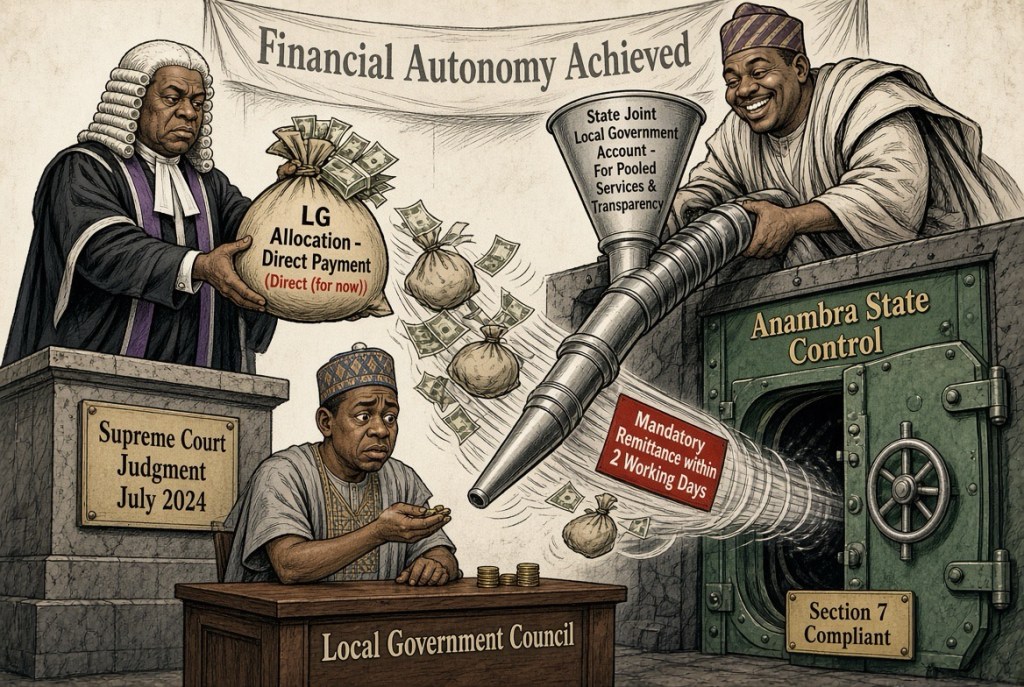
In the grand theatre of Nigerian federalism, few performances are more impressive than watching a state government loudly applaud a Supreme Court judgment while simultaneously rewriting the script so the money still ends up in the same old pockets. Anambra’s Local Government Administration Law of 2024 is that performance, complete with standing ovation from the Governor’s Lodge and polite confusion from anyone who actually read the judgment.
On 11 July 2024, the Supreme Court, in its usual understated fashion, told the 36 state governors that the long-standing habit of treating local government allocations as temporary loans to be repaid at gubernatorial convenience was unconstitutional. Justice Emmanuel Agim and his colleagues ordered that funds standing to the credit of the 774 local governments must henceforth be paid directly to them. No more joint accounts as holding pens. No more “we are only keeping it safe for you.” Direct. Full stop.
Anambra heard this message clearly. Then it passed a law that requires local governments, upon receiving their direct allocations, to remit a healthy percentage of those same funds into a State Joint Local Government Account within two working days. The state, of course, will manage the joint account for “pooled services,” salaries, pensions, primary education and other noble causes that somehow always require state supervision. It is the legal equivalent of a bank telling you that your money is now in your personal account, but you must immediately transfer a chunk of it back into a joint account controlled by the bank manager who previously helped himself.
Governor Soludo and the state House of Assembly insist this is not defiance. It is, they say, the purest form of constitutional obedience. Section 7 of the 1999 Constitution still allows State Houses of Assembly to make laws for the “establishment, structure, composition, finance and functions” of local governments. The Supreme Court, they note with lawyerly precision, did not abolish Section 7. Therefore the Assembly is merely filling the practical gaps left by the judgment: how the money should be spent, accounted for, and, most importantly, shared for the common good.
This is clever. It is also the sort of cleverness that makes constitutional lawyers reach for the nearest strong drink. The Supreme Court did not ban cooperation between tiers of government. It banned the state from treating local government money as its own. Requiring councils to hand a prescribed portion of their freshly arrived federal allocation back into a state-controlled pot is not cooperation. It is a mandatory reverse transfer dressed up as progressive governance. The joint account has simply been relocated downstream of the direct payment, like a tollgate built just after the free road was declared open.
The defence relies heavily on the claim that without state legislation there would be no rules governing local government finances. This is touching. One might almost believe that the only alternative to state control is total fiscal anarchy, with chairmen buying private jets and primary school teachers going unpaid. In reality, the Constitution already contemplates democratic local government with its own responsibilities. The judgment simply insisted that the funds belonging to that tier should actually reach it. Oversight, audit and accountability can exist without the state first dipping its hand in the till and calling it partnership.
Meanwhile, the Central Bank and the federal allocation machinery continue their leisurely stroll towards full implementation. Two years after the judgment, significant sums still find their way through the familiar channels. Anambra’s law has not been struck down because no one with both the standing and the political appetite has yet forced the issue in court. The federal government prefers committees and mediation to confrontation. State Houses of Assembly retain residual legislative powers. And Nigerian politics has long specialised in creative non-compliance: obey the letter, strangle the spirit, then lecture critics on the importance of the rule of law.
The result is a familiar Nigerian paradox. The Supreme Court has spoken. The Constitution remains intact. The money continues its traditional journey—direct in theory, joint in practice. Anambra has simply modernised the arrangement and given it a progressive title. Local government autonomy has been affirmed, celebrated, and then carefully redesigned so that the real question is no longer whether the funds will arrive, but how much of them will be allowed to stay.
In the end, the law is less a constitutional crisis than a masterclass in Nigerian statecraft. It demonstrates that when the highest court removes the old joint account, a resourceful government can invent a new one and call it transparency. The only remaining mystery is how long it will take before someone bothers to ask the courts whether this particular brand of obedience is still consistent with the Constitution the Supreme Court was interpreting. Until then, the performance continues, and the audience is expected to applaud the ingenuity.

