


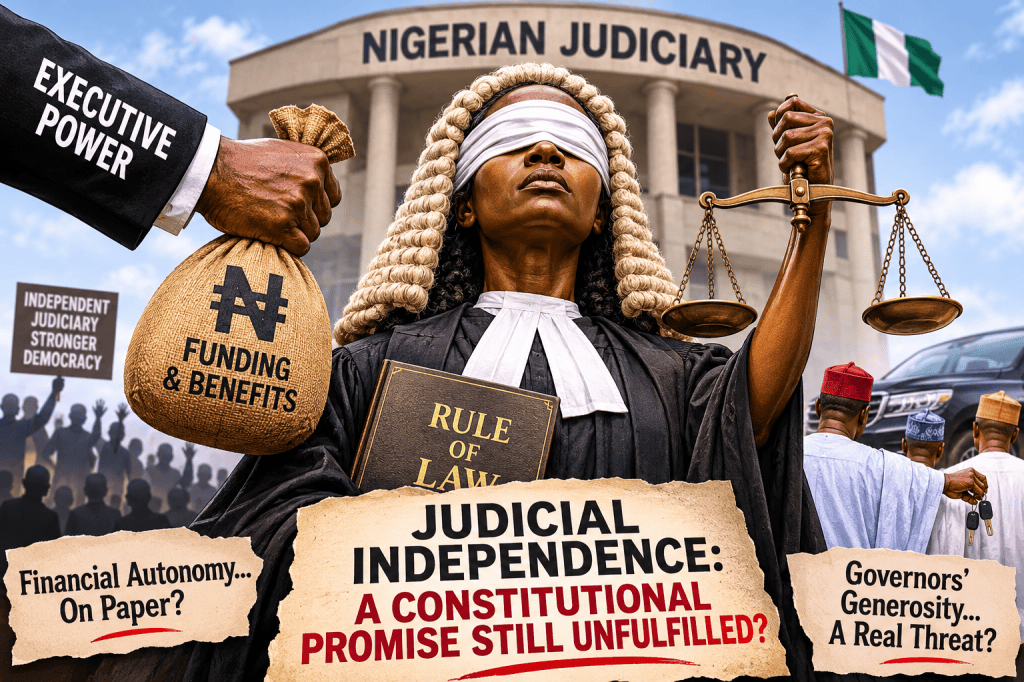
An update to PUNCH Editorial Board’s 2019 editorial, “Democracy Without Independence of Judiciary”
In November 2019, PUNCH published an editorial that raised an uncomfortable but fundamental question about Nigerian democracy: how independent can the judiciary be when it must depend on the executive arm of government for the money required to perform its constitutional duties?
The editorial was prompted by the then Chief Justice of Nigeria, Mohammed Tanko, who complained that the judiciary was expected to be independent while having to go cap in hand to the executive for its operational funding.
Seven years later, the question remains relevant. Indeed, it has become more complicated.
Nigeria has since amended its Constitution, introduced mechanisms for financial autonomy at state level, substantially increased judicial remuneration and witnessed renewed controversy over the provision of houses, vehicles and other benefits to judicial officers by politicians.
Yet, the fundamental constitutional problem remains: the judiciary is supposed to exercise authority over the executive, but the executive continues to exercise considerable influence over the financial environment in which the judiciary operates.
We have legislated independence, but have we actually delivered it?
The constitutional promise and the political reality
The 2019 PUNCH editorial identified financial dependence as one of the greatest threats to judicial independence. It called for the judiciary to enjoy the same financial protection as the National Assembly.
There was already a constitutional foundation for this argument.
Section 81(3) of the 1999 Constitution provides for the funding of the federal judiciary as a first-line charge on the Consolidated Revenue Fund. At state level, the Fourth Alteration to the Constitution, which came into effect in 2018, amended Section 121(3) to require that money standing to the credit of the judiciary be paid directly to the heads of the courts concerned.
The intention was unmistakable. Governors were no longer supposed to act as financial gatekeepers between their state treasuries and the judiciary.
In May 2020, President Muhammadu Buhari went further by signing Executive Order 10, intended to enforce financial autonomy for state legislatures and judiciaries.
However, the implementation encountered constitutional and political difficulties. The Supreme Court subsequently invalidated Executive Order 10 in Attorney-General of Abia State & Others v Attorney-General of the Federation (2022), illustrating the limitations of attempting to enforce constitutional autonomy through an executive instrument.
The constitutional amendment itself, however, remained in force.
The Fifth Alteration (No. 6) Act 2023 further strengthened the framework by providing for disbursement committees and clearer arrangements for the direct payment of funds to state legislatures and judiciaries.
In other words, Nigeria has not been short of constitutional provisions. It has been short of the political will to make those provisions effective.
The salary question: Have we bought judicial independence?
One significant development since the PUNCH editorial has been the improvement in judicial remuneration.
In August 2024, President Bola Tinubu signed the Judicial Office Holders (Salaries and Allowances, etc.) Act 2024, introducing a substantial upward review of judicial remuneration after years of stagnation.
The increase was reported as approximately 300 per cent, with the Chief Justice of Nigeria’s monthly salary and regular allowances amounting to approximately ₦5.39 million.
The 2026 Appropriation Bill also proposed approximately ₦341.6 billion for the National Judicial Council, largely to meet judicial salaries and allowances.
These developments are welcome. A judge should not be expected to administer justice while struggling with the basic economic conditions of professional life.
But we must distinguish between judicial remuneration and judicial independence.
A well-paid judge is not necessarily an independent judge. Equally, a poorly paid judge is not automatically a corrupt judge.
Judicial independence is an institutional condition, not a salary package.
It requires the ability to administer the courts, determine operational priorities, maintain court infrastructure, employ appropriate personnel and discharge judicial responsibilities without having to negotiate with the government whose actions may ultimately be challenged before those same courts.
The salary increase addresses one part of the problem. It does not resolve the larger constitutional question of who controls the judiciary’s resources.
The governor as benefactor: A constitutional embarrassment
Perhaps the most revealing development is the continuing spectacle of governors and ministers publicly providing judges with vehicles, houses and other facilities.
We have seen governors announce the procurement of official vehicles for judges. We have seen governments celebrate the construction and renovation of court buildings. More recently, the provision of housing for judicial officers by the Federal Government and the FCT administration has generated another national debate.
In June 2026, the controversy over proposed housing benefits for judges attracted criticism from human rights advocates, lawyers and civil society organisations. The Nigerian Bar Association had also raised concerns about the practice of executive officials providing material benefits directly to serving judicial officers.
There is an important distinction here. Judicial welfare is a legitimate governmental responsibility. Judges require secure accommodation, transportation, adequate working facilities and appropriate remuneration.
The problem is not the provision of these necessities. It is the manner in which they are provided.
When a governor personally announces that he has given judges twenty vehicles, the optics are difficult to defend. When a minister publicly presents housing facilities to judicial officers, the question becomes unavoidable: why is the executive presenting itself as the benefactor of an independent arm of government?
Would the governor publicly announce that he has provided vehicles for the accountant-general, permanent secretaries or members of his cabinet? Would he expect the same gratitude from the legislature?
The judiciary should not be placed in the position of appearing grateful to the executive for receiving the basic facilities necessary to perform its constitutional responsibilities.
There is also a more serious consideration.
The executive is frequently a litigant before the courts. Governments defend their policies, challenge judicial decisions, contest contractual claims and appear in constitutional disputes.
The same government that provides a judge’s official vehicle may subsequently appear before that judge seeking a favourable determination of a dispute.
This does not establish that the judge will be influenced. Nor does every government-funded judicial facility constitute an automatic legal breach.
But judicial independence is not merely about the absence of actual interference. It is also about removing circumstances that create a reasonable perception of dependence or indebtedness.
Justice must not only be done; it must be seen to be done.
The Nigerian governor and the 37 little empires
The problem is particularly acute at state level.
Nigeria operates a federal constitutional structure, but the political reality in many states is closer to gubernatorial presidentialism.
Governors frequently dominate their state legislatures, influence the political environment in which judicial appointments are made and exercise enormous control over the state’s financial machinery.
The judiciary is constitutionally a separate arm of government, but its practical ability to operate independently can be compromised by the concentration of political and financial power in the governor’s office.
The 2023 constitutional amendment was supposed to address this problem through direct disbursement arrangements.
Yet the continuing complaints about financial autonomy demonstrate that constitutional provisions do not implement themselves.
A governor who can influence the release of funds, determine the pace of infrastructure development and make judicial welfare dependent on executive initiatives retains considerable leverage, even where the Constitution says otherwise.
This is the deeper problem with Nigerian federalism: the concentration of power at state level has created political establishments that are often reluctant to surrender any meaningful control.
We have 36 states, but too frequently, we have 36 political empires.
The judiciary should be one of the institutions capable of checking these empires. It cannot perform that responsibility effectively if its operational survival depends on their occupants.
Independence is not an invitation to impunity
There is another side to this argument that must not be ignored.
Judicial independence cannot become a convenient shield against accountability.
The judiciary must be financially independent, but it must also be financially accountable.
An independent judiciary must publish credible budgets, account for public expenditure, maintain transparent procurement systems and demonstrate that public resources are being used efficiently.
The National Judicial Council must also be strengthened in its responsibility for judicial discipline, appointments and professional standards.
There must be no confusion between protecting judges from political interference and protecting judges from legitimate scrutiny.
The judiciary cannot demand independence from the executive while resisting accountability to the public.
Indeed, the credibility of judicial independence depends on the integrity of the institution itself.
The public must be able to trust that judicial decisions are based on law and evidence, rather than political relationships, financial inducements or personal loyalties.
This is particularly important in election disputes, where the judiciary is frequently asked to determine the legitimacy of political power.
The old expression of billionaire judges, recalled in the PUNCH editorial through the observations of the late Justice Kayode Eso, should not become a permanent feature of our democratic experience.
The missing constitutional reform
There is a further structural problem.
Although the Constitution provides for financial autonomy, the process by which judicial budgets are prepared, presented, approved and implemented still leaves room for executive influence.
The judiciary should have a clearly defined institutional mechanism for presenting its budgetary requirements directly to the legislature, with the executive having no discretionary power to frustrate approved allocations.
The National Judicial Council should play a central coordinating role, while state judicial institutions should have direct access to their constitutionally appropriated funds.
Capital expenditure must also be properly addressed. It is not sufficient to protect salaries while leaving court buildings, technology, accommodation, security and administrative infrastructure dependent on executive generosity.
The proposed 2026 federal allocation of ₦341.6 billion for judicial remuneration illustrates the distinction. A substantial salary allocation is important, but it cannot, by itself, establish that the judiciary has adequate control over the wider resources required to administer justice.
The institutional architecture must be independent, not merely the payroll.
Democracy cannot survive on the benevolence of politicians
The original PUNCH editorial concluded that the judiciary was a separate arm of government with the responsibility to uphold the rule of law and deliver justice to ordinary Nigerians.
That observation remains the central point.
The judiciary is not a department of the Ministry of Justice. It is not an agency of the presidency. It is not an appendage of a governor’s administration.
It is a constitutional institution entrusted with the power to determine disputes between citizens, governments and institutions, and to declare unlawful the actions of the other arms of government.
That responsibility requires genuine independence.
Seven years after Mohammed Tanko complained about having to go cap in hand to the executive, Nigeria has made legislative and financial adjustments. But the sight of politicians presenting judges with vehicles, houses and other benefits suggests that the underlying relationship has not been sufficiently transformed.
We have moved from the language of financial dependence to the language of executive benevolence.
The difference may be more cosmetic than constitutional.
The tragedy is that a democracy cannot be sustained by three arms of government when two are powerful and the third is expected to remain grateful for its upkeep.
The executive must understand that funding the judiciary is not a favour. Providing judges with official facilities is not an act of political generosity. It is a constitutional obligation.
And the judiciary must understand that independence cannot be established by declarations at ceremonial court sessions while its institutional needs are negotiated in government offices.
A judiciary that must thank the executive for the tools with which it is expected to hold the executive accountable is a judiciary whose independence remains in question.
Nigeria does not need a judiciary that is merely independent in constitutional language. It needs one that is independent in its finances, administration, conduct and courage.
Otherwise, our democracy will continue to have three arms of government in theory, but only one hand holding the purse strings.

