

The roadside collector may be the visible face of the system, but the real question is who controls the pyramid, who receives the proceeds and what political interests protect it.
I have written previously about the legal and illegal tax burdens imposed on Nigerians and the disturbing reluctance of governments at different levels to confront a problem that is steadily suffocating economic activity.
Nigeria’s taxation problem is not simply about how much government collects. It is also about who collects it, under what authority, how much is accounted for and, perhaps most importantly, who benefits from the money extracted from ordinary citizens.
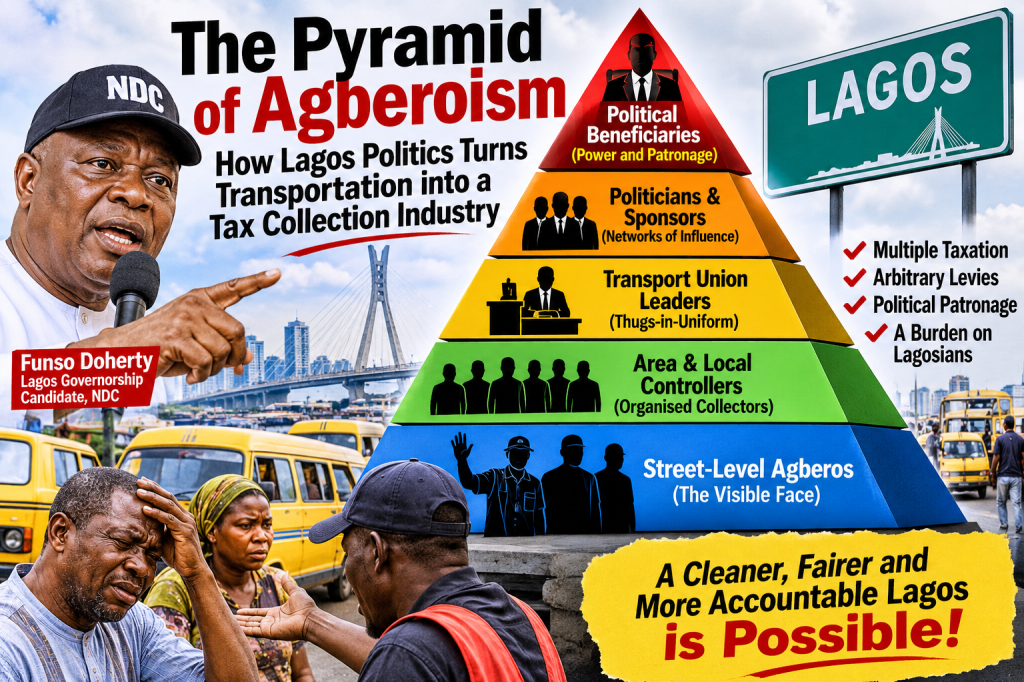
An intervention by Funso Doherty, the Lagos State governorship candidate of the Nigeria Democratic Congress (NDC), brings another dimension of this problem into focus: the pyramid of agberoism and multiple taxation operating on Lagos roads.
Doherty’s intervention is important because it directs attention away from the familiar spectacle of young men collecting money from commercial drivers and towards the structure that makes such collections possible.
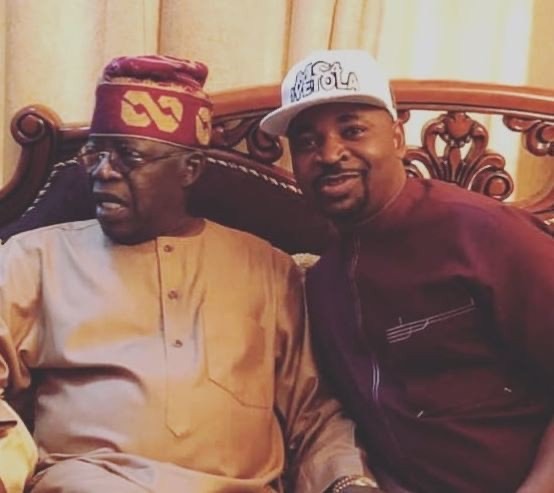
But to understand the Lagos transport taxation system, one organisation deserves particular attention: the National Union of Road Transport Workers (NURTW), whose Lagos operations became closely associated with Musiliu Akinsanya, popularly known as MC Oluomo.
This is not simply a story about agberos. It is a story about the intersection of transport unions, informal revenue collection, political patronage and the economics of power.
The NURTW: The institutional face of agberoism
The National Union of Road Transport Workers is a recognised transport workers’ organisation. Its legitimate functions include representing transport workers and protecting their occupational interests.
However, the problem arises when the machinery of a transport union becomes associated with compulsory collections, intimidation and multiple layers of roadside payments that have little apparent connection with legitimate union subscriptions or properly authorised government revenue.
In Lagos, the NURTW has historically occupied a particularly influential position in the informal transport economy.
Its former Lagos State chairman, Musiliu Akinsanya, popularly known as MC Oluomo, became the most recognisable figure associated with this structure. In November 2024, he was elected and sworn in as the national president of the NURTW.
His rise from the leadership of the Lagos transport union to the national presidency is significant when examining the relationship between transport organisation, informal collections and political influence.
The point is not that every NURTW member is involved in unlawful activity, or that every payment collected by a transport union is illegal. That would be an unfair generalisation.
The issue is the distinction between a legitimate union and a collection system in which drivers may face demands at multiple points, sometimes accompanied by threats, intimidation or damage to their vehicles.
The question is whether the union’s organisational structure has been used, in particular locations and circumstances, to facilitate or sustain collections that lack transparent legal authority.
And if so, who supervises the operation and where does the money go?
The ICIR investigation: Following the money
This is not an entirely new controversy.
In July 2021, the International Centre for Investigative Reporting (ICIR) published an extensive investigation titled Money for the Boys: How Agberos Pocket Billions of Lagos Transport Revenue.
The investigation examined the collections imposed on commercial bus, tricycle and motorcycle operators across Lagos.
Its findings were remarkable.
Based on interviews with more than 50 commercial bus drivers across 21 local council development areas, the investigation estimated that commercial bus drivers paid at least ₦3,000 daily to agberos.
It also examined collections from tricycle and motorcycle operators and calculated that the combined annual collections could amount to approximately ₦123 billion.
These were investigative estimates derived from reported daily payments and estimated numbers of vehicles, not audited accounts or officially verified government revenue.
Nevertheless, the scale of the reported collections raises serious questions.
The ICIR identified the NURTW as the most powerful transport union in Lagos and named MC Oluomo, then chairman of its Lagos chapter, as its head.
More importantly, the investigation described an organised collection arrangement involving motor-park chairmen, area operators and street-level collectors.
According to the investigation, individual motor parks were controlled by chairmen who supervised collections, distributed proceeds among subordinates and retained substantial portions of the money.
The investigation also questioned the destination of the collections. It found that the estimated transport revenues were not transparently reflected in Lagos State’s published financial statements and raised concerns about the absence of proper accounting.
It reported that some local councils received only small amounts from collections made within their jurisdictions, while much larger sums appeared to remain within the informal collection structure.
This is the heart of the controversy.
If billions of naira are extracted annually from the transport economy, who has the authority to collect the money? Who accounts for it? And why should the public be unable to establish its final destination?
The investigation provides a foundation for questions that the Lagos Government should have answered through transparent financial disclosures and an independent examination of the collection system.
The pyramid: From the roadside to the political establishment
The structure described in the ICIR investigation provides a useful starting point for understanding the pyramid Doherty has brought into public discussion.
At the bottom are the street-level agberos. They are the visible collectors who approach commercial drivers at bus stops, loading points, junctions and motor parks.
Above them are local operators and motor-park chairmen who organise collections and supervise the activities of the collectors.
Further up is the transport union structure, with its leadership and networks of authority across the state.
Beyond the formal union structure lies the more difficult question of political relationships and possible beneficiaries.
It is this upper level that deserves particular scrutiny.
The existence of a collection structure does not, by itself, establish that every person in its chain remits money to a political officeholder or party. Such allegations require evidence.
But the scale, organisation and persistence of the system make it reasonable to investigate whether political patronage, protection and mobilisation have contributed to its survival.
The pyramid is therefore not merely an organisational chart of transport workers. It is a question about the relationship between economic extraction and political influence.
Who allocates the collection points? Who determines the amounts demanded? Who has the power to intervene when drivers refuse to pay? Who receives the proceeds? And what happens when a collector’s activities conflict with the interests of government?
These are questions that cannot be answered by arresting a few agberos at a bus stop.
MC Oluomo and the politics of transport unions
MC Oluomo’s significance in this discussion goes beyond his personal prominence.
His long association with the Lagos NURTW leadership and subsequent emergence as national president illustrate the considerable organisational importance of transport unions.
The informal transport economy provides an extensive network of people who interact with the public every day. Motor parks, bus stops and loading points are not simply commercial locations. They are also potential centres of organisation and mobilisation.
Political parties need grassroots networks. They need people who can organise meetings, mobilise supporters, distribute political messages and coordinate activities across neighbourhoods.
Transport unions possess an established presence within many of these communities.
This creates an important question about the relationship between political power and the informal transport economy.
Have transport union structures been used for political mobilisation? Have relationships between political officeholders and transport union leaders influenced the regulation of the sector? Have political considerations discouraged successive administrations from confronting unlawful collections?
These questions deserve investigation, particularly in a state where the transport sector plays such an important role in daily economic activity.
It would be wrong to assume that every relationship between a politician and a transport union is evidence of wrongdoing. Political engagement with trade unions is not inherently unlawful.
But where a union’s influence extends into the coercive collection of money from citizens, the public is entitled to demand transparency about the relationships that sustain that influence.
The government cannot afford to confuse political usefulness with public interest.
The economic burden: The commuter eventually pays
The consequences of this arrangement extend far beyond commercial drivers.
Every unofficial payment becomes part of the operating cost of transportation.
A commercial driver who has to make payments at several points will seek to recover those costs from passengers. A trader who pays additional charges transporting goods to market will incorporate those expenses into the selling price.
The burden therefore travels through the economy.
The passenger pays higher fares. The trader charges more for goods. The driver has less money available for maintenance, wages and savings.
The ordinary Lagosian ultimately pays for a system over which he or she has little control.
This is taxation without the essential safeguards of taxation: lawful authority, transparent assessment, proper receipts, accountability and public benefit.
It is particularly troubling because Nigerians are already struggling with formal taxes, fuel costs, electricity expenses, inflation and the rising cost of basic necessities.
The Lagos transport economy adds another layer of financial extraction to an already difficult environment.
There is a peculiar Nigerian arrangement in which government may demand that citizens pay their taxes, while the citizen must also negotiate payments with people whose authority to collect those payments is uncertain.
The state collects its taxes. The union collects its dues. The roadside collector demands his own share. And the commuter is left to finance the entire arrangement.
Everybody appears to have a hand in the taxpayer’s pocket, but nobody seems particularly anxious to provide an account.
The legal question: Who authorised the collection?
There is an important constitutional and legal dimension to this controversy.
Section 1 of the Constitution of the Federal Republic of Nigeria 1999 establishes constitutional supremacy. Government revenue collection must therefore be supported by lawful authority.
A payment does not become a legitimate tax simply because it has been collected for years, because the collector wears a uniform or because a particular motor park recognises the person demanding it.
There must be a distinction between legitimate union subscriptions, properly authorised transport charges, statutory government levies and arbitrary demands.
The legal authority for each collection must be identifiable.
The fact that a transport union is a recognised organisation does not confer an unrestricted power to impose compulsory payments on every commercial driver operating in Lagos.
Indeed, in 2022, a Federal High Court order restrained MC Oluomo and other transport union officials from collecting union dues and levies from commercial drivers who were not members of their unions.
The legal principle is important: membership obligations and the authority to impose compulsory payments cannot simply be assumed.
The Lagos Government must therefore publish a comprehensive schedule of authorised transport-related levies, identify the relevant statutory authority and explain the collection arrangements.
Any payment outside that framework should be investigated.
The law should not become a decorative instrument that government invokes against ordinary citizens while ignoring questionable practices within politically influential organisations.
Why successive governments have struggled to confront the problem
This is where the politics of Lagos becomes central.
If agberoism were simply a matter of criminal conduct by individual collectors, the solution should be relatively straightforward.
The police and relevant enforcement agencies could act against extortion, intimidation, assault and unlawful obstruction. The transport authorities could introduce transparent collection systems. The government could regulate motor parks and ensure that all authorised payments enter designated accounts.
But the persistence of the problem suggests that enforcement alone may not be sufficient.
The ICIR investigation raised questions about the political usefulness of transport union structures and the reluctance of successive administrations to dismantle or properly regulate the informal collection arrangements.
The problem is that a system may become difficult to reform when the institutions or networks associated with it also possess political value.
Transport unions can provide an extensive grassroots network. Their leaders may command loyalty, influence and organisational capacity within communities.
A government that depends on such networks for political mobilisation may find it difficult to confront them when their activities become inconsistent with the rule of law.
This creates a potential conflict between political convenience and public administration.
It also explains why occasional announcements of a crackdown may achieve little. Removing a few collectors does not necessarily dismantle the structure that deploys them.
The real test is whether government is prepared to investigate the entire chain, including those who may exercise authority or derive benefits from the arrangements.
The wider Nigerian taxation crisis
The Lagos example takes us back to the wider question of taxation in Nigeria.
We are attempting to build a modern economy while allowing practices associated with informal coercion to operate alongside formal government institutions.
The government wants to expand its tax base, increase internally generated revenue and encourage investment.
Yet businesses and ordinary citizens encounter multiple demands from government agencies, local authorities, associations and individuals, sometimes for substantially similar activities.
Tax reform cannot succeed by concentrating exclusively on how much additional money government can collect.
It must also address the total financial burden imposed on citizens and businesses.
There is a fundamental difference between taxation that finances public services and extraction that finances private or political interests.
The former can be part of a social contract. The latter undermines it.
Lagos has consistently presented itself as a centre of economic development and institutional innovation. It cannot indefinitely reconcile that ambition with a transport economy in which commercial operators face multiple layers of compulsory payments without transparent accountability.
A megacity cannot become world-class through infrastructure projects alone. Its institutions must also protect the people who keep its economy moving.
The pyramid must be investigated, not merely photographed
Funso Doherty’s intervention deserves attention because it raises a question that goes beyond the immediate political contest in Lagos.
The issue is not whether Lagos needs transport unions. It is whether the operations of those unions are properly regulated and whether the government has allowed informal collection systems to become embedded in the state’s transport economy.
The NURTW, particularly its historical Lagos structure under MC Oluomo, must form part of that examination.
The investigation should establish:
- The legal authority for every transport-related levy collected from commercial operators.
- The identities of the organisations and individuals authorised to collect those payments.
- The amounts collected at motor parks and roadside locations across Lagos.
- The proportion remitted to government accounts and the destination of the remainder.
- The role of transport union leadership in supervising collections and preventing intimidation.
- Whether political relationships have influenced the regulation or continuation of the system.
The Lagos State Government should publish the relevant financial information and subject the collection system to independent scrutiny.
The legislature should exercise its oversight responsibilities. Law enforcement agencies should investigate credible allegations of extortion and intimidation. Transport operators should have accessible channels for reporting unlawful demands.
There should also be a clear distinction between legitimate transport workers and those who use union identity or political connections to extract money through coercion.
The objective is not to criminalise an entire union. It is to ensure that no organisation, however politically influential, operates outside the law.
Conclusion: Who really owns the road?
The Lagos road belongs to the public. It is not the private property of a transport union, a motor-park chairman, a political party or an individual collector.
The right to operate a commercial vehicle should not depend on satisfying an endless succession of unofficial financial demands.
The roadside agbero may be the most visible face of the problem, but the NURTW’s historical role in the Lagos collection structure, the influence associated with MC Oluomo and the wider political relationships surrounding the transport economy raise questions that cannot be answered at street level.
The challenge for Lagos is to move beyond periodic declarations of war against agberoism and confront the institutional and political arrangements that may sustain it.
I have argued previously that Nigeria’s tax problem is not simply excessive taxation. It is also the absence of accountability over who is entitled to collect money from the citizen and how that authority is exercised.
Lagos provides a particularly revealing illustration.
The question is no longer simply why an agbero demands money from a danfo driver.
The more important questions are: Who put him there? Who supervises him? Who receives the money? And who has the political authority to ensure that the arrangement continues?
Until those questions are answered, the pyramid will remain standing.
And the Lagosian will continue to pay, one bus stop, one motor park, one market entrance and one journey at a time.

