


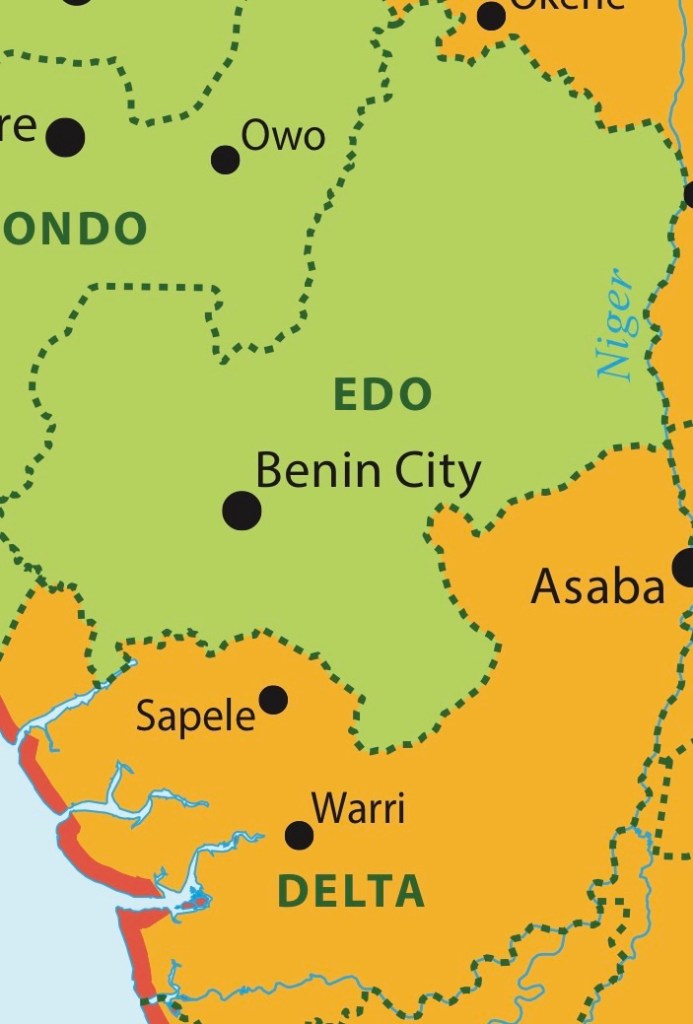
The present day Edo State, created on August 27, 1991, is far more than a modern administrative convenience. Its borders, ethnic makeup, and linguistic landscape are direct descendants of a complex history that stretches from the powerful pre-colonial Benin Empire through the colonial era, and into Nigeria’s post-independence political restructuring.
To truly understand Edo State today, one must trace its lineage back to the colonial provinces that formed its core: Benin Province and Afemai Province.
The Pre-Colonial Foundation: The Benin Empire
Before any colonial administrator drew a line on a map, the area now known as Edo State was the heartland of the historic Benin Empire. This ancient kingdom, whose Oba still holds a revered traditional role, provided the cultural and political bedrock upon which all later structures were built. The Bini (Edo) people were the dominant group, but their influence extended over various Edoid-speaking peoples who shared a common origin, even as their dialects diverged with distance from the state capital, Benin City.
The Colonial Genesis: Benin and Afemai Provinces
The modern political identity of Edo State began to take shape following the British conquest of the Benin Kingdom in 1897. The colonial administration organized the conquered territory into Benin Province, which was itself divided into four main administrative divisions:
· Benin Division – The Bini heartland.
· Ishan (Esan) Division – Home to the Esan people.
· Asaba Division – An Igbo-speaking area west of the Niger.
· Kukuruku Division – Later renamed Afemai (Afenmai) Division, encompassing the northern Edoid groups.
This colonial framework was pivotal. The Kukuruku/Afemai Division was administratively distinct from the Bini and Esan areas, even though all were linked by Edoid linguistic roots. This division-in-name foreshadowed later political identities, as the Afemai people (a collective comprising Etsako, Owan East and West, and Akoko-Edo) maintained a separate colonial administrative trajectory while sharing deep cultural ties with the south.
The Road to Statehood: From Colonial Divisions to a Modern State
The colonial provinces did not disappear; they evolved through successive political reorganizations:
· 1963: The Mid-Western Region was carved out of the Western Region following a referendum. This new region brought together Benin and Delta provinces, uniting the old Benin Province (including its Afemai Division) with the Asaba Division and other western Igbo areas.
· 1967: The Mid-Western Region became Mid-Western State.
· 1976: Following another federal restructuring, it was renamed Bendel State – a portmanteau of “Benin” and “Delta.”
· 1991: In a move that fulfilled long-standing requests by Edo-speaking groups (famously presented by the Oba of Benin in 1981), Bendel State was split into the present Edo State and Delta State.
Critically, Edo State was largely formed from the old Benin and Afemai Divisions, while Delta State took the former Asaba Division and other western Igbo areas. Thus, the 1991 creation did not invent new entities; it restored a historical-administrative reality rooted in the colonial provincial system.
Ethnic Composition: A Tapestry of Edoid Peoples
Edo State is relatively homogenous compared to many Nigerian states, with five main ethnic groups dominating the population:
Ethnic Group Approx. Percentage Geographic Concentration
Bini (Edo) ~57.5% Benin City and seven LGAs
Esan ~17.1% Esan-speaking LGAs
Afemai (Etsako, Owan West and East, Akoko-Edo) ~25.3% Northern LGAs
Ijaw, Okpe, Igbanke, Emai Smaller minorities Scattered communities
This distribution mirrors the old colonial divisions: the Bini and Esan correspond to the former Benin and Ishan Divisions, while the Afemai groups occupy the former Kukuruku/Afemai Division. The Afemai are often treated as a collective, though they are internally diverse, with Akoko-Edo LGA being notably the most linguistically heterogeneous area in the state.
Linguistic Landscape: More Than Just the Bini Language
While the Bini (Edo) language is the most prominent and serves as a de facto language of provincial identity used in education, the state actually boasts over 26 languages. The major ones include:
· Bini (Edo)
· Esan
· Afemai (with dialects like Etsako, Owan, and Akoko-Edo)
· Ora
· Akoko Edo
All these languages belong to the Edoid language family, a subgroup of the larger Niger-Congo phylum. Their common origin in the Benin Empire is evident in shared vocabulary and grammatical structures, but centuries of relative isolation have led to distinct dialects, some of which are mutually unintelligible.
Notably, while Edo and Esan have developed standard orthographies and are taught in schools, many of the Afemai dialects remain underdeveloped in written form. This poses challenges for mother-tongue education policies and highlights the linguistic diversity that exists even within a seemingly cohesive state.
A State Forged by History
The history of present-day Edo State is a continuum: from the spiritual and political dominance of the Benin Empire, through the administrative carving of Benin and Afemai Provinces under British rule, to its emergence as a distinct state in 1991. Its ethnic and linguistic composition dominated by Edoid-speaking groups is not a random demographic fact but a living map of that journey.
The colonial provinces of Benin and Afemai were not arbitrary lines; they were the crucibles in which modern Edo identity was forged. Today, as the state navigates the challenges of development, cultural preservation, and linguistic diversity, it does so with a deep historical foundation that continues to shape its present and future.
Edo State is divided into three senatorial districts comprising a total of 18 Local Government Areas (LGAs):
1. Edo South Senatorial District
(7 Local Government Areas)
- Egor
- Ikpoba-Okha
- Oredo
- Orhionmwon
- Ovia North-East
- Ovia South-West
- Uhunmwonde
2. Edo Central Senatorial District
(5 Local Government Areas)
- Esan Central
- Esan North-East
- Esan South-East
- Esan West
- Igueben
3. Edo North Senatorial District
(6 Local Government Areas)
- Akoko-Edo
- Etsako Central
- Etsako East
- Etsako West
- Owan East
- Owan West

