

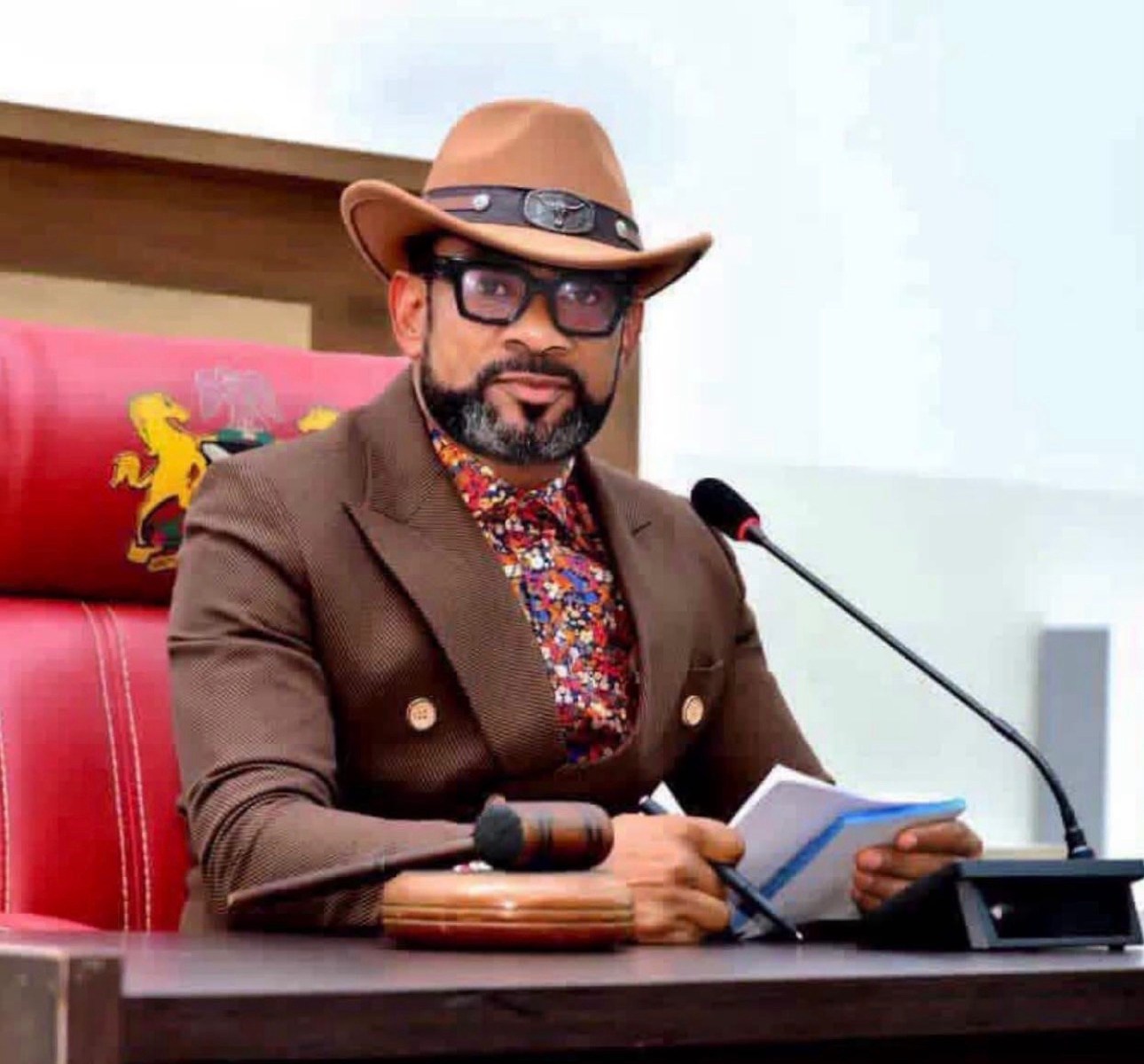

How Edo politics turned a suspended lawmaker into Speaker, and then reminded him that political power comes with an expiry date
Nigerian politics has a peculiar talent for recycling its characters.
Yesterday’s political victim can become tomorrow’s political kingmaker. Yesterday’s opposition politician can become tomorrow’s occupant of the very office controlled by the political establishment he once opposed.
And, just when the political resurrection appears complete, politics can produce the sequel.
The story of Rt. Hon. Blessing Sheriff Agbebaku is one such story.
It is a journey through electoral victory, political adversity, legislative suspension, litigation, political exile, comeback, Speakership, party defection and, ultimately, another confrontation with the unforgiving mathematics of legislative power.
Agbebaku’s political career is therefore more than the biography of one Edo politician.
It is a small but revealing window into the way Nigerian politics works.
In Nigerian politics, there is rarely a permanent enemy.
There is rarely a permanent friend.
And there is certainly no permanent Speaker.
FROM OWAN WEST TO THE EDO ASSEMBLY
Blessing Agbebaku was born on November 12, 1972, in Edo State and studied Economics and Statistics at the University of Benin.
His first major electoral breakthrough came in 2007 when he was elected to represent Owan West Constituency in the Edo State House of Assembly on the platform of the Peoples Democratic Party.
He entered the Assembly at a time when the PDP dominated Edo politics.
But politics, as Edo politicians have discovered repeatedly, is not a straight road.
Sometimes the road changes direction while the politician is still driving.
Agbebaku’s first spell in the Assembly would eventually become entangled in one of the most turbulent episodes in the history of the Edo legislature.
THE OSHIOMHOLE YEARS
The arrival of Adams Oshiomhole as Governor of Edo State in 2008 changed the political landscape.
Oshiomhole’s political machine, operating initially through the Action Congress/Action Congress of Nigeria structure, challenged the PDP’s dominance.
Agbebaku remained aligned with the PDP.
The resulting political divide was not merely theoretical.
The legislature became another theatre in the wider political contest for control of Edo State.
And in February 2010, the theatre caught fire.
Literally and politically.
THE 2010 ASSEMBLY CRISIS
On February 22, 2010, a motion was moved seeking the removal of the then Speaker, Zakawanu Garuba.
What followed was not exactly Westminster-style parliamentary disagreement.
The confrontation inside the Assembly became violent.
Court records from the subsequent litigation describe an extraordinary scene involving physical confrontation and the use of objects including axes, tear gas and chemicals.
Agbebaku and other lawmakers were suspended by the House.
This is where political mythology and the legal record need to be separated.
It is sometimes casually said that Oshiomhole suspended Agbebaku.
That is not the precise legal position.
The suspension was imposed by the Edo State House of Assembly.
It occurred, however, during Oshiomhole’s governorship and in the middle of a bitter political struggle between the PDP political bloc and the political structure associated with the governor.
That distinction matters.
Governors may wield enormous political influence, but influence is not the same thing as the formal exercise of legislative power.
THEN CAME THE LAWYERS
Agbebaku did not simply accept his political exile.
He went to court.
In Hon. Blessing Agbebaku v. Edo State House of Assembly & Others, the National Industrial Court examined the legality and duration of the suspension.
The case produced a rather important lesson for legislators who occasionally discover that the Constitution and statute books are less flexible than political arithmetic.
The court found that the suspension imposed on Agbebaku on February 22, 2010 had expired by operation of law on February 24, 2010, when the House next sat.
The applicable legislative privileges law prescribed the duration of such a suspension.
The House, in effect, could not suspend a legislator indefinitely simply because the political temperature remained high.
The court therefore held that Agbebaku had been unlawfully prevented from sitting after the suspension had expired.
It also awarded arrears of salary, allowances and other entitlements.
This part of Agbebaku’s story deserves particular attention.
Because it demonstrates something frequently forgotten in Nigerian political life:
A legislative majority is powerful, but it is not above the law.
Parliamentary privilege is not parliamentary sovereignty.
A legislature has powers.
But those powers have boundaries.
And when those boundaries are crossed, the courts may eventually be invited to draw the line.
POLITICAL EXILE
The court victory did not restore Agbebaku to the political position he might have expected.
His first legislative tenure ended in 2011.
The political landscape had changed.
The PDP’s dominance in Edo had been severely weakened, while the Oshiomhole political machine had become firmly established.
Agbebaku spent years outside the Assembly.
For a politician, political exile can be more dangerous than losing an election.
An election defeat tells you where you stand.
Political irrelevance leaves you wondering whether anybody still remembers where you stood.
But Agbebaku did not disappear.
He remained around Edo politics and eventually became Chief of Staff to the then Speaker, Marcus Onobun.
That was an important bridge between political exile and political resurrection.
THE GREAT COMEBACK
In the 2023 election, Agbebaku returned to the political battlefield.
Again contesting the Owan West Constituency seat on the PDP platform, he won.
But this time he did not return merely as another legislator.
He returned to the centre of legislative power.
On June 16, 2023, the 8th Edo State House of Assembly was inaugurated.
Agbebaku emerged as Speaker.
And he did so unopposed.
The 24 members unanimously adopted him as Speaker, with Maria Edekor emerging as Deputy Speaker.
Think about the journey.
A lawmaker suspended during a violent legislative crisis.
A politician forced into years outside the Assembly.
A man who had taken the legislature to court over his treatment.
Then, years later, the same political system placed him in its highest legislative chair.
That is not merely a comeback.
That is Nigerian politics writing its own plot twist.
FROM THE OUTSIDE OF POWER TO THE TOP OF THE HOUSE
Agbebaku’s emergence as Speaker also demonstrated another permanent feature of Nigerian politics:
political alliances are remarkably elastic.
The politician who had been part of the PDP opposition during the Oshiomhole years was now Speaker of an Assembly controlled by the PDP under Governor Godwin Obaseki.
Contemporary reports described him as a loyal figure within the Obaseki political structure. His emergence was also seen in the context of the political balancing and loyalty calculations surrounding the Speakership.
The political outsider had become the man sitting in the chair.
And, as every Nigerian politician eventually discovers, sitting in the chair creates its own problems.
Because everybody wants the chair.
THE SPEAKER DISCOVERS THAT THE CHAIR HAS ENEMIES
By 2024, Agbebaku’s Speakership was facing internal tensions.
Three lawmakers were suspended amid an alleged plot to remove him and other principal officers.
The episode became particularly colourful when reports quoted Agbebaku as alleging that charms and ritual objects had been brought into the Assembly complex.
Nigerian politics had apparently decided that parliamentary procedure alone was insufficient.
There would be legislative tactics.
And, allegedly, supernatural assistance.
Whatever one makes of those claims, the political message was unmistakable.
The Speaker was no longer merely presiding over legislative proceedings.
He had become a principal character in the Assembly’s own struggle for power.
THE GREAT PARTY MIGRATION
Then came another familiar Nigerian political ritual.
Defection.
In 2025, Agbebaku left the PDP and joined the APC, alongside other lawmakers.
The move significantly strengthened the APC’s position in the 24-member Assembly. Contemporary reports put the APC’s strength at 18 seats following the defections.
The political symbolism was difficult to miss.
The PDP politician who had spent part of his early career opposing the political structure associated with Oshiomhole was now a senior figure in the APC political establishment.
But perhaps this is the wrong way to look at Nigerian politics.
Political parties are often treated as ideological homes.
In practice, they sometimes resemble bus stations.
Passengers get on.
Passengers get off.
Sometimes the entire bus changes colour while everybody remains seated.
THE POLITICS OF SURVIVAL
Agbebaku’s defection was not merely about changing the colour of his party card.
By 2026, his political future had become closely connected to the APC structure.
He sought another term representing Owan West.
There were tensions within the local APC structure, including opposition to attempts to secure an automatic return for him.
Eventually, however, Agbebaku won the APC primary to return to the House for another term.
He had therefore survived another political test.
But the greater test was still inside the Assembly.
AUGUST 2026: THE CHAIR BEGINS TO SHAKE
And then came August.
After more than three years occupying the Speakership, Agbebaku once again found himself facing a political storm.
Reports emerging in August 2026 said a substantial number of lawmakers had moved to remove him from office.
The same political institution that had once elected him unanimously was now contemplating his removal.
There is a certain brutal symmetry to Nigerian politics.
The House can make a Speaker.
The House can unmake a Speaker.
And sometimes the interval between the two events is surprisingly short.
Agbebaku eventually resigned as Speaker on August 17, 2026, saying he was doing so for personal reasons and in the interest of peace, Edo State and his constituency.
Yekini Idiaye subsequently emerged as the new Speaker.
Reports surrounding the circumstances of the change have included allegations of poor leadership and corruption.
Those remain allegations, not findings of fact.
That distinction is not a courtesy.
It is the difference between journalism and a political charge sheet.
Unless proved through the appropriate legal or institutional process, allegations should remain allegations.
THE BEAUTIFUL IRONY OF POLITICAL POWER
Agbebaku’s career now reads almost like a Nigerian political parable.
In 2007, he entered the Assembly as a PDP lawmaker.
In 2010, he was suspended during a bitter legislative crisis.
He went to court.
The court held that the suspension had expired by operation of law.
He eventually left the Assembly in 2011.
For years, he remained outside the legislature.
Then came the comeback.
In 2023, he returned to the Assembly.
Not merely as a lawmaker.
As Speaker.
Then came another political transformation.
He left the PDP.
He joined the APC.
He survived the political battles surrounding his return to the House.
He even secured the APC ticket for another term.
And then, in August 2026, the Speakership itself slipped from his hands.
It is almost as if Edo politics had decided to demonstrate the old proverb:
What goes around the political roundabout eventually comes around again.
FROM VICTIM TO POWER BROKER TO VICTIM?
There is a temptation to describe Agbebaku’s story simply as one of political rise and fall.
That would be too easy.
The more interesting story is the transformation of the politician himself.
He was once the legislator fighting the Assembly.
Later, he became the man presiding over it.
He once challenged legislative power through the courts.
Later, he became the person exercising legislative power.
He once experienced suspension.
Later, lawmakers under his leadership suspended colleagues.
He once stood outside the political establishment.
Later, he became part of it.
And now he has experienced the other side of political power again.
This is why political history matters.
It prevents today’s powerful politician from believing that today’s circumstances are permanent.
THE LEGAL LESSON FROM 2010 HAS NOT DISAPPEARED
There is also a constitutional lesson buried inside the Agbebaku saga.
The 2010 litigation was not merely an old political quarrel.
It raised fundamental questions about the limits of legislative disciplinary power.
Can elected representatives be suspended indefinitely?
Can a legislature use its disciplinary powers for political purposes?
What happens when an Assembly exceeds the statutory limits of its powers?
And who protects the constitutional rights of an elected representative when the institution in which he serves becomes the source of the alleged wrong?
The answer from Agbebaku’s litigation was clear enough:
Legislative power is not unlimited power.
That principle remains relevant today.
Indeed, it becomes even more relevant whenever another Assembly enters another leadership crisis.
Because Nigeria has a curious habit of forgetting yesterday’s constitutional lesson until today’s politician becomes tomorrow’s defendant.
WHAT DOES THE AGBEBAKU STORY TELL US ABOUT NIGERIAN POLITICS?
Perhaps the most important lesson is not about Blessing Agbebaku at all.
It is about the institutions around him.
A healthy democracy should not depend on whether the occupant of the Speaker’s chair is politically popular with the majority of legislators at a particular moment.
There must be rules.
There must be procedure.
There must be accountability.
And there must be institutional memory.
Otherwise, every change of political fortune becomes another episode of Game of Thrones: Edo Edition.
One faction occupies the throne.
Another faction gathers signatures.
The throne changes hands.
The new occupants congratulate themselves.
And somewhere in the archives, yesterday’s defeated faction waits patiently for its turn.
POWER IS TEMPORARY. THE INSTITUTION MUST BE PERMANENT.
Agbebaku’s political journey is therefore worth examining without either romanticising him or demonising his opponents.
He has survived political adversity.
He has fought legislative battles.
He has used the courts.
He has rebuilt his political career.
He has reached the summit of Edo legislative politics.
He has changed political parties.
He has fought to preserve his political future.
And now he has lost the Speakership.
That does not make him either hero or villain.
It makes him a participant in the extraordinary churn of Nigerian politics.
The greater question is what happens to the institution after the politician leaves the chair.
Because politicians come and go.
Assemblies remain.
Governors come and go.
Political parties rise and fall.
But democratic institutions are supposed to outlive the people who temporarily occupy them.
That is the real test.
FROM SUSPENSION TO SPEAKERSHIP — AND BACK INTO THE STORM
The chronology tells the story rather neatly:
2007 — Elected to the Edo State House of Assembly representing Owan West on the PDP platform.
February 2010 — Suspended during the violent Assembly crisis.
2010–2013 — Fought the suspension and its consequences through litigation; the National Industrial Court subsequently held that the suspension had expired by operation of law.
2011 — His first legislative tenure came to an end.
2011–2022 — Remained outside the Assembly while continuing his political career.
2023 — Returned to the Assembly representing Owan West on the PDP platform.
June 16, 2023 — Elected unopposed as Speaker of the 8th Edo State House of Assembly.
2024 — Faced internal legislative tensions and an alleged impeachment plot.
2025 — Defected from the PDP to the APC, strengthening the APC’s position in the Assembly.
2026 — Sought another term, survived the APC primary and continued as Speaker into the fourth session of the 8th Assembly.
August 17, 2026 — Resigned as Speaker amid moves by lawmakers to remove him.
August 2026 — Yekini Idiaye emerged as the new Speaker, according to reports supplied for this account.
From suspended legislator to litigant, from political exile to political resurrection, from ordinary lawmaker to Speaker and from Speaker to former Speaker, Blessing Agbebaku’s political career has travelled almost the entire Nigerian political circle.
And perhaps that is the final lesson.
In politics, the person sitting in the chair today should never mistake the chair for a permanent address.
The chair belongs to the institution.
The politician merely occupies it.
For a while.
A final word on the allegations
Reports concerning the events surrounding Agbebaku’s departure from the Speakership include allegations relating to leadership and corruption. Those claims should not be treated as established facts unless and until they are proved through an appropriate legal, legislative or investigative process.
The same principle that protected Agbebaku in his earlier legal battle must also apply to those making allegations against him today:
due process cannot be optional simply because the political weather has changed.
That is perhaps the most important lesson of the Agbebaku story.
The law should not become a shield when we are the accused and a sword when our political opponents are in the dock.
It must remain the law.

