


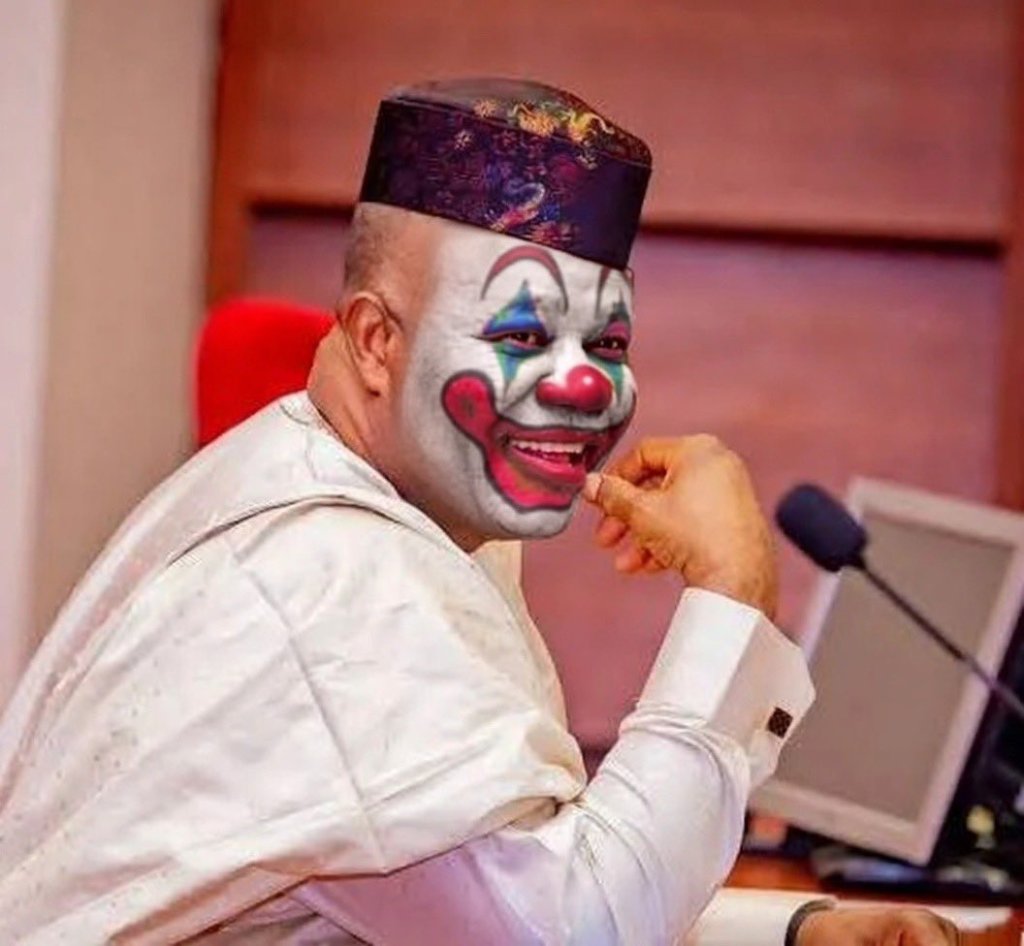
Back in 2017, human rights lawyer Inibehe Effiong caused a stir when he accused former Akwa Ibom governor Godswill Akpabio of looting the state treasury on a scale that could fund neighbouring Ebonyi State for decades.
At the time, many dismissed his comments as political rhetoric. Others defended Akpabio as a victim of political persecution. Nine years later, however, Nigeria has accumulated enough evidence to ask a more uncomfortable question:
Was the greatest tragedy of the Niger Delta not federal neglect, but the systematic looting of the region by its own political elite?
For over fifty years, the Niger Delta has been presented as the victim of the Federal Government. There is truth in that narrative. Oil-producing communities have suffered environmental degradation, underdevelopment and neglect. Successive federal governments have extracted enormous wealth from the region while leaving many communities without roads, hospitals or clean drinking water.
But there is another side to the story that is far less popular.
The region has also been governed by some of the wealthiest politicians in Africa, men who controlled budgets larger than those of several neighbouring countries while presiding over widespread poverty among their own people.
Akwa Ibom is a perfect example.
Between 2007 and 2015, during Akpabio’s administration, the state enjoyed unprecedented oil revenues. Billions poured into state coffers from federal allocations, excess crude accounts and derivation funds.
The administration became famous for its ambitious infrastructure projects, flyovers, government buildings and what supporters called “uncommon transformation.”
Critics, however, questioned the costs.
Many projects attracted allegations of inflated contracts, opaque procurement processes and unsustainable borrowing. Those allegations have never entirely disappeared from Nigeria’s political discourse.
What is remarkable is that the argument has become almost irrelevant.
Today, Godswill Akpabio is no longer simply a former governor defending his legacy. He has risen through the ranks of national politics and currently occupies one of the most powerful offices in the country as President of the Senate.
That fact alone illustrates one of the peculiar features of Nigerian politics.
In most functioning democracies, allegations of financial misconduct are career-threatening.
In Nigeria, they often seem to function as a leadership development programme.
The higher the controversy, the higher the office.
The story does not end with Akwa Ibom.
Since 2017, Nigerians have witnessed the spectacular collapse of the credibility of many institutions established specifically to develop the Niger Delta.
The Niger Delta Development Commission (NDDC), established to transform the region, became the subject of scandal after scandal. Public hearings exposed allegations involving abandoned projects, questionable contracts and billions of naira spent with little visible impact on communities.
At one point, Nigerians watched senior officials openly contradict one another before the National Assembly in scenes that resembled political comedy more than accountability.
The Ministry of Niger Delta Affairs suffered a similar reputation.
The tragedy is not merely that funds disappeared.
The tragedy is that the disappearance became normal.
Entire generations have grown up hearing about billions allocated to development agencies while continuing to live among failed roads, polluted rivers and collapsing public services.
The irony is painful.
The same politicians who frequently accuse Abuja of neglect often return home in private jets purchased with resources supposedly stolen from their people by Abuja.
Meanwhile, ordinary Niger Deltans remain trapped between two predators: a distant federal bureaucracy and a local political class that frequently behaves like a colonial administration.
In 2017, Inibehe Effiong criticised former President Goodluck Jonathan for presiding over what he described as an era in which corruption became institutionalised.
That claim remains politically controversial.
Jonathan’s supporters point to relative political stability, improvements in electoral administration and investments in infrastructure. His critics point to massive corruption scandals, the fuel subsidy fraud era and the seeming inability of government institutions to enforce accountability.
The passage of time has strengthened one conclusion.
The problem was never one president.
The problem was never one governor.
The problem was a political culture that rewards loyalty above competence, ethnicity above accountability and symbolism above performance.
For decades, Niger Delta politicians mastered the art of presenting themselves as freedom fighters while behaving like shareholders in a private oil company.
Whenever questions were raised about missing billions, the discussion quickly shifted to resource control.
Whenever accountability was demanded, critics were accused of attacking the region.
Whenever corruption investigations emerged, ethnic solidarity was deployed as a shield.
The result is visible today.
Despite producing the wealth that sustains Nigeria, large parts of the Niger Delta remain underdeveloped.
Young people continue risking their lives in illegal refining operations.
Communities still lack basic infrastructure.
Environmental devastation remains largely unresolved.
Yet the political class continues to prosper.
Perhaps the most important question is not whether Akpabio looted Akwa Ibom.
That remains a matter of allegation, evidence and due process.
The more important question is this:
After receiving trillions of naira in oil revenues, derivation funds, intervention programmes and special development allocations, why does the Niger Delta still look like a region waiting for development?
Until that question is honestly answered, the region will continue to suffer from a dangerous illusion.
Its greatest challenge is not merely what was taken from it by outsiders.
It is what was stolen from it by those who claimed to be its own.
How Akpabio looted Akwa Ibom state treasury as governor – Eromosele Ebhomele was published 2 June 2017

