

There is a uniquely Nigerian expression that deserves to be elevated from office gossip to a constitutional concept:
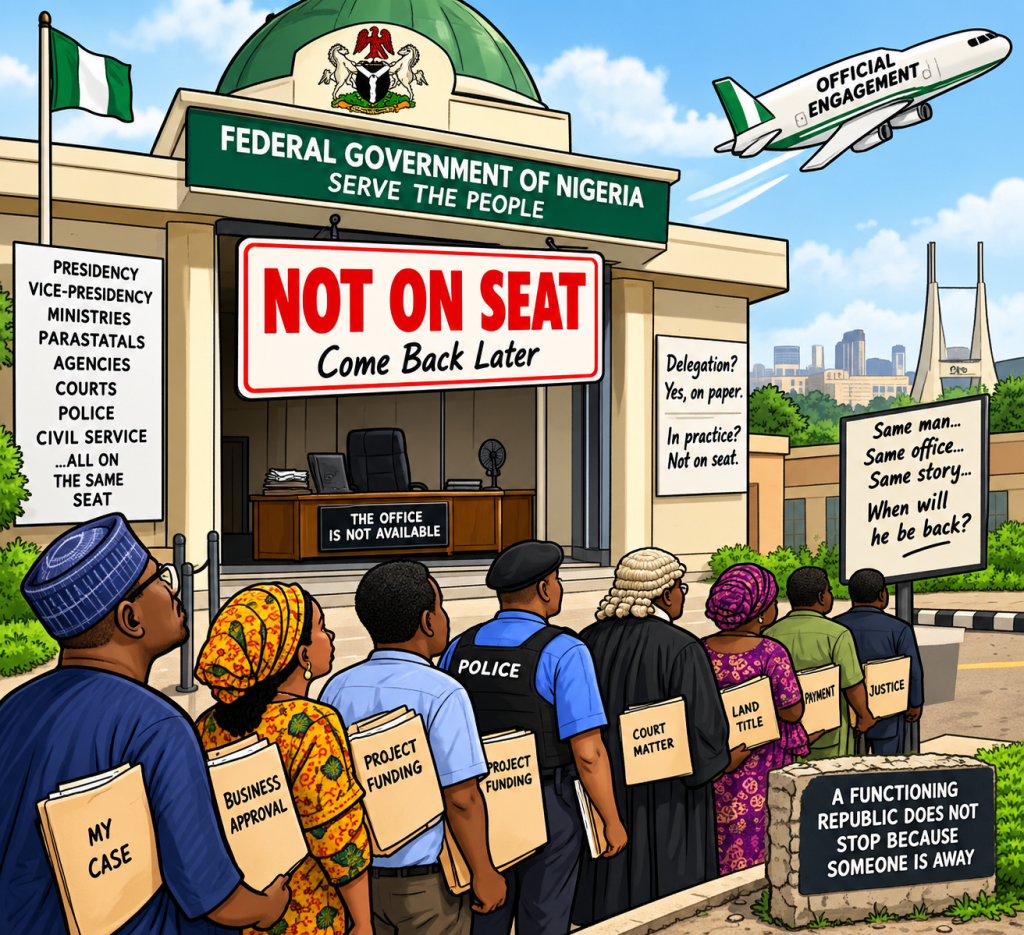
“Not on seat.”
You arrive at a government office because you need a service. You have your documents. You have paid the required fees. You have probably taken three days off work and spent half your morning fighting traffic.
You finally reach the desk.
“Where is the officer?”
“Not on seat.”
“When will he return?”
“We don’t know.”
“Can someone else attend to the matter?”
Silence.
The file belongs to him.
The authority belongs to him.
The knowledge belongs to him.
Apparently, the Nigerian Republic belongs to him too.
So you sit down and wait.
Or you come back tomorrow.
Or next week.
Or whenever His Excellency, His Honour, His Officer, His Inspector, His IPO, His Registrar or His Clerk decides to return to his seat.
This is not merely bad customer service.
It is a philosophy of government.
The Republic of One Man, One File
The deeper problem with “Not on Seat” is that the Nigerian public service often behaves as though authority is attached to the person, rather than the office.
In a properly functioning institution, an officer may be absent without the institution becoming incapacitated.
There should be delegated authority.
There should be acting officers.
There should be chains of command.
There should be records, procedures and institutional memory.
The work should continue because the office exists independently of the person occupying it.
In Nigeria, however, the file can become a personal possession.
The officer goes away and the file goes into hibernation.
This phenomenon is familiar in the civil service, but it does not stop there.
It can be found in policing.
It can be found in the courts.
It can be found throughout the administrative machinery of government.
And sometimes, remarkably, it reaches all the way to the top.
The Police IPO Problem
Consider the Investigating Police Officer.
You have a criminal complaint.
The IPO is handling it.
You have supplied documents.
You have made statements.
You have answered questions.
Then one day you are told:
“The IPO has been transferred.”
And suddenly your investigation has acquired a new beginning.
The new officer may need to read the file.
Or ask you to repeat your statement.
Or reconstruct what has already happened.
Institutional memory has apparently been transferred to another state.
The same principle can affect judicial proceedings.
A judge is assigned a matter.
Hearings take place.
Applications are argued.
Years pass.
Then the judge is transferred, elevated, retires or, tragically, dies.
And the system can behave as though the case has been born again.
The parties return to the starting line.
The clock resets.
The system says, in effect:
“Sorry. The person has changed. Please start again.”
That is not institutional continuity.
That is institutional amnesia.
The Presidency: “Not on Seat” at Constitutional Scale
Now take the ordinary Nigerian “Not on Seat” culture and enlarge it to the size of the Federal Republic.
That is where the problem becomes frightening.
The Constitution does not contemplate a country that stops functioning because the President is temporarily absent.
Indeed, the Constitution specifically provides for temporary absence.
Section 145 provides a mechanism for the Vice-President to discharge the functions of the office of President where the President transmits a written declaration of temporary absence to the President of the Senate and the Speaker of the House of Representatives. Section 146 also deals with circumstances in which the Vice-President discharges presidential functions. (PLACNG)
The constitutional architecture therefore recognises an obvious truth:
Governments cannot operate on a “Not on Seat” basis.
But constitutional architecture and administrative culture are two different animals.
One lives in the law books.
The other lives in the corridors of power.
And Nigeria’s administrative culture has often behaved as though the President is not merely the holder of presidential authority but the physical location at which presidential authority resides.
That is dangerous.
When the President Leaves, Does Government Leave With Him?
This is the question Nigeria needs to confront.
A President is entitled to travel.
A Vice-President is entitled to travel.
Ministers travel.
Governors travel.
Judges travel.
Civil servants travel.
Nobody is suggesting that public officials should be chained to their desks like Victorian furniture.
The issue is different.
Can the institution continue functioning effectively when the individual is absent?
That is the test of a mature state.
A modern state is designed precisely to prevent the absence of one human being from paralysing public administration.
The United States does not cease to function because its President travels.
The United Kingdom does not close Whitehall because the Prime Minister is in Washington.
A hospital does not stop treating patients because the consultant is attending a conference.
A bank does not stop transferring money because the branch manager has gone on holiday.
The institution has systems.
Nigeria often has personalities.
And personalities are terrible substitutes for systems.
The Buhari Lesson
During the Buhari years, there were repeated concerns about presidential absence and the constitutional requirement for an acting President to be properly designated.
There were also disputes surrounding time-sensitive decisions involving international partners and military procurement.
One documented example was the 2018 controversy surrounding Nigeria’s acquisition of twelve A-29 Super Tucano aircraft from the United States. Reports at the time said President Muhammadu Buhari had approved the release of $496 million because the US had imposed a payment deadline, while the legality and parliamentary approval of the transaction became the subject of domestic controversy. (TheCable)
The broader lesson is more important than the particular transaction.
International diplomacy, financing, security procurement and government contracting operate according to clocks.
Washington has a clock.
London has a clock.
The World Bank has a clock.
The IMF has a clock.
Investors have clocks.
Airlines have clocks.
Only the Nigerian government sometimes behaves as though the world should pause politely until the appropriate official returns to his seat.
It will not.
Abuja Cannot Become a Waiting Room
This becomes particularly serious when the absence of key political actors coincides.
The President is away.
The Vice-President is away.
The Senate President is away.
Senior ministers are away.
And somewhere in Abuja, somebody is sitting beside a file saying:
“The person that can approve this is not on seat.”
Meanwhile:
A contractor is waiting for payment.
A business is waiting for regulatory approval.
A ministry is waiting for an instruction.
A security operation requires authorisation.
An international agreement requires a signature.
A procurement deadline is approaching.
A patient needs a government intervention.
A court matter is waiting for an administrative step.
A state is waiting for funds.
A citizen is waiting for justice.
And the answer remains:
“Come back when he returns.”
That is not government.
That is a national waiting room.
The Most Dangerous “Not on Seat” Is in National Security
There is an especially serious dimension to this problem.
Government must sometimes make decisions during emergencies.
Security threats do not consult the President’s itinerary.
Bandits do not check whether the Commander-in-Chief is in Abuja.
Terrorists do not wait for the National Security Council to finish its tea.
Kidnappers do not postpone an attack because the appropriate official is travelling.
A constitutional democracy therefore needs clear chains of command.
Authority must be capable of flowing downward and sideways.
Decisions must be capable of being made by authorised officials without waiting for one individual to physically return to his chair.
Otherwise, the state becomes vulnerable precisely when it most needs to be operational.
The Tinubu-Shettima Question
This brings us to the present administration.
President Bola Ahmed Tinubu and Vice-President Kashim Shettima have both undertaken extensive domestic and international engagements. The Presidency has itself demonstrated that the Vice-President can represent the President abroad. In November 2025, for example, the State House announced that Shettima would represent Tinubu at the G20 Leaders’ Summit in Johannesburg. (State House Abuja)
That is precisely how a functioning executive should work.
Delegation is not weakness.
Delegation is government.
The real question is whether the wider machinery of government operates with the same institutional discipline.
Because the Nigerian problem is not that officials travel.
The Nigerian problem is what happens after they leave.
If the answer is that decisions continue to be made through properly authorised deputies, permanent secretaries, ministers, heads of agencies and established chains of command, then the system is functioning.
If the answer is:
“Wait until he comes back,”
then we have a problem.
And it is a constitutional problem disguised as customer service.
Even the Senate Has a Seat
The same principle applies to the legislature.
The National Assembly is an institution.
The Senate is an institution.
The Senate President presides over the Senate, but the Senate does not cease to exist because the Senate President is travelling.
The institution must have procedures for continuity.
The Nigerian state must therefore stop confusing the importance of an officeholder with the indispensability of his physical presence.
No public official should become a single point of institutional failure.
That is a principle familiar to engineers, computer scientists, military planners and serious corporate organisations.
You design systems so that one component can fail without bringing down the entire network.
Nigeria sometimes designs government as though the network consists of one computer.
And unfortunately, that computer travels.
From “Not on Seat” to “Not My Job”
There is another ugly feature of the phenomenon.
“Not on seat” frequently becomes a cousin of another Nigerian bureaucratic phrase:
“Not my department.”
One officer refuses to act because the matter belongs to another officer.
The other officer refuses because the matter belongs to another department.
The department refuses because the director is away.
The director’s deputy refuses because he has not been authorised.
The permanent secretary says it requires ministerial approval.
The minister says it requires presidential approval.
The presidential aide says the President is travelling.
And somewhere in the chain, the citizen is still standing there holding the file.
Nigeria has perfected the art of turning a simple administrative question into an expedition through the bureaucratic Amazon.
The Cost Is Not Just Annoyance
The cost of “Not on Seat” is enormous.
It delays justice.
It delays investment.
It delays procurement.
It delays infrastructure.
It delays payments.
It frustrates businesses.
It encourages corruption.
It creates opportunities for middlemen.
It encourages citizens to search for “connections” rather than procedures.
And it teaches Nigerians a particularly poisonous lesson:
If you want government to work, find the person who knows the person.
That is how institutions become personalised.
That is how patronage flourishes.
That is how citizens become supplicants.
And that is how the Republic gradually changes from a system of rules into a collection of relationships.
The Cure Is Institutional, Not Inspirational
The answer is not another presidential speech about working harder.
It is not another retreat.
It is not another committee.
And it certainly is not another prayer meeting asking God to help government officials do the work for which they are being paid.
The answer is institutional design.
Every critical government function should have:
- a clearly defined principal officer;
- a designated deputy;
- written delegation of authority;
- documented procedures;
- electronic records;
- mandatory handover arrangements;
- clear time limits;
- accountability for delays;
- continuity arrangements for transfers, retirement, illness or death;
- and mechanisms for citizens to escalate matters when an official is unavailable.
The question should never be:
“Where is the man?”
The question should be:
“What does the system provide for when the man is not here?”
That is the difference between an institution and a personality cult.
Nigeria Does Not Need More People on Seat
It needs fewer things dependent upon their being on seat.
That is the real lesson.
The civil servant should be replaceable.
The police investigator should be replaceable.
The administrative judge’s support structure should be capable of continuity.
The permanent secretary should be replaceable.
The minister should be replaceable.
The Vice-President should be capable of discharging presidential functions when constitutionally required.
And the President himself must operate within an institutional system that does not collapse when he boards a presidential aircraft.
A functioning republic cannot be built around the physical location of one individual.
Otherwise, every journey becomes a constitutional event.
Every holiday becomes an administrative crisis.
Every transfer becomes institutional amnesia.
Every retirement becomes a new beginning.
And every citizen becomes a man or woman sitting outside an office asking the same immortal Nigerian bureaucratic question:
“When will he be back?”
The answer Nigeria needs is not:
“Tomorrow.”
It is:
“It doesn’t matter. The institution is still working.”
That is what government is supposed to mean.
And until Nigeria learns that lesson, “Not on Seat” will remain more than a notice on an empty office door. It will remain a description of the Nigerian state itself.

