


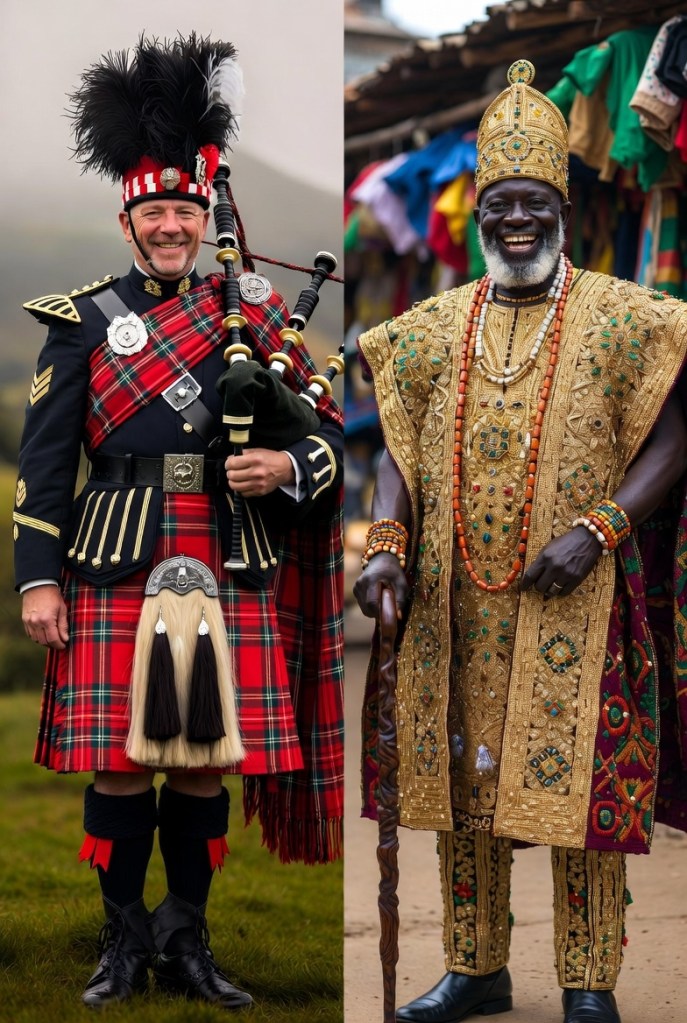
There is a particular magic trick performed daily in the Western press, the Western university, and shamefully the Western-trained African mind. A group of people organised around shared language, custom, ancestral territory, and a system of governance is, if it happens to be pink and live north of Calais, called a nation. The identical group, organised on the identical principles, is called a tribe if it happens to be Black and live south of the Sahara. The word does no descriptive work. It does political work. It is not analysis; it is a costume change.
Scotland has a parliament, a flag, a football team that loses with tremendous dignity, and roughly the population of Lagos’s Ikeja Local Government Area. The Yoruba nation and I use the word advisedly has an empire’s worth of history, a written and oral constitutional tradition running from Ile-Ife through the Oyo Mesi and the Alaafin’s checks and balances, a diaspora spanning three continents, and something in the region of forty million native speakers. One of these is routinely described in the Financial Times as a nation debating its constitutional future. The other is routinely described, by the same publication, as a tribe engaged in an ethnic dispute. I invite the reader to spot the empirical difference. I have been looking for thirty years and have found only prejudice wearing a monocle.
ACT I — THE CRUSOE INHERITANCE
The taxonomy did not arrive by accident. It was manufactured, and the manufacturer left a receipt. Daniel Defoe’s Robinson Crusoe required reading in every colonial schoolroom from Freetown to Fiji is not merely an adventure story. It is a founding document of European self-conception: the shipwrecked Englishman, alone, builds calendars, fortifications, agriculture, and law out of nothing but his own rational will. The African he encounters, Friday, arrives fully formed as raw material grateful, teachable, and, crucially, without prior civilisation of his own worth the name. Crusoe does not find Friday’s society and study it. He erases it and starts again, as though from a blank slate.
That literary gesture became an administrative one. The colonial officer who followed Defoe’s fictional footsteps two centuries later carried the same assumption into the field: the European brings complexity, the African merely inhabits simplicity. Where Europe had “nations” self-evidently sophisticated, worthy of treaties, entitled to sovereignty Africa had “tribes”: small, static, pre-political units awaiting organisation from outside. The word tribe did not describe a smaller society. It described a society that colonial administration had decided, in advance, not to recognise as a state.
ACT II: WHAT THE ANTHROPOLOGISTS ACTUALLY FOUND
The trouble for this fiction is that the people sent to document it kept, inconveniently, doing their jobs properly. The Ugandan sociologist Archie Mafeje spent much of the 1970s dismantling the “tribal model” from within anthropology itself, arguing that what colonial scholarship called tribal structures were frequently as large, as politically differentiated, and as historically dynamic as any European kingdom the difference lay in the observer’s willingness to see it. Terence Ranger’s later work on the “invention of tradition” in colonial Africa went further: much of what passed for ancient, immutable tribal custom was in fact freshly codified by colonial administrators seeking legible units to govern, then handed back to Africans as timeless heritage.
Meanwhile the Benin Kingdom whose bronzes now sit, still unreturned in most cases, in the British Museum maintained a centralised monarchy, a guild-based administrative bureaucracy, standing military structures, and diplomatic relations with Portugal from the fifteenth century onward. The Aro Confederacy among the Igbo built a trading and judicial network across the south-east that functioned, in practical terms, as a federated commercial polity. None of this resembles Crusoe’s blank slate. It resembles, rather precisely, the feudal and mercantile structures that European historians are perfectly happy to call statecraft when the actors are Venetian or Hanseatic.
“What is called tribalism when Lagos does it is called nationalism when Edinburgh does it. The manifestation is identical. Only the observer’s generosity has changed address.”
ACT III: NATIONALISM IS TRIBALISM WITH A FOREIGN OFFICE
Consider the actual mechanics of what Europe calls nationalism. Benedict Anderson’s famous formulation the nation as an “imagined community,” bound not by daily face-to-face contact but by shared language, shared myth, and a sense of common fate was written about Europe, but it is, without alteration, a description of Yoruba, Igbo, or Bini ethnic identity. Ernest Gellner’s account of nationalism as the political principle that cultural and political units should align maps just as neatly onto Biafra’s founding claim in 1967 as it does onto Slovenia’s in 1991. The Scottish National Party’s case for independence rests on shared history, shared grievance against a dominant neighbour, and linguistic-cultural distinctiveness categories indistinguishable in kind, though not in scale, from the case an Ijaw or Ogoni activist might make about the Niger Delta.
The distinction the world insists on drawing, then, is not between complex and simple societies. It is between societies whose self-determination claims Europe finds administratively convenient and those it does not. Catalonia’s push for independence is treated in Brussels as a constitutional headache to be managed with referenda and courts. Biafra’s was treated in London and Lagos as a rebellion to be managed with a blockade and, by credible estimate, over a million starvation deaths. Same grammar of claim shared ethnicity, shared language, shared grievance against a metropole. Entirely different vocabulary of response, because one people were permitted the word “nation” and the other was not.
ACT IV: DECOLONISING THE DICTIONARY
None of this is an argument that every ethnic nationality in Africa should have its own sovereign state tomorrow morning that is a separate and much harder constitutional conversation, and Nigeria’s federal structure exists precisely to manage the tension between ethnic nationality and civic nationhood without pretending the former is somehow less real than the latter. The argument is narrower and, I think, harder to escape: the words we use to describe human political organisation should track observable features of that organisation — scale, institutional complexity, historical continuity, capacity for self-governance — and not the observer’s inherited assumptions about which continents are permitted complexity.
Until that correction is made, every reference to “tribal conflict” in the Niger Delta sits beside every reference to “national tension” in the Basque Country as a small, quiet lie the same phenomenon, differently dressed, because Robinson Crusoe needed Friday to be simple in order for the island to make sense. The island stopped making sense a long time ago. It is time the dictionary caught up.

