


The World Bank’s reversal on industrial policy followed the ideology and interests of its powerful shareholders and Africa should treat its advice with caution.
On March 17 2026, the World Bank published a report called Industrial Policy for Development: Approaches in the 21st Century. Its headline finding is that industrial policy “should be considered in the national policy toolkit of all countries.”
If you are an African policymaker/technocrat/leader who has been following the World Bank’s development advice for the last say 30 years, this finding would shock you.
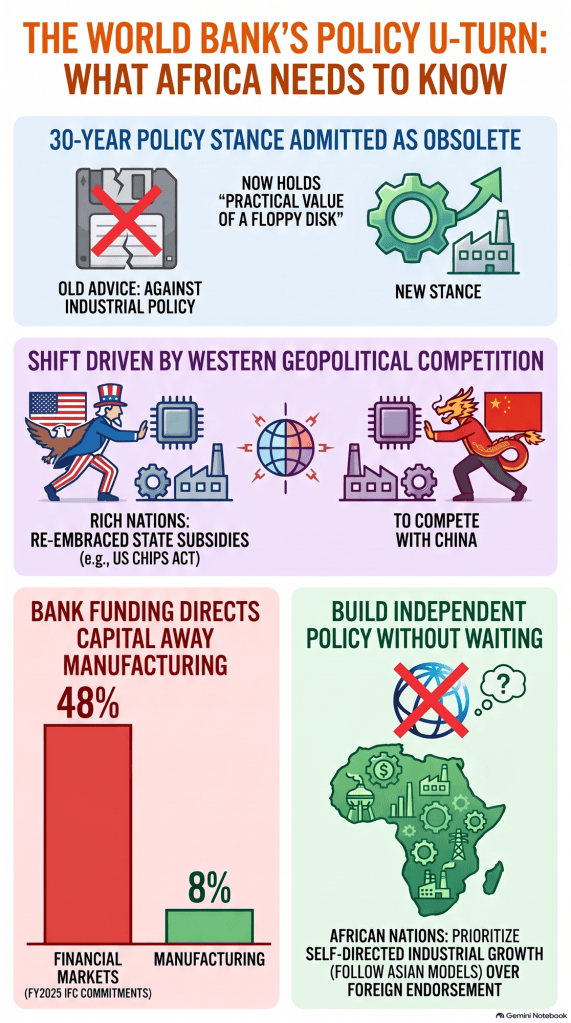
Because that sentence would have been heresy inside the Bank thirty years ago. And the Bank knows this, which is why in the foreword of the report, chief economist, Indermit Gill, writes that the institution’s decades-old advice against industrial policy “has not aged well” and now has “the practical value of a floppy disk today.”
And the report spends significant energy explaining why the Bank feels differently about industrial policy now. Bits of the explanation read as an apology. This essay is about what the explanation leaves out. Because it is what matters for Africa and it requires us as Africans to ask the harder question the apology does not answer: if the Bank could be this wrong for this long, whose interests was its advice actually following?
Why the change?
Industrial policy is respectable again, in my opinion, because the “rich world” now needs it. The United States passed the CHIPS and Science Act and the Inflation Reduction Act. The European Union answered with its Net-Zero Industry Act. Semiconductors, electric vehicles, critical minerals and the green transition have become the terrain of great-power competition with China, and on that terrain nobody in the “West” is leaving the outcome to comparative advantage. Industrial policy is the plan of attack and defense.
When all is said and done, China is the country that has built much of its rise on exactly what the World Bank spent thirty years warning Africa against. And every development economist knows this.
China employs an extensive set of industrial policy instruments at both the national and provincial levels to shape economic development. A study by Hanming Fang, Ming Li and Guangli Lu used large language models to read Chinese government policy from 2000 to 2022, around three million documents, and classified more than 768,000 as industrial policy. These include financial incentives such as subsidies and tax concessions, policies designed to facilitate firm entry and improve the business environment, and public investments in infrastructure, land provision, and workforce development. The state also stimulates demand through public procurement programmes and consumer incentives. In addition, policymakers seek to build integrated industrial ecosystems by promoting geographic clustering and linkages among firms operating across related sectors.
None of what China has done is hidden knowledge.
A 1993 World Bank report titled The East Asian Miracle acknowledged that governments in countries like Japan, South Korea, Taiwan and Singapore had used industrial policy to guide development. Yet it concluded that such interventions were difficult to replicate and generally advised against them. Three decades later, the World Bank has softened its position. Its 2026 report acknowledges that industrial policy never disappeared and that every country uses it in some form.
My point is, the conditions for successful industrial policy outlined in 2026 are similar to those identified in 1993: interventions should address market failures, be tied to performance, and be implemented by capable, accountable institutions. In 1993 these conditions were presented as reasons for restraint; in 2026 they are presented as reasons to proceed with care.
Countries that went against the Bank’s advise have industrialised, while countries dependent on World Bank and IMF financing are left with the 2026 “apology”.
It is also important to say that despite acknowledging how badly their advice has aged, The Bank still emphasises sound macroeconomic management and cautions that industrial policy offers only modest gains even under favourable conditions. As Charles Kenny of the Center for Global Development put it, the Bank is “tiptoeing rather than striding away from the skepticism of thirty years ago”
On Misaligned Interests
To put it bluntly, Africans and their leaders need to understand that their interests and those of the World Bank do not always align so it is important to take their advice with caution.
If you don’t believe me, lets look at the Bank’s own 2025 Annual Report.
Start with the private arm. The International Finance Corporation (IFC), the part of the Bank that invests directly in firms, put its single largest share of FY2025 commitments, 48 percent, into financial markets. Manufacturing took 8 percent, agribusiness 8 percent, tourism and property around 9 percent. Yet the Bank’s own industrial-policy report names agricultural commodities, food and beverage manufacturing, heavy manufacturing and tourism as the sectors most targeted by industrial policy worldwide. The institution’s money flows in almost the opposite direction from the activity its researchers identify as the engine of structural transformation. Charles Kenny’s verdict is hard to argue with: the IFC is doing industrial policy, and doing it wrong.
Then look at the architecture the Bank is actually building for Africa. The entire 2025 report is organised around a single promise, “creating jobs, growing economies,” and the strategy has three pillars that end in the one that does the real work: mobilise private capital. For African countries this means guarantees, political-risk insurance through MIGA, the Private Sector Window, de-risking instruments designed to make the continent safe for foreign investors. Mission 300 is about electricity access. The flagship initiatives are about enabling environments and crowding in private capital. They are not about backing an African state to direct its own industrialisation, build capacity it controls, and capture the returns. The model on offer is one where Africa supplies the de-risked opportunity and someone else supplies, and owns, the capital.
And the asymmetry from the structural-adjustment years has not gone anywhere. Nigeria is the single largest recipient of IDA financing in FY2025, at over $3 billion. The continent that absorbed the most orthodoxy is now the one offered the most de-risking.
In both eras the Bank’s advice and the Bank’s money pointed the same way: toward an Africa integrated into the global economy on terms that suit the holders of capital, and away from the kind of directed, state-led industrial building that every country now rich once used to get there.
What do Africans do now?
The point of this essay is that the World Bank is not Africa’s friend and “committed partner in development”. This does not mean the Bank wishes Africa ill. It is staffed by many who care a great deal. I worked at the Bank for 6 wonderful months. It means the World Bank and Africa do not always have the same incentives, goals and interests.
The World Bank is an institution full of good intentions. But at best it is an institution that provides advice based on its own idelogy without regard for the development of its weakest borrowers, at worst its advice tracks the interests of its most powerful shareholders.
I recognise how I sound like a tinfoil-hat-wearing-the-west-and-its-institutions-is-against-africa consipracy theorist. So it is worth talking about Nancy Birdsall who was acting chief economist at the Bank for the 1993 report and is listed as one of its authors. In a 2025 essay revisiting her work, she argues that the 1993 caution against industrial policy was largely a product of its time, written in the years of NAFTA, the new World Trade Organization and the Washington Consensus, when open markets were taken for granted inside the Bank and barely debated.
Her point is that the doctrine moved with the intellectual climate of the powerful. It did not move with their interests. She admits that the 1993 report was financed by the Japanese government, which wanted the Bank to take industrial policy seriously, and the Bank still mostly declined to. So the Bank was stubborn enough to resist Japan’s pushes because of ideology.
The thing is, she is still making my point. The 1993 stance served a world economy in which open markets in the developing world delivered cheap inputs and cheap goods to the rich one. The 2026 reversal serves a world in which those same powerful states have rediscovered industrial policy for their own competition with China. In both cases the doctrine moved with the ideology of the powerful. This is crucial because ideology feeds interests and in the end, Africa is the constituency expected to adjust.
So the lesson for African policymakers is not to wait for the Bank’s blessing, and not to read the new report as a friend’s change of heart.
Several East Asian states built their industries in open defiance of Bank advice, and the Bank has now conceded they were right. The World Bank’s approval is a lagging indicator of what works, not a leading one.
Treat the feasibility framework in the 2026 report as useful technical material, because matching tools to your market size, capacity and fiscal space is sound regardless of who says it. But treat the institution itself the way you would treat any powerful actor whose interests are not yours: read what it funds, not what it says, and assume that a door which opened because of someone else’s geopolitics can close the same way.
The floppy disk line was supposed to be a joke about obsolete technology. The more honest reading is that the advice was never really about technology or evidence. It was about who gets to climb, and when, and on whose terms. The ladder is being lowered again, not out of friendship, but because the people at the top have decided they need to use it themselves. Africa should climb anyway, and should be clear-eyed about who is holding the bottom rung.

