



There are crimes that belong to history books. There are crimes that belong to the dark chapters of colonial rule. And then there are crimes so shocking that one assumes they could only have happened in some distant century before the emergence of modern law, human rights conventions, and international criminal courts.
Yet this happened in Nigeria in 2004.
Not in 1904.
Not in 1804.
In 2004, in the heart of Edo State, 27 people reportedly lost their lives in circumstances so horrifying that they read less like a contemporary news report and more like a medieval witch trial.
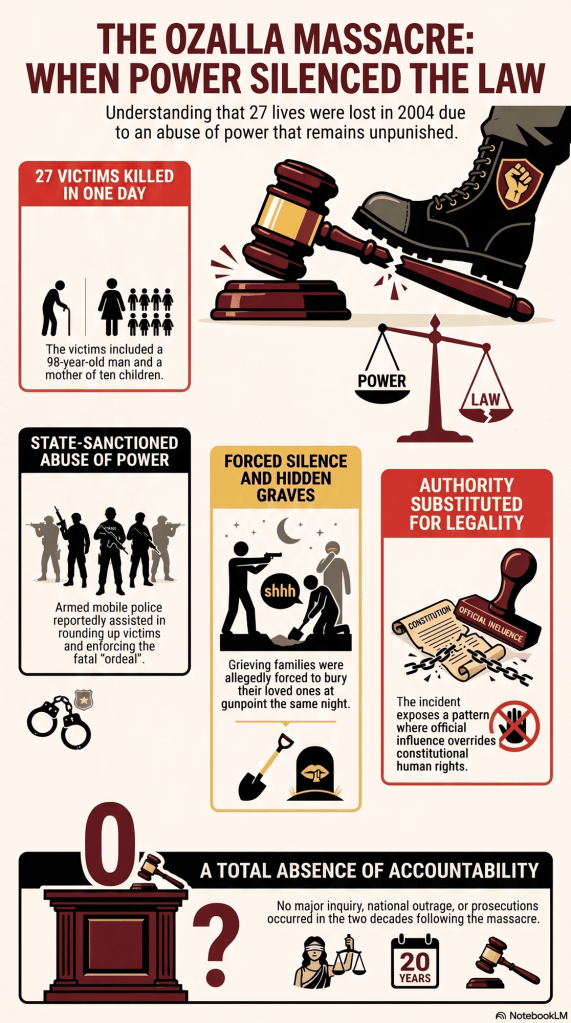
According to a report by TELL Magazine, a retired Assistant Inspector General of Police and former military governor, Amen Oyakhire, allegedly convened a gathering in Ozalla community on November 4, 2004. Accompanied by native doctors and heavily armed mobile policemen, he reportedly accused members of the community of using witchcraft to frustrate his life, delay his retirement benefits, hinder the construction of his country home, and even cause mental illness among some of his children.
What followed, if accurately reported, was not justice. It was not due process. It was not even superstition operating in isolation.
It was the exercise of raw power.
The accused were allegedly rounded up from their homes and brought before the traditional ruler’s palace. Twenty-seven men and women were reportedly identified by native doctors as witches and wizards. They were then allegedly forced to drink concoctions, beaten with horsewhips, bamboo sticks and canes, and compelled to perform physically exhausting acts.
Many never survived.
Some reportedly vomited. Others defecated uncontrollably. One after another, they died.
Among the dead were elderly citizens in their eighties and nineties, mothers, fathers, husbands and wives. One victim was a 98-year-old man. Another was a mother of ten children. A married couple left behind seven orphaned children.
The families, according to reports, were allegedly forced to bury their loved ones that same night under threats of suffering a similar fate.
If true, this was not merely a local tragedy.
It was a massacre.
The Silence That Followed
The most disturbing part of the story may not even be the deaths themselves.
It is what happened afterwards.
Or more accurately, what did not happen.
No major independent inquiry.
No national outrage.
No commission of investigation.
No prosecutions that entered the public consciousness.
No sustained activism.
No annual remembrance ceremonies.
No documentaries.
No political reckoning.
A week after the incident, police reportedly stated that no investigation could proceed because no formal complaint had been lodged.
That explanation raises more questions than it answers.
How does a community allegedly terrorised into silence file a complaint against individuals accompanied by armed police officers?
How do grieving families, reportedly forced to bury victims at gunpoint, suddenly become free and fearless complainants a few days later?
How does the absence of paperwork become an excuse when dozens of people have reportedly died in a single incident?
The law is supposed to protect the vulnerable from the powerful. It becomes meaningless when it demands courage only from those who have every reason to fear retaliation.
A Test for the Rule of Law
The Ozalla incident exposes a recurring Nigerian problem: the substitution of authority for legality.
Too often, official power becomes its own justification.
A powerful person makes an accusation.
State agents appear.
Fear spreads.
People suffer.
The system closes ranks.
And eventually the country moves on.
The dead become statistics.
The living learn the lesson that power is stronger than law.
This pattern has repeated itself in different forms across Nigeria. Sometimes the victims are labelled criminals. Sometimes they are protesters. Sometimes they are ethnic minorities. Sometimes they are merely inconvenient individuals caught in the path of someone influential.
The labels change.
The underlying problem remains.
Why International Justice Exists
The International Criminal Court was not established simply to prosecute dictators after wars.
Its existence is based on a broader principle: where states are unwilling or unable to genuinely investigate and prosecute serious crimes, international scrutiny becomes necessary.
The ICC operates on the doctrine of complementarity. It is not intended to replace national courts but to act when national systems fail.
The Ozalla allegations raise uncomfortable questions about accountability. If dozens of citizens die under circumstances involving allegations of torture, coercion and abuse of authority, and no effective investigation follows, what message does that send about the value of human life?
Justice delayed is damaging.
Justice abandoned is devastating.
The Forgotten Dead
Twenty-two years later, many Nigerians have never heard of Ozalla.
Yet the names of the victims deserve remembrance.
Not because they were famous.
Not because they held public office.
But because citizenship should be enough.
A 98-year-old grandfather should not disappear into historical obscurity because he lacked political influence.
A mother of ten should not become a footnote because her family lacked connections.
Seven orphaned children should not be forgotten because nobody powerful chose to champion their cause.
The measure of a nation’s commitment to justice is not how it treats the powerful. It is how it treats the powerless.
The Unfinished Question
The Ozalla tragedy leaves Nigeria with a question that remains unanswered.
If twenty-seven people can allegedly die in one community under such circumstances, and the state simply shrugs its shoulders, what exactly protects the ordinary citizen?
A constitution?
A police force?
A court system?
Or merely the hope that one never attracts the attention of someone more powerful?
Until that question is answered honestly, Ozalla remains more than a historical tragedy.
It remains a warning.
And the silence surrounding it may be as disturbing as the events themselves.
 Centre for Nigeria Progress