

A president cannot bind his successors with executive orders. This is not radical constitutional theory. It is the plain, unromantic fact of the American system. Executive orders are the administrative equivalent of sticky notes left on the Resolute Desk: useful for the person who wrote them, mildly binding on the next occupant only for as long as that occupant finds them convenient, and entirely disposable the moment convenience ends.
Democratic presidents, frustrated by Congress’s refusal to enact progressive racial and electoral rules by statute, reached for the executive pen. They issued orders. Those orders survived successive administrations not because they possessed some mystical force of law that outlived their authors, but because subsequent presidents judged them reasonable enough to leave alone. Reasonableness, it turns out, is a fragile shield.
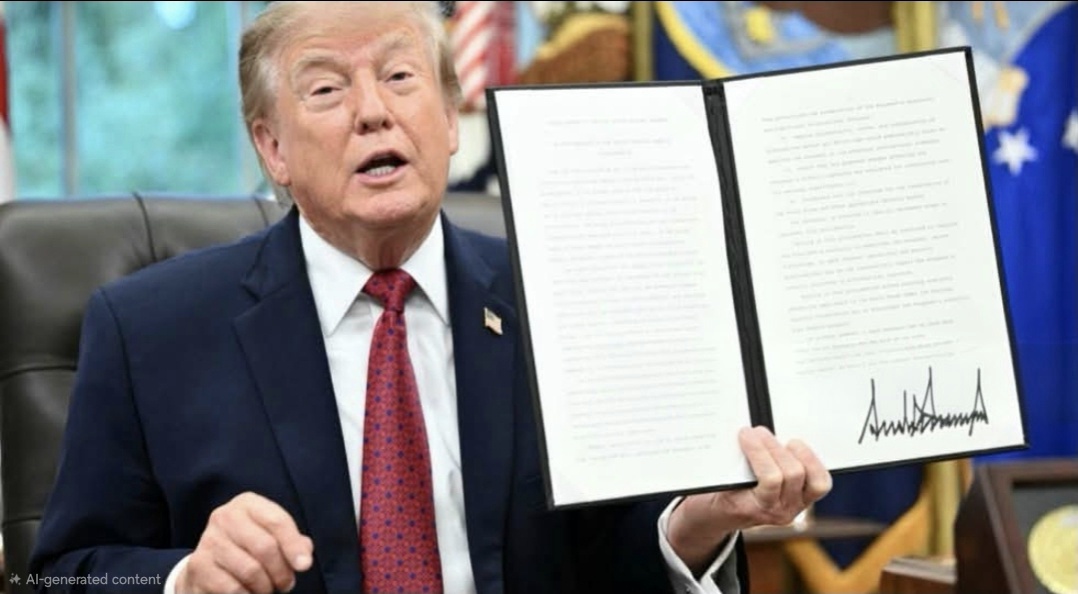
Then came an unreasonable president. Donald Trump, who had spent years denouncing executive overreach when it belonged to the other side, discovered that the pen worked just as well in his own hand. He overturned the long-standing protection orders with—yes, you guessed it—executive orders. The cycle completed itself with perfect, if grim, symmetry. Live by the EO, die by the EO.
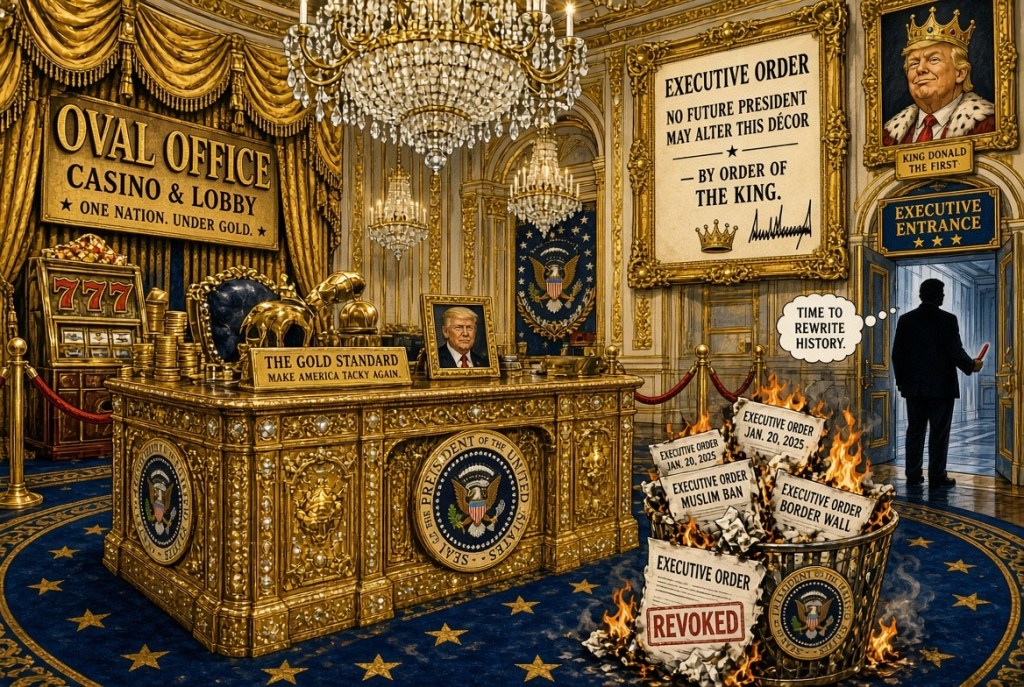
The real sting arrives in the tail of this narrative, and it is pure hubris. Having used the instrument to dismantle what others built, Trump signed an executive order mandating the permanent preservation of his own tacky remodeling of the Oval Office. No future president, the order grandly declares, may alter the décor. The gold. The excess. The aesthetic of a man who confuses the Oval Office with a casino lobby.
This is to his shame. After two terms in the office, he still has not grasped the import of the office. He is not a king. The Oval Office is not a personal monument. It is a temporary workspace whose furnishings have always reflected the temporary judgment of the person who sits there. Claiming permanent aesthetic sovereignty over it is the act of a man who has mistaken occupancy for ownership.
During the transition, the incoming president will, one hopes, reach for the same instrument Trump so freely employed. An executive order will bin this particular vanity decree. A subsequent bonfire of Trump-era executive orders will follow. Good riddance to bad rubbish.
The pen that writes the order can also cross it out. That is the entire point.

