

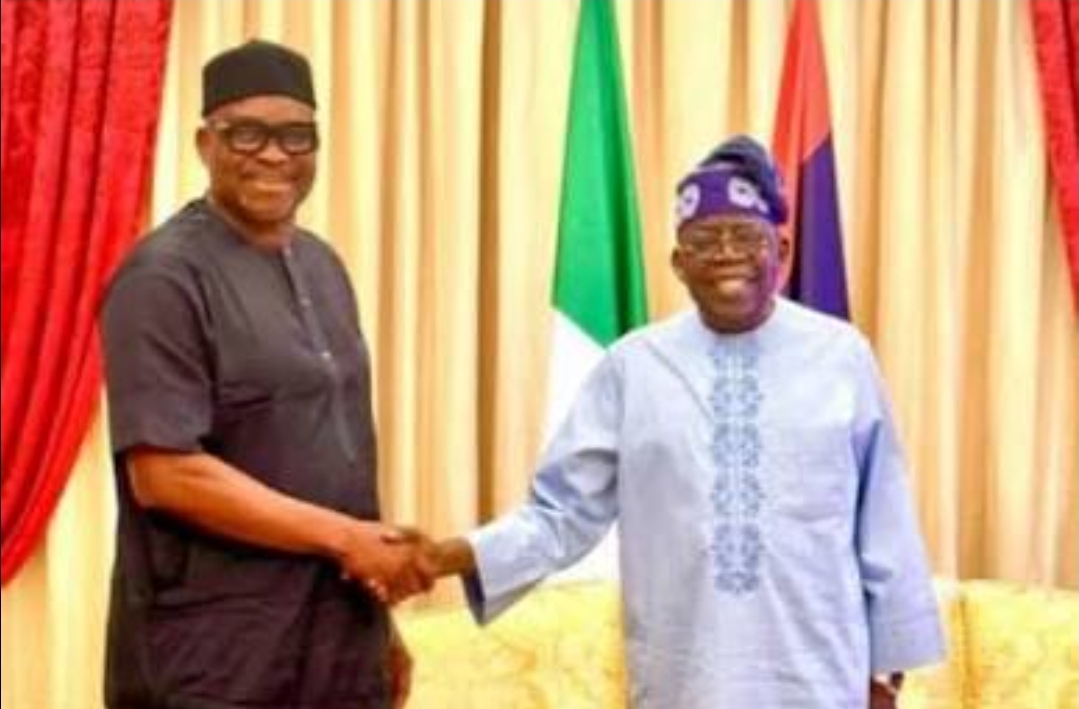

One of the great mysteries of Nigerian politics is the remarkable journey politicians undertake between the words “I want nothing” and the phrase “I am honoured to accept.”
It is a voyage as old as the Republic.
The route is well known.
The passengers are familiar.
Only the destination changes.
This week, the latest traveller appears to be former Governor of Ekiti State, Mr. Ayo Peter Fayose.
For years, Fayose occupied a unique position in Nigerian politics. He was the political equivalent of a monk living atop a mountain, untouched by the earthly temptations of appointments, contracts, board memberships and official convoys.
Whenever rumours surfaced that his friendship with President Bola Tinubu might lead to an appointment, Fayose would descend from the mountain and reassure the public.
He wanted nothing.
Nothing at all.
Not a ministerial position.
Not a special adviser role.
Not a board appointment.
Not even a ceremonial title involving a large office, an official vehicle and a government-funded air conditioner.
Nothing.
The word “nothing” became so attached to Fayose that one expected it to appear on his business card.
Ayo Fayose
Former Governor
Professional Collector of Nothing
Indeed, Fayose’s declarations became so frequent that one could set a clock by them.
When political appointments were discussed, he wanted nothing.
When favours were mentioned, he wanted nothing.
When speculation arose about rewards for supporting President Tinubu, he wanted nothing.
Had Abuja offered him the keys to Aso Rock itself, one got the impression he would have politely declined and returned to his living room.
Then Abuja called.
As Abuja often does.
Abuja is a curious city.
It possesses magical powers.
Politicians enter the city opposing something and emerge supporting it.
They arrive denouncing appointments and leave carrying appointment letters.
They swear eternal loyalty to one party and discover a new political religion before lunch.
Abuja is less a city than a conversion centre.
And so it was announced that President Tinubu had appointed Ayo Fayose as Chairman of the Rural Electrification Agency.
At that moment, thousands of old interview clips across Nigeria stirred from their slumber.
Television archives stretched awake.
Newspaper headlines rubbed their eyes.
Journalists reached for their notebooks.
The ghosts of statements past began floating through cyberspace.
“I am not looking for any position.”
“I will never take an appointment.”
“I have not asked anybody for favours.”
“I want nothing.”
Nothing, it turns out, has a chairman’s office.
Now, before Fayose’s supporters become alarmed, let us be clear.
There is absolutely nothing unlawful about accepting the appointment.
Former governors routinely serve on boards and commissions.
Public service is not a crime.
Indeed, if Fayose helps expand rural electrification, communities that currently rely on generators and lanterns may benefit enormously.
The issue is not the appointment.
The issue is the extraordinary amount of energy previously devoted to explaining why there would never be an appointment.
This is what makes Nigerian politics such a rich source of comedy.
Politicians rarely say:
“If an opportunity comes, I will consider it.”
That would be sensible.
That would be prudent.
That would leave room for changing circumstances.
But sensible statements do not generate headlines.
Absolute statements do.
So politicians prefer:
Never.
Impossible.
Not interested.
Over my dead body.
Then reality arrives carrying a government letterhead and a fresh set of talking points.
The politician who wanted nothing suddenly discovers a patriotic obligation to accept something.
The appointment is no longer patronage.
It becomes sacrifice.
It becomes service.
It becomes a call to nation-building.
It becomes a burden reluctantly accepted for the good of the people.
One can almost hear the violins.
To be fair, Fayose is not alone.
Nigeria has produced an entire generation of politicians who spend years condemning a table only to sit comfortably at it.
Some have rejected appointments before accepting appointments.
Some have rejected coalitions before joining coalitions.
Some have rejected governments before entering governments.
The consistency lies not in their positions but in their ability to explain why today’s position is completely different from yesterday’s position.
Nigerian politicians do not change their minds.
They merely discover that circumstances have evolved.
Repeatedly.
Conveniently.
And usually after an appointment letter arrives.
The real victim in all this is not the public.
Nigerians have seen this movie too many times.
The real victim is the English language.
Words like “never,” “nothing,” and “impossible” have suffered terrible abuse in our political arena.
They now require witness protection.
Perhaps the Rural Electrification Agency should begin its work by restoring power to those words.
Until then, Nigerians will continue watching this familiar drama unfold.
Act One: I want nothing.
Act Two: I still want nothing.
Act Three: I have never wanted anything.
Act Four: I am honoured to accept this appointment.
Curtain falls.
Official photographs follow.
And somewhere in the distance, another politician is preparing a television interview to explain why he too wants absolutely nothing.

