


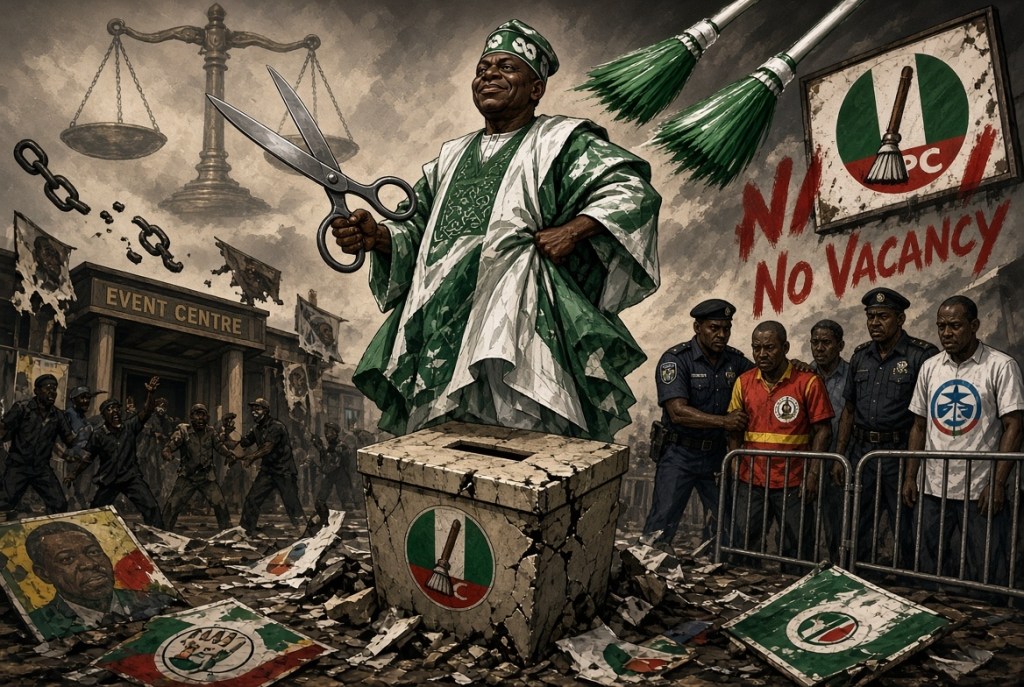
There’s a special kind of Nigerian magic that turns a man who once dodged military bullets for democracy into the man who now decides which opposition party is allowed to breathe near a billboard.
Welcome to the Tinubu era, where the fight against dictatorship has been upgraded into a more sophisticated product: democracy with the brakes on, the windows tinted, and the opposition’s microphones mysteriously unplugged.
Hungary has Orbán. Poland had its Law and Justice party. America is busy experimenting with its own version under Trump. Nigeria, never one to be left out of a global trend, has decided to join the club of illiberal democracies. We just do it with more thugs, more market women, and far better excuses.
The Democracy Toolkit, APC Edition
Opposition parties trying to hire billboards? Sorry, those spaces are mysteriously “booked.” Posters going up at night? They vanish by morning, courtesy of anonymous patriots with scissors and strong opinions about national unity. Rallies? Interrupted by energetic young men who appear to have studied disruption as a professional qualification. Marching on the streets? Expect an early introduction to the nearest police station. Event centres suddenly discover they have prior bookings stretching into the next millennium the moment an opposition party calls. And the market women and civil servants? Many are discovering that party membership is no longer a private choice but a public service obligation, complete with the subtle suggestion that non-compliance might affect their next allocation of pepper or promotion.
This is not the crude dictatorship of the 90s. This is democracy with Nigerian characteristics: elections still happen, the constitution is still quoted, and everyone insists the process is free and fair — just free and fairer for some than others.
The Fighter Who Forgot How to Fight Fair
The official narrative remains charming. Tinubu fought the military. He was a NADECO man. He suffered. Therefore, whatever he does now must, by definition, be democratic. It is the political equivalent of a man who once escaped a burning building insisting he now has the right to set the furniture on fire because he knows what fire feels like.
The political space is not merely shrinking. It is being professionally managed. Labour Party finds itself in legal quicksand until certain high-profile figures exit stage left. ADC develops sudden institutional headaches. Other platforms discover that independence is a lovely theory until the practicalities of operating under the current climate intervene. The message is clear: you may exist, but only on terms that do not inconvenience the ruling party’s sense of destiny.
Illiberal Democracy: The Global Franchise Comes to Abuja
The playbook is familiar. Keep the formal institutions. Hold elections. Allow just enough opposition activity to claim pluralism. Then use every instrument of state and party power — soft pressure, hard disruption, selective enforcement — to ensure the outcome is never seriously in doubt. Orbán perfected the art of hollowing out democracy while still inviting election observers. Trump’s America is currently testing how far institutional norms can stretch before they snap. Nigeria has simply localised the model: replace judicial capture with billboard capture, replace culture wars with market-woman registration drives, and replace cable news with the more efficient language of thugs and “no vacancy” signs at event centres.
The result is a political arena where competition is permitted in theory and carefully rationed in practice.
The Quiet Danger
The real achievement is not the visible bullying. It is the atmosphere. When opposition parties start calculating whether a rally is worth the risk of disruption, when event centres start pre-emptively saying no, when ordinary citizens begin to treat party registration as a survival strategy rather than a political choice, the formal structures of democracy remain standing while the substance quietly exits through the back door.
Tinubu’s defenders will say this is merely effective politics. Every ruling party protects its advantage. True. But there is a difference between competing hard and systematically reducing the space in which others can compete at all. One is politics. The other is the slow conversion of democracy into a managed spectacle.
Nigeria has seen the military version of this movie before. The current production is more polished, better scripted, and comes with democratic branding. The ending, however, risks looking uncomfortably familiar.
A man who once risked everything for the right to disagree now appears determined to make disagreement as inconvenient as possible. That is not the victory of democracy. That is democracy learning how to eat itself while still posing for the official photograph.
The billboards may be empty. The event centres may be full of prior bookings. The streets may be carefully managed. But the question remains: how long can a democracy survive when the only safe political activity is applause?

