


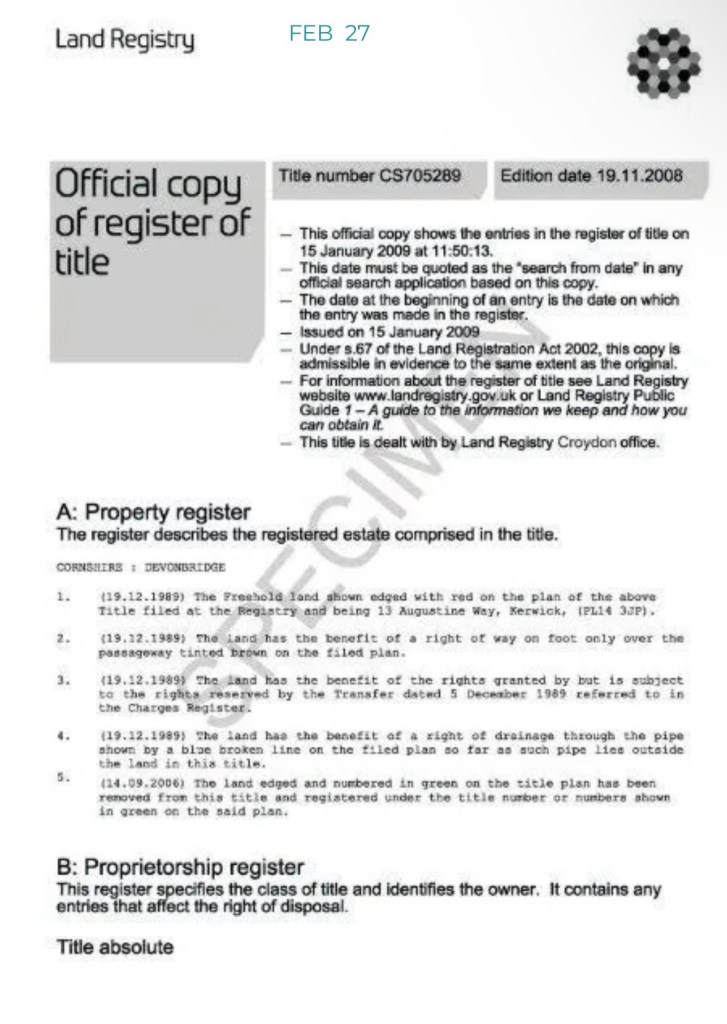
In 1925, while Britain was still recovering from one war and quietly preparing for the next, its legislators decided that land law had become an expensive medieval farce. The result was a cluster of statutes, most notably the Land Registration Act 1925, working in tandem with the Law of Property Act 1925, that performed a quiet but decisive act of administrative hygiene. They did not nationalise the soil. They did not turn every landowner into a tenant of the state. They simply made the register the master of the title, and the process of dealing with land a matter of bureaucracy rather than political favour or ancestral archaeology.
The contrast with Nigeria’s Land Use Act of 1978 is almost comic in its severity.
Britain’s Administrative Cure
Before 1925, English conveyancing required a buyer to chase a chain of paper deeds back through decades, praying that no forgotten equitable interest or missing seal would emerge like a ghost from the attic. The 1925 reforms reduced legal estates to two (freehold and leasehold), introduced overreaching so that beneficial interests under trusts stayed behind a “curtain,” and made registration of title the primary mechanism of ownership. Once land was on the register, the state guaranteed the title. A purchaser could largely rely on what the register said. Investigation of the full historical chain became largely unnecessary.
Registration itself was designed as a purely administrative function. HM Land Registry (and its predecessors) processed applications according to rules. There was no requirement that a Cabinet minister, a local politician, or anyone with competing political priorities personally approve every transfer, mortgage, or lease. The system expanded gradually, compulsory on trigger events such as sale, until today roughly 85–90 per cent of land in England and Wales is registered, with a target of completing the rest. The economic effect has been straightforward: secure, marketable titles that banks will accept as collateral without lengthy due-diligence theatre. Land became liquid capital rather than a semi-frozen asset. Mortgages flowed. Investment followed. Transaction costs fell. The property market, for all its other modern pathologies, was not permanently obstructed by the personal availability of a single signature.
Nigeria’s Political Choke-Point
Nigeria’s 1978 Act took the opposite road. It vested radical title in the state governor as trustee. Citizens hold only rights of occupancy. Alienation (sale, mortgage, gift) requires the governor’s consent. In practice this consent has often been treated as a discretionary political act rather than a time-bound administrative certification. Files accumulate. Competing demands intervene. The economic purpose of title, turning land into bankable collateral, is delayed or diluted. Certificates of Occupancy themselves sometimes rest on incomplete verification trails. The result is precisely the vacuum described in the earlier piece: when the official path becomes unreliable or glacially slow, people invent workarounds. Historical weight, oral tradition, and the continued productivity of a monarch who died in the same year the Act was born become rational adaptations.
Britain’s system was built to remove friction so that the market could function. Nigeria’s system, whatever its original egalitarian intentions, introduced a structural friction point at the apex of the state. One is administrative; the other remains, in critical respects, political.
The Economic Difference
Secure, easily transferable title is not a technical nicety. It is the difference between dead capital and living capital. In the British model, a registered title can be mortgaged, sold, or used as security with relative confidence and speed. The register provides the mirror; the state provides the insurance; the process is bureaucratic rather than discretionary. In the Nigerian model, the governor’s pen can become both the most powerful and the most elusive instrument in the transaction chain. Every month of delay is a month in which that asset generates nothing for its owner or the wider economy. Banks grow cautious. Investors demand discounts or walk away. Informal and semi-formal arrangements proliferate, including, in some places, the continued appearance of signatures from beyond the grave.
The 1925 reforms did not eliminate all complexity or all disputes. They did, however, treat registration as an administrative public service whose purpose was to facilitate economic activity rather than to centralise political control. Nigeria’s Act treated land as a resource to be managed through the governor’s trust, and in doing so created a chokepoint that the living have sometimes found harder to navigate than the dead.
Until consent is converted from discretionary favour into mandatory administrative process, until the register (or its digital equivalent) becomes the reliable mirror rather than one more contested document, and until the system is designed to unlock capital rather than ration signatures, the anomalies will continue. The British experience of a century ago suggests that land administration works best when it is boring, rule-bound, and subordinate to the needs of the market. Anything more dramatic risks leaving the living to compete with the ghosts for productivity.
 Centre for Nigeria Progress