

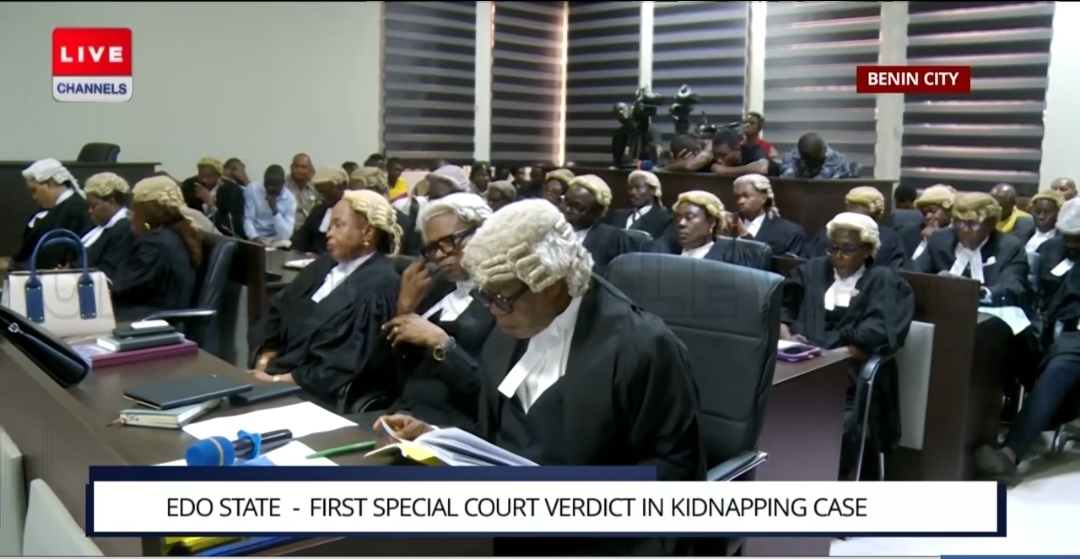
There is an old legal maxim that justice must not only be done, but must also be seen to be done. Somewhere between Osadebe Avenue and King’s Square, however, that venerable principle was evidently fed into a shredder, doused in kerosene, and traded for prime-time television ratings.
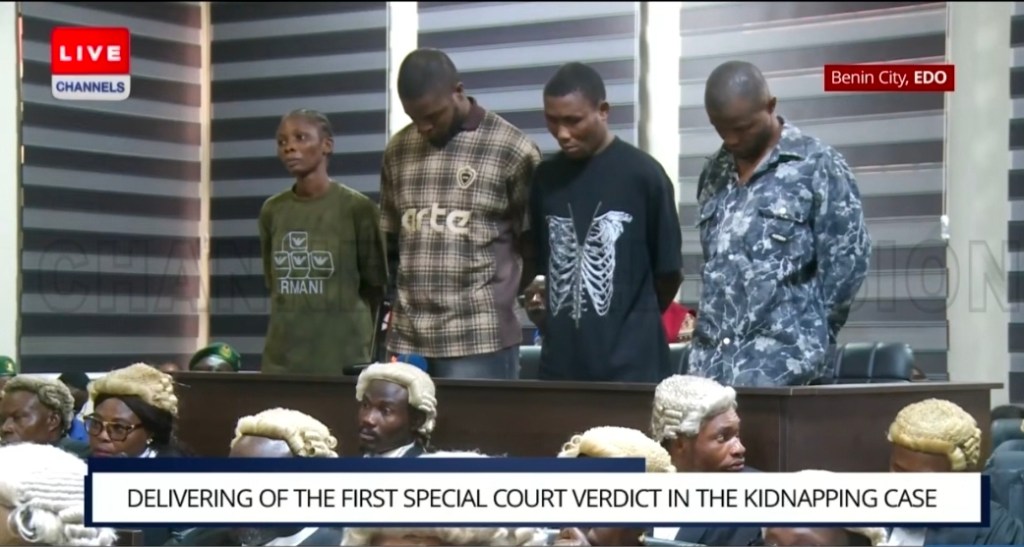
Today in Benin City, the curtain rose on the climax of a play whose script was published weeks before the actors took their marks. The “Special Criminal Court” delivered its verdict on a cohort of alleged kidnappers. Convictions rolled off the bench, and with them came the ultimate sanction: death by hanging or, in a bizarre nod to statutes written for a parallel universe, lethal injection.
On paper, the state was asserting the majesty of the law. In practice, the proceedings had all the constitutional sanctity of a medieval pageant staged for applause.
The Executive as Inquisitor, Judge, and Executioner
To understand the sheer absurdity of today’s sentencing, one must rewind to the genesis of this legal circus.
Long before evidence was weighed, witnesses were sworn, or cross-examinations occurred, the executive branch had already held court.
The Governor had personally conducted an interrogation of the suspects in front of rolling cameras. In that televised masterclass of constitutional overreach, the verdict was rendered, the venue for execution selected, and the punishment settled. His Excellency promised the cameras that the men would face their end right in downtown Benin City at King’s Square, assuring the public that his signature on their death warrants would dry before the court clerks could file the paper.
In one theatrical sweep, the presumption of innocence was relegated to an irritating technicality. Why bother with the cumbersome friction of trial procedure when the Chief Executive can simply play detective, prosecutor, and town executioner before the 7:00 PM news?
Judicial Alchemy: Turning a Court into a “Tribunal”
Having preempted the judgment, the executive turned to the mechanics of the trial. The Governor issued marching orders to the Chief Judge of Edo State to create a “Special Kidnapping Tribunal.”
There was, of course, a minor constitutional snag: the Chief Judge has no legal authority to create a court.
Under Section 6 of the 1999 Constitution (as amended), the power to establish courts of superior or inferior jurisdiction belongs strictly to the legislature. A Chief Judge cannot conjure a tribunal out of thin air simply because Government House has promised a Roman spectacle at King’s Square.
Faced with this constitutional wall, the judiciary engaged in administrative sleight of hand. Rather than decline an improper executive directive, the leadership designated an existing High Court as a “Special Kidnapping Court.” Slapping a new moniker on a courtroom door does not make it a specialized constitutional tribunal, but in the theatre of performative governance, rebranding is cheap and speed is everything. The message was unmistakable: the machinery of justice had been requisitioned to deliver a pre-ordered outcome on an expedited timetable.
The Lethal Injection Delusion
The theatricality reached its crescendo when the presiding judge pronounced sentence: Marvelous Isaac, Wisdom Michael, and their co-defendants were sentenced to death by hanging “or through the administration of a lethal injection.”
It is a curious bit of statutory prose, borrowed from the Administration of Criminal Justice framework, intended to lend an air of sterile, clinical modernity to capital punishment. But reciting it in a Nigerian courtroom is an act of pure legal ventriloquism.
Nigeria does not possess a single functioning execution chamber equipped for lethal injection. The Nigerian Correctional Service has no medical protocols for it, no pharmaceutical supply lines to obtain the regulated barbiturates and paralytics required, and no licensed medical personnel willing to risk their professional oaths to serve as executioners.
The judge seemed to recognize the farce in real time. Having dutifully mumbled the statutory nod to intravenous chemicals, the bench immediately corrected course and reverted to the grim, terrestrial certainty of the penal code: “you shall be hanged by the neck till you are dead.”
The law pretends to be a clinical European hospital; the court remembers it only has the gallows.
The Dangerous Mirage of “Quick Justice”
Kidnapping is a scourge that has terrorized commuters on the Benin-Auchi corridor, extorted families, and broken the social fabric of Edo State. The public’s fury is legitimate, and their craving for swift accountability is completely understandable.
Yet cheering on executive interrogations and cobbled-together special courts is a dangerous bargain. When an executive can publicly designate guilt, decree public executions in city squares, and dictate trial speeds to a compliant judiciary, the rule of law ceases to protect citizens, it becomes a weapon of sovereign whim.
Furthermore, it is a hollow bluff.
Governors across Nigeria have spent the last two decades refusing to sign death warrants, leaving hundreds of convicts to languish on death row while crime figures climb unabated. An executive who promises public executions at King’s Square is not solving the structural collapse of local police intelligence; he is serving bread and circuses to distract from it.
True security is achieved through meticulous investigative police work, forensic tracking, and independent judicial scrutiny that can survive appellate review without collapsing under the weight of procedural errors.
Parading suspects on television and ordering bespoke tribunals may satisfy the daytime audience, but it does not deter crime. It merely proves that when the state decides to put on a show, justice is the first casualty sacrificed on the stage.

