There are speeches that belong to history.
And there are speeches that history refuses to leave alone.
As Nigeria prepares to mark another Independence Day on 1 October, I have been reading a speech delivered on 31 December 1983 by a young Brigadier, Sani Abacha, announcing the overthrow of the democratically elected government of President Shehu Shagari.
It is an extraordinary document.
Not because of what Abacha subsequently became. That is another and considerably darker chapter of Nigerian history. It is extraordinary because, forty-three years later, parts of the diagnosis sound disturbingly contemporary.
Abacha told us:
“You are all living witnesses to the great economic predicament and uncertainty, which an inept and corrupt leadership has imposed on our beloved nation…”
He continued:
“Our economy has been hopelessly mismanaged; we have become a debtor and beggar nation.”
Then came the catalogue: food becoming unaffordable, hospitals without drugs and equipment, a deteriorating educational system, unemployment, unpaid salaries, corruption, indiscipline, waste and the proliferation of public appointments despite economic hardship.
And then the punchline:
“Yet our leaders revel in squandermania, corruption and indiscipline…”
The speech was not merely an indictment of a government. It was presented as an indictment of a political system.
And that is where the ghost of 1983 becomes uncomfortable.
The Independence Day paradox
Nigeria became independent on 1 October 1960.
The official historical record describes that day as the moment Nigeria became a sovereign nation, replacing colonial rule with self-government. The Independence Constitution established a federal system, with regional governments possessing substantial autonomy.
Tafawa Balewa, speaking at the independence ceremony, expressed the hope that Nigeria’s nation-building would proceed on “firm foundations”.
Sixty-six years later, the question is not whether Nigeria is legally independent.
It obviously is.
The more awkward question is what we have done with the independence we inherited.
Independence was supposed to transfer political authority from London to Nigerians.
It did.
But independence did not automatically transfer wisdom, accountability, institutional discipline or economic competence.
Those had to be built.
And that is where the our story becomes considerably more complicated.
The ghost of 1983
Abacha’s broadcast was made to justify the military overthrow of an elected government.
That distinction must never be lost.
The military did not discover democracy’s superior replacement in 1983. It suspended the Constitution, terminated the Second Republic and seized political power.
The historical irony is therefore deliciously Nigerian.
A military officer complained about corruption, indiscipline, economic mismanagement and political irresponsibility.
The military then governed.
And we subsequently experienced more coups, more military governments and, under Abacha himself, one of the most notorious periods of authoritarian rule in the country’s history.
The lesson is not that the military was right.
The lesson is that a correct diagnosis does not make the doctor competent, and certainly does not make the coup legitimate.
That distinction matters.
Because we has repeatedly confused the diagnosis of a national problem with the legitimacy of whoever claims to possess the cure.
Replace 1983 with 2026
Now read the speech again.
Not as a military manifesto.
Read it as a checklist.
Food?
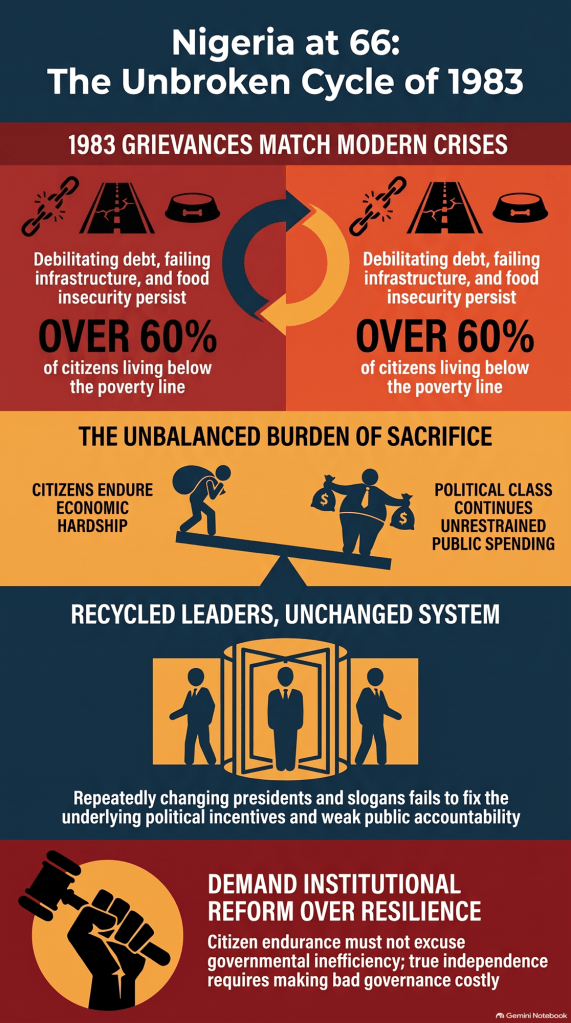
Poverty remains widespread and food inflation continues to hit poorer households particularly hard. More than 60 percent of us lived below the national poverty line in 2025.
Employment?
Nigeria adds millions of people to its labour force every year, while weak job creation remains a major structural problem.
Debt?
The Debt Management Office continues to publish substantial federal and total public debt obligations, including its June 2026 debt figures.
Poverty and food insecurity?
63 percent of us are living below the national poverty line and estimated that 27 million people had faced food insecurity in late 2025.
Healthcare, education and infrastructure?
These remain among our country’s persistent development challenges, alongside insecurity, electricity, transport and logistics deficiencies.
There is, of course, another side to the story.
A serious examination of Nigeria cannot simply turn every economic statistic into an indictment of government. Economic reform is painful, inflation can have multiple causes, and governments inherit structural problems that cannot be repaired overnight.
But neither should macroeconomic improvement become an excuse for ignoring what citizens experience at the kitchen table.
GDP is not a loaf of bread.
A stronger balance sheet does not automatically mean a stronger household.
The most haunting sentence
For me, the most haunting part of Abacha’s speech is not just “debtor and beggar nation”.
It is the reference to leaders who “revel in squandermania, corruption and indiscipline” while we ordinary Nigerians are being asked to endure hardship by Bola Ahmed Tinubu and his APC.
Because this is where the problem becomes institutional rather than merely economic.
Every Nigerian government eventually discovers the vocabulary of sacrifice.
The people must tighten their belts.
The economy requires difficult decisions.
There is no money.
Subsidies are expensive.
Government must cut expenditure.
Citizens must make sacrifices for the future.
All of these arguments can sometimes be economically legitimate.
But there is a constitutional and moral question lurking underneath:
Who is making the sacrifice?
If citizens are being told that the national cupboard is bare, they are entitled to ask why the political kitchen never seems to run out of money.
That was the question hiding inside Abacha’s 1983 broadcast.
It remains the question today.
The Nigerian disease is older than any government
There is a temptation to make every Independence Day a referendum on the government of the day.
That is too easy.
Nigeria’s problems are older than the present administration.
They are older than the Fourth Republic.
Older than the Second Republic.
Older even than military rule.
We have repeatedly changed governments without changing the incentives that govern government.
We change presidents.
We change parties.
We change slogans.
We change economic programmes.
We change ministers.
Sometimes we even change the name of the programme while keeping the same policy in a freshly printed folder.
But the underlying political economy survives.
Public office remains too valuable.
Accountability remains too weak.
Institutions remain vulnerable to political interference.
Government remains excessively centralised.
Political patronage remains deeply embedded.
And the citizen remains strangely powerful once every four years and remarkably powerless in between.
That is not merely a failure of one administration.
It is a failure of political development.
Independence is not a birthday
Perhaps this is what Independence Day should mean in 2026.
Not another ceremony.
Not another parade.
Not another collection of flags, fireworks, schoolchildren and speeches about Nigeria’s greatness.
Nigeria certainly has much to celebrate.
It has survived civil war, military dictatorship, economic crises, religious and ethnic tensions, terrorism, institutional failures and repeated political disappointments.
The country has also produced extraordinary entrepreneurs, professionals, artists, academics, scientists and citizens who continue to build lives and businesses despite the obstacles placed in their path.
The Nigerian people have repeatedly demonstrated resilience.
But resilience should not become government’s favourite excuse.
A people should not have to be endlessly resilient because their government is endlessly inefficient.
Survival is not the same thing as development.
And patriotism should not require pretending that failure is success.
The uncomfortable lesson of Abacha’s speech
There is another reason we should read that 1983 broadcast carefully.
Abacha’s words remind us that Nigeria’s political class has been making essentially the same promises for generations.
In 1983, the military claimed it had come to rescue Nigeria from corruption and economic mismanagement.
In 1985, another military government overthrew that government.
In 1993, another military intervention followed.
In 1999, democracy returned.
Since then, Nigerians have repeatedly gone to the polls in search of better government.
Yet the vocabulary of national crisis has remained remarkably durable.
That should make us pause.
Perhaps the Nigerian problem is not simply that we occasionally elect the wrong people.
Perhaps the deeper problem is that our political institutions have not yet become sufficiently strong to make bad government expensive and good government rewarding.
That is the real Independence project.
Not just changing the occupant of Aso Rock as we must on this occasion.
Changing the relationship between power and accountability.
And so, on Independence Day…
On 1 October 1960, the Union Jack came down and the green-white-green went up.
That was political independence.
The challenge since then has been to make independence meaningful in the daily lives of Nigerians.
Independence should mean that a Nigerian can eat without fear of tomorrow’s price.
That a child can attend a decent school without requiring a parent to sell a kidney, a generator and possibly the family dog.
That a sick person can enter a public hospital and find more than a building, a queue and a prescription to buy the missing medicine outside.
That a young graduate can look for work without discovering that the most reliable career path is political networking.
That public servants are paid on time.
That public money is treated as public money.
That government appointments are made for competence rather than political accommodation.
That elections are genuinely about choosing governments rather than merely choosing which political network will control the government.
And, perhaps most importantly, that citizens do not have to wait for another generation to hear the same speech.
Because there is something almost tragic about celebrating independence while recycling the complaints of the past.
Nigeria is 66.
Abacha’s 1983 speech is 43 years old.
The words are old.
The country is older.
The problems, however, remain uncomfortably young.
Perhaps the real Independence Day question is therefore not What have we achieved since 1960?
It is:
Why, after 66 years of independence, are we still arguing about problems that were already being used to justify overthrowing governments in 1983?
That is not a question for the military.
It is a question for democracy.
And this time, the answer must come from the citizens.