


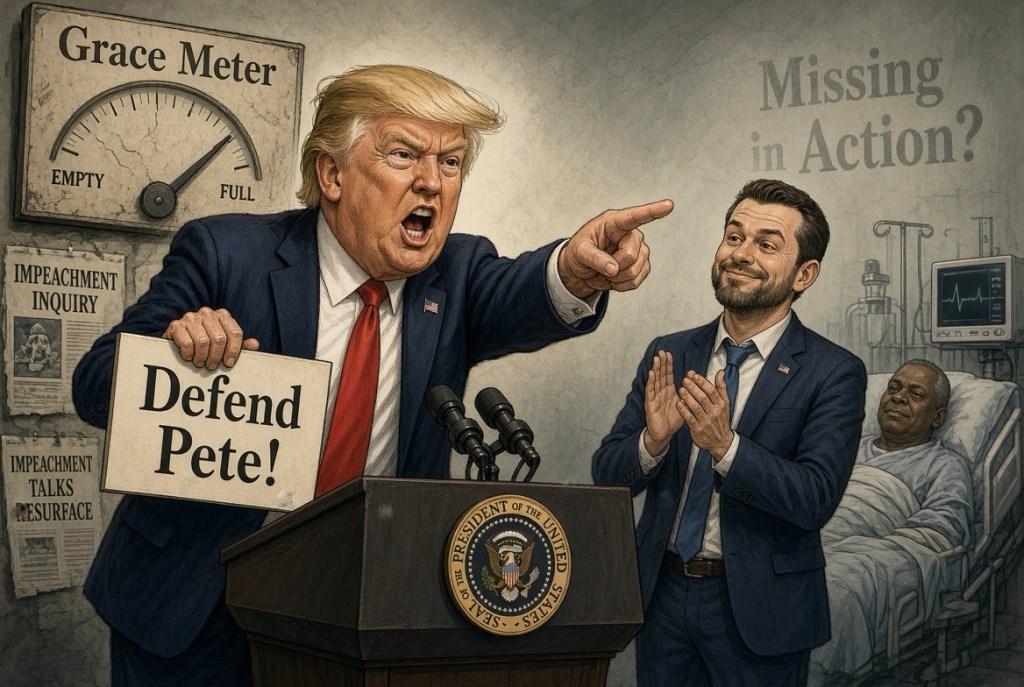
Trump’s chronic shortage of grace is not a glitch. It is the operating system. The man treats basic human decency the way most people treat leftover brussels sprouts: with suspicion, then disposal. But even by his standards, the latest performance deserves a special citation for tastelessness.
General Lloyd Austin, Biden’s Defense Secretary, spent roughly two weeks in hospital in early 2024 after complications from prostate cancer surgery. The Pentagon’s handling of the disclosure was clumsy; the White House and Congress were kept in the dark longer than they should have been. Fair enough to criticize the opacity. What is not fair—what is, in fact, pure gutter politics—is to treat a man’s medical crisis as a punchline years later when your own Defense Secretary faces heat.
Enter the impeachment articles against Pete Hegseth. Congressman Thomas Massie dropped a set of charges, and Trump, never one to miss a chance to play the aggrieved protector, reached for the nearest contrast. Why, he asked, was Lloyd Austin never impeached after he “went missing for two weeks”? The implication was clear: if we’re impeaching people for questionable judgment, start with the guy who had the bad manners to get sick and not send out a press release on schedule.
This is the presidential version of kicking a man while he’s on a gurney. Austin’s absence was medical, not a weekend in the Bahamas with a burner phone. Turning a cancer-related hospitalization into a “missing in action” jab is the sort of rhetorical move that makes civilized people check whether the speaker still has a pulse of ordinary empathy. It is crass. It is inelegant. It is, in the precise language of the moment, unbecoming of the office.
And no, this is not a sudden character development. The pattern is long and consistent. When former FBI Director Robert Mueller died earlier this year, Trump’s response was not restraint or even silence. It was celebration: “Good, I’m glad he’s dead. He can no longer hurt innocent people!” The score-settling continued past the grave. Grace, in this worldview, is optional equipment, and the default setting is scoreboard politics.
Defending Hegseth is one thing. Doing it by dragging a predecessor’s illness into the mud is another. It reveals a leadership style that confuses toughness with the inability to distinguish between policy disagreement and human frailty. Presidents are allowed to be partisan. They are not required to be small.
The office still carries some residual expectation of elevation, however battered. Using a man’s hospital stay as a political prop—and treating a former public servant’s death as an occasion for score-settling—does not elevate anything. It just confirms what many already suspected: for some people, the only thing lower than the bar is the person still trying to limbo under it.

