

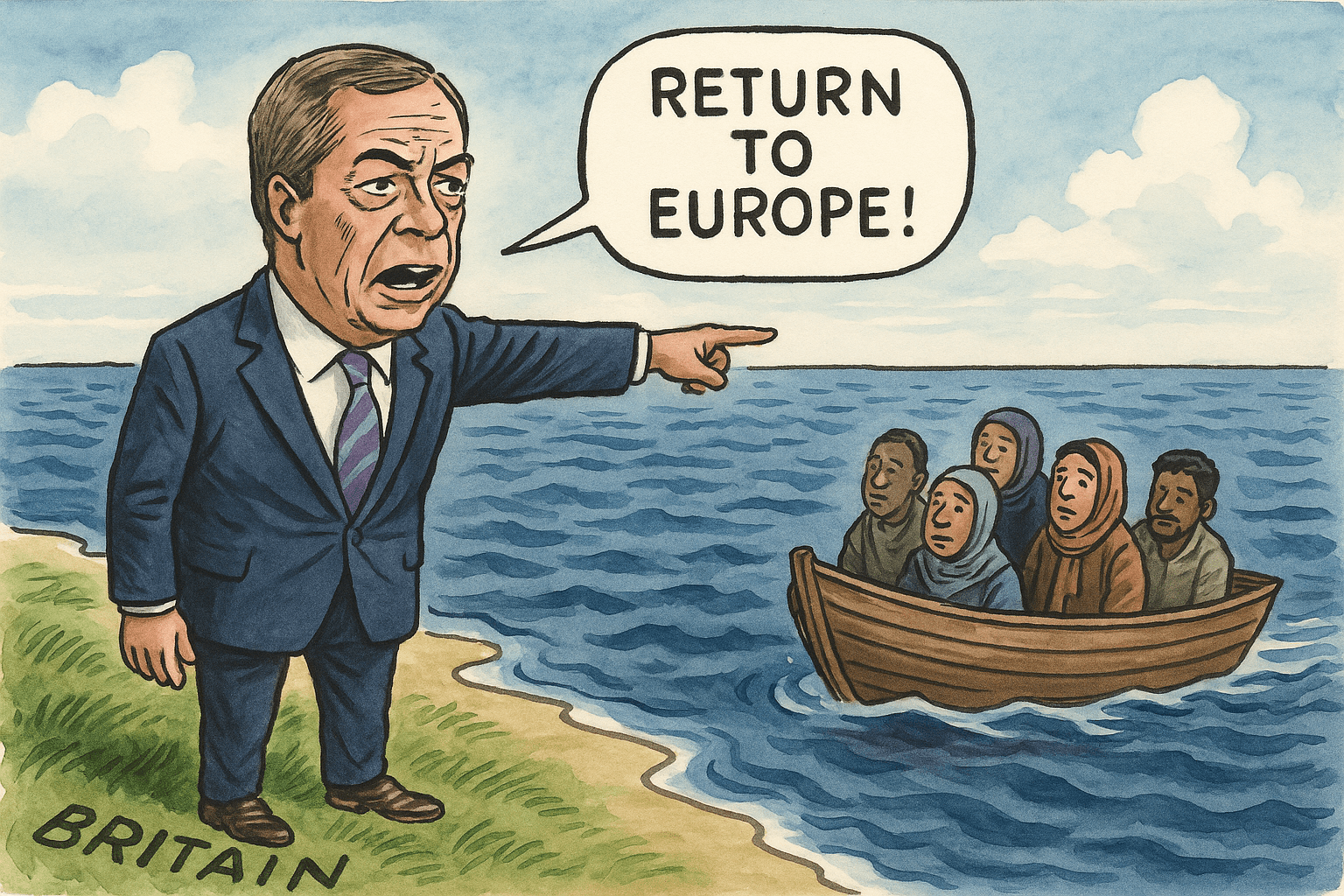

The Boats That Never Sailed
Every crisis deserves a prompt, and the far right is nothing if not punctual. Five men were arrested early on a Sunday near RAF Fairford, the Gloucestershire base from which US B-1 bombers have flown missions against Iran, after a local farmer noticed three white vans heading towards it. Bomb disposal robots trundled about the woods, and dozens of villagers were bundled out of their homes. Nigel Farage, meanwhile, had already left the building, intellectually speaking.
He had linked the incident to Iranian agents arriving in small boats, before police confirmed that all five men were British nationals from London. The boats, it seems, were the one part of the story that never left the harbour. Farage could scarcely have done better if he had summoned Iran’s Revolutionary Guard himself and asked them to arrive by dinghy. One imagines a Channel crossing on which the migrants are all in their twenties, hold British passports and got a lift from Camden.
The Secretary of State Weighs In
Across the Atlantic, Marco Rubio took the stage. He went on Fox News to say the affair “clearly involves the hands of a foreign actor,” though he did not name a country. It is a wonderful phrase, since it commits to nothing and implies everything. It is the diplomatic equivalent of a man telling you he knows who ate your sandwich but cannot say who.
I owe Mr Rubio some fairness here. Counter-terrorism police did say they were examining whether the men were acting for a foreign state, and Iran’s Guard Corps had said in July that the base was a legitimate target. That is a serious line of inquiry, and it is not closed. But an inquiry is not a conclusion, and a hunch on television is not evidence. This is the pattern we watched in 2003, when Iraq was quietly slid into the frame for the September 11 attacks, and I am unwilling to call it a coincidence. The sequence is the same: first the conclusion, then the search for a fact to hang it on.
Reality Files a Late Response
Then the police spoiled everything with facts. Officers said no improvised explosive devices were found in the three vans, though a quantity of petrol was recovered. All five men were released on bail, which left President Trump “surprised”. One does not need a law degree to note that bail, on its own, is no proof of innocence, and I have one anyway. The investigation continues, and petrol in a van is not a character reference. But police do not usually bail men they consider an imminent bomb threat, and the gap between “terror plot” and “some blokes with petrol and dodgy van markings” is now wide enough to drive a fuel tanker through.
Even the vans supplied a subplot. They bore the logo of a real fuel transport company, which denied owning them, and this fed local speculation that the men were fuel thieves. If so, then Britain’s great terror scare may turn out to be a very expensive petrol theft, with a bomb disposal robot and an American Secretary of State attending as guests of honour.
Never Waste a Crisis
The lesson is not that no threat exists. Perhaps one does, and I hope British investigators are thorough. The lesson concerns the reflex, which reached for foreigners and boats before the facts had put their boots on. The far right treats a crisis like a buffet that has to be cleared before the food goes cold, and the facts are always stuck in the queue behind it.
When the story turns out to be about British men from London, the boats quietly vanish from the narrative and nobody apologises. The next time a van appears near a base, remember the order of events: the tweet came first, the evidence came later, and the apology, as usual, is still in the post.


Fairford and the B-1s are the visible tip. The real leverage is the sanctions ledger and the blockade on the strait. Bombs make headlines, tankers and insurers move the oil price. The quiet enforcement is what hurts Tehran.
LikeLiked by 1 person
Remote Reply
Original Comment URL
Your Profile
Why do I need to enter my profile?
This site is part of the ⁂ open social web, a network of interconnected social platforms (like Mastodon, Pixelfed, Friendica, and others). Unlike centralized social media, your account lives on a platform of your choice, and you can interact with people across different platforms.
By entering your profile, we can send you to your account where you can complete this action.