

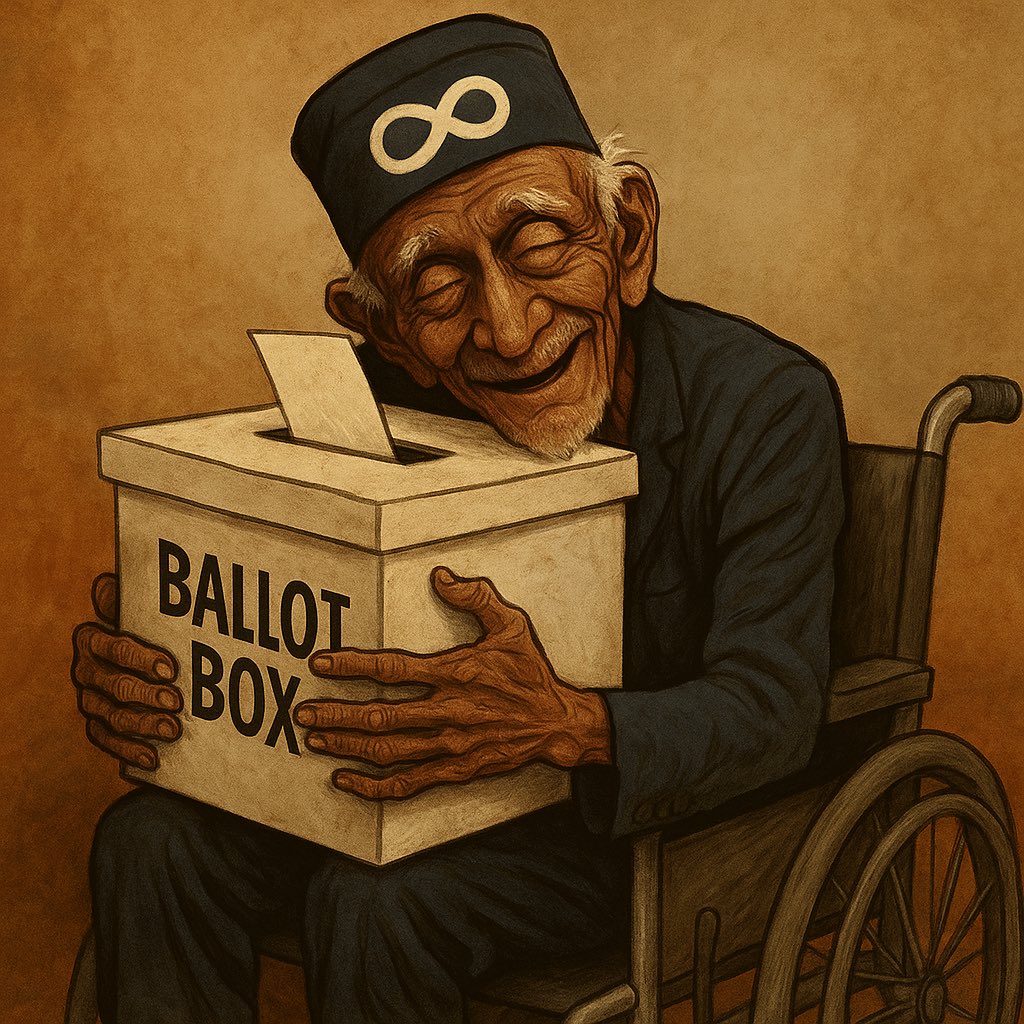
Nigeria has seen this political movie before. The costumes have changed, the actors have acquired new titles, and the language of justification has become more sophisticated. But beneath the democratic vocabulary lies a familiar ambition: the concentration of political power in the hands of one man, the weakening of opposition, and the conversion of a multiparty democracy into a political arrangement in which everybody is expected to agree with the president.
General Sani Abacha attempted to achieve this through a military dictatorship preparing to wear civilian clothes. President Bola Ahmed Tinubu operates under a constitutional democracy, with elections, political parties, courts and a legislature. The distinction matters. Yet the similarities in the political methods employed to pursue overwhelming political dominance deserve serious scrutiny.
Abacha wanted to become a civilian president without a meaningful opponent. Tinubu, approaching the prospect of a second term, faces a different constitutional environment but appears determined to build a political structure in which opposition becomes increasingly difficult, fragmented and, ideally for the ruling party, irrelevant.
The central question is not whether Nigeria has formally returned to military rule. It has not. The question is whether the institutions of democracy can survive when the governing party begins to treat political competition as an inconvenience to be eliminated rather than a constitutional right to be protected.
Abacha’s Five Fingers
General Sani Abacha’s political experiment remains one of the most extraordinary episodes in Nigeria’s constitutional history.
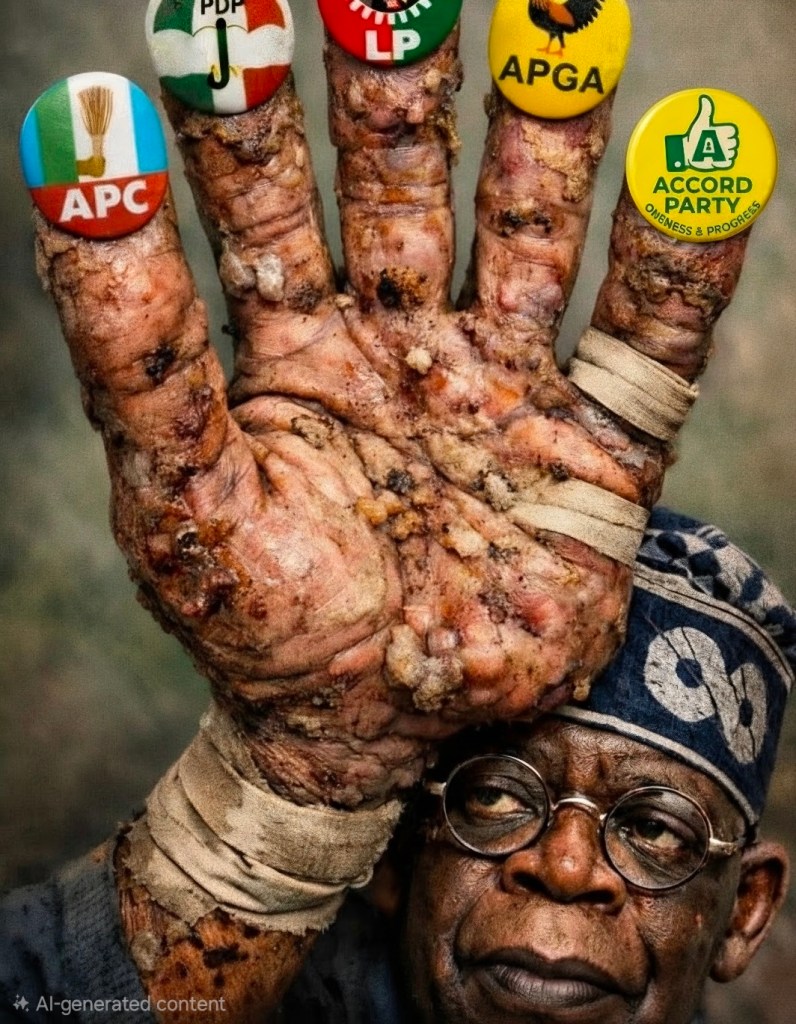
After seizing power in November 1993, Abacha ruled through a military government. In 1998, as his transition programme advanced, five political parties emerged as officially registered participants in the process. All five eventually adopted Abacha as their presidential candidate, leaving Nigerians with the spectacle of multiple parties competing to demonstrate their loyalty to a single man.
The parties were the United Nigeria Congress Party (UNCP), the National Centre Party of Nigeria (NCPN), the Democratic Party of Nigeria (DPN), the Grassroots Democratic Movement (GDM) and the Committee for National Consensus (CNC).
Their unanimous endorsement of Abacha gave rise to the memorable description of the parties as the five fingers of a leprous hand. The image was devastating in its simplicity. Five fingers might suggest diversity, but when every finger belongs to the same hand and answers to the same command, the appearance of plurality conceals the reality of political uniformity.
A political party is supposed to offer an alternative vision of government, organise competing interests and provide voters with a meaningful choice. Under Abacha’s transition arrangement, the five parties performed the opposite function. Their apparent diversity served to legitimise a predetermined political outcome.
The transition collapsed before the proposed civilian presidency could materialise. Abacha died suddenly on 8 June 1998, and the political project died with him.
The lesson, however, survived its architect. A country can have several political parties without having genuine political competition. The number of parties on the ballot tells us little if they all serve the same political master.
The Businessmen Behind the Political Machine
Political power does not sustain itself through ideology alone. It requires money, networks, patronage and people capable of moving resources between the worlds of business and government.
Abacha’s regime became notorious for the scale of the public funds subsequently traced to accounts and assets associated with him and his associates. The recovery of Abacha-linked assets across several jurisdictions demonstrated how public office, private intermediaries and international financial structures could become intertwined.
Among the prominent Nigerian-Lebanese business figures associated in public reporting with Abacha-era financial dealings was Gilbert Chagoury. The Chagoury brothers, Gilbert and Ronald, have maintained significant business interests in Nigeria across successive administrations. Alhaji Muhammadu Indimi and other wealthy businessmen have also featured in discussions of the relationships between Nigerian political power and private capital, although their respective roles and relationships should not be casually conflated.
The point is not that every businessman who has dealt with successive Nigerian governments is guilty of wrongdoing. Businessmen engage governments because governments award contracts, regulate industries and control access to valuable opportunities. Such relationships are not, by themselves, evidence of criminality.
The more important question is one of accountability: who finances political power, who benefits from its exercise, and what safeguards prevent public resources and public policy from becoming instruments of private influence?
When powerful commercial interests maintain access to successive administrations, regardless of who occupies the presidential residence, Nigerians are entitled to ask whether the continuity reflects ordinary commercial relationships or a deeper political economy in which access to the state is more valuable than competition in the marketplace.
This question is particularly relevant to the Tinubu presidency. Figures associated with Nigeria’s established business and political networks continue to operate across administrations. The Chagoury business interests, for example, have remained prominent in Nigeria during Tinubu’s presidency.
That continuity invites scrutiny. It does not, without evidence, establish that the individuals concerned are performing the same functions they allegedly performed under Abacha. The distinction between documented fact, political inference and allegation must remain clear. Otherwise, criticism of elite power risks becoming the very thing it accuses government of being: a substitute for evidence.
Nevertheless, the broader pattern is unmistakable enough to warrant examination. Nigerian politics has repeatedly demonstrated how financial power, political patronage and personal networks can survive changes in constitutional arrangements. Military rule may disappear, but the networks that thrive around concentrated state power can prove remarkably adaptable.

