

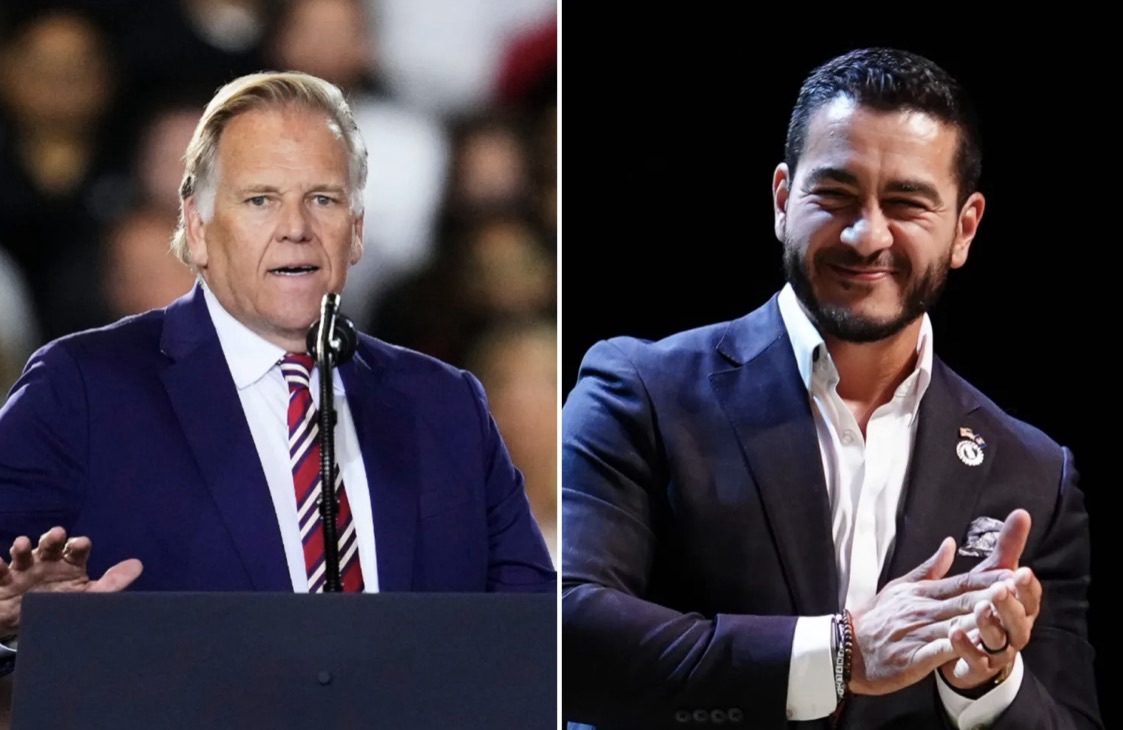
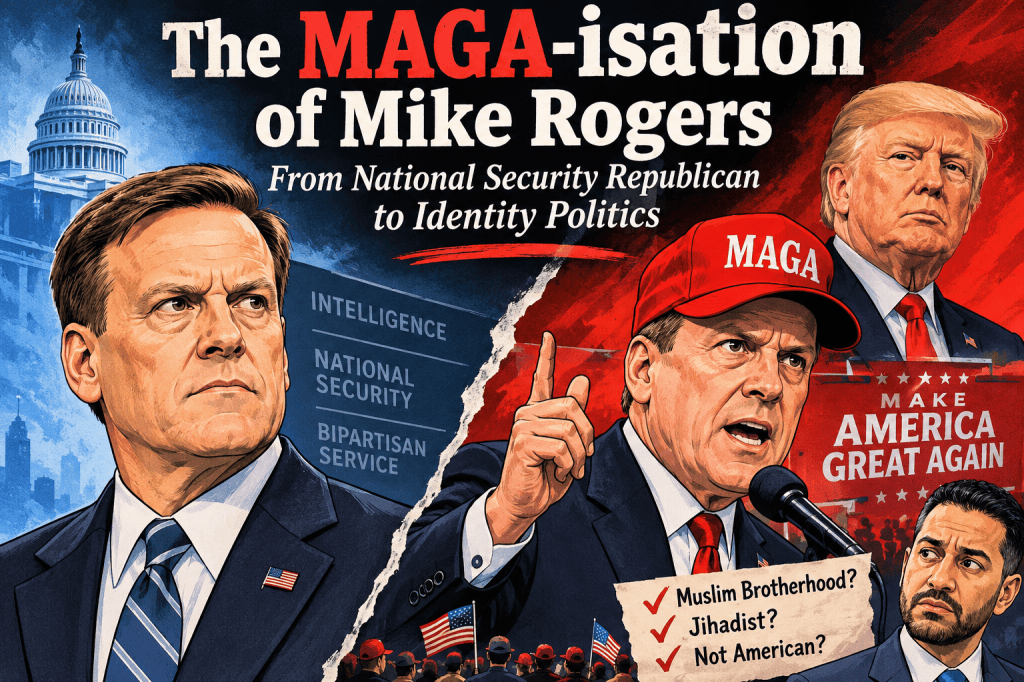
There was a time when Mike Rogers occupied a particular place in my understanding of American politics. He appeared to belong to that category of Republican politicians who, whatever their ideological differences with Democrats, understood that national security was too serious a business to be reduced to partisan theatre. He was measured, disciplined, informed and, above all, appeared to be a man who understood the difference between intelligence work and political propaganda.
I first became conscious of Rogers during the George W. Bush presidency. He subsequently became a familiar face in American national security commentary, particularly after leaving Congress. He was the sort of Republican whose interventions appeared informed by professional experience rather than the daily requirements of partisan political combat.
That impression makes his current political transformation particularly interesting.
The MAGA-isation of Mike Rogers raises a question that goes beyond the fortunes of one Republican politician: what happens when a political movement gradually changes the standards by which its adherents conduct themselves? Does the politician reshape the movement, or does the movement eventually reshape the politician?
In Rogers’ case, the contrast is becoming difficult to ignore.
Who is Mike Rogers?
Michael J. Rogers is an American Republican politician from Michigan, born on 2 June 1963.
His professional and political background is worth recalling:
- Education: Graduated from Adrian College in 1985 with a Bachelor of Science degree.
- Military service: Served in the United States Army between 1985 and 1989.
- Federal law enforcement: Served as an FBI Special Agent from 1989 to 1994, working on organised crime and public corruption.
- Michigan State Senate: Served from 1995 to 2000, becoming Majority Floor Leader.
- United States House of Representatives: Represented Michigan’s 8th Congressional District from 2001 to 2015.
- House Intelligence Committee: Chaired the House Permanent Select Committee on Intelligence between 2011 and 2015.
- Post-Congressional career: Became a national security commentator, consultant and cybersecurity professional.
- 2024: Contested the Michigan Senate election but lost to Democrat Elissa Slotkin.
- 2026: Returned as the Republican candidate for the United States Senate in Michigan, with Donald Trump’s endorsement.
This is not an insignificant résumé. Rogers has experience in military service, federal law enforcement, intelligence oversight and elected public office. He has occupied positions where evidence, professional judgment and the protection of constitutional institutions ought to matter.
It is precisely this background that makes his present campaign conduct worthy of examination.
From intelligence to insinuation
The current Michigan Senate contest between Rogers and Dr Abdul El-Sayed has become an extraordinary demonstration of how identity can displace political argument.
El-Sayed is a physician, epidemiologist and former public health official. He is also a Muslim American of Egyptian heritage. His candidacy would, if successful, make him the first Muslim elected to the United States Senate.
Instead of concentrating exclusively on his opponent’s policies, qualifications, public record and political philosophy, Rogers has repeatedly attempted to associate him with the Muslim Brotherhood and Islamist extremism.
The most striking aspect of this campaign is that the allegations have not been supported by evidence establishing that El-Sayed is affiliated with the Muslim Brotherhood.
The controversy has centred partly on a 2012 open letter signed by El-Sayed and other Egyptian Americans expressing support for certain decisions taken by Egypt’s then newly elected president, Mohamed Morsi. Morsi was associated with the Muslim Brotherhood.
But supporting a political statement about an Egyptian president is not evidence of membership of, or allegiance to, the Muslim Brotherhood.
Indeed, the distinction between political association, ideological sympathy and organisational membership is elementary. It should be particularly familiar to someone whose professional background includes intelligence and law enforcement.
There was also the controversy over whether El-Sayed had disavowed the Muslim Brotherhood. Rogers claimed that he had not. However, video footage examined by PolitiFact showed El-Sayed expressly responding, “Sure, yeah, absolutely,” when asked whether he would disavow the organisation.
The question then becomes: what exactly is Rogers seeking to establish?
Is he examining an opponent’s demonstrable political associations, or is he asking voters to treat Muslim identity itself as a reason for suspicion?
These are very different propositions.
The Trump effect
The influence of Donald Trump on this campaign cannot be ignored.
Trump has amplified the allegations against El-Sayed, describing him as a jihadist and making remarks about the prospect of a Muslim entering the United States Senate. Such rhetoric has attracted condemnation, including from the NAACP, which described the attacks surrounding the Michigan contest as racist and divisive.
Rogers has also agreed with a social media post characterising El-Sayed as a terrorist.
This is where the political transformation becomes particularly revealing.
The Republican Party has always contained different traditions: conservative constitutionalism, business conservatism, national security internationalism, religious conservatism and, more recently, the populist nationalism associated with Trump.
These traditions have not always been comfortable bedfellows.
The traditional national security Republican might disagree profoundly with a Muslim candidate’s political positions, but would ordinarily be expected to demonstrate the disagreement through evidence, policy analysis and constitutional argument.
The MAGA political environment has introduced a different vocabulary. Allegiance, patriotism, immigration, religion and national identity are increasingly deployed as instruments of political suspicion.
In this environment, the question is no longer simply what a candidate believes or proposes to do. It becomes whether the candidate belongs to a group that can be presented as inherently suspect.
Rogers’ campaign raises the question of whether his earlier professional identity has been subordinated to the political requirements of the Trump movement.
The constitutional problem
America’s constitutional settlement was not constructed around the proposition that political office should be reserved for people of a particular religious persuasion.
Article VI of the United States Constitution expressly prohibits religious tests as a qualification for public office. The First Amendment protects the free exercise of religion and prohibits governmental establishment of religion.
These provisions are not decorative constitutional language. They reflect a fundamental understanding that citizenship and constitutional allegiance are not determined by religious identity.
A Muslim American does not have to establish his patriotism to a higher standard than a Christian American. Nor should an individual be required to answer for every organisation, political movement or government with which someone believes his religious or ethnic background might associate him.
The appropriate test is individual conduct.
If El-Sayed has made a statement or taken a position that conflicts with American constitutional principles, it is perfectly legitimate to examine and challenge it. If he has supported an organisation, that support can be investigated and discussed.
But the burden of proof cannot be replaced by innuendo.
There is also a wider historical irony. John F. Kennedy faced questions about whether his Catholic faith would compromise his loyalty to the American republic. His response in 1960 was a defence of the constitutional separation between religious identity and public responsibility.
More than six decades later, a Muslim candidate finds himself confronted with a remarkably familiar question.
America appears to have travelled a considerable distance technologically, but some of its political arguments are still waiting for an upgrade.
What happened to the national security Republican?
I do not suggest that Mike Rogers has abandoned every principle associated with his previous political career. Nor does his association with Trump automatically establish that he agrees with every position the President adopts.
Indeed, Rogers has occasionally departed from Trump on particular policy questions.
But political character is revealed not only by the positions one takes when circumstances are comfortable, but also by the standards one is prepared to abandon when political advantage beckons.
Rogers knows the difference between evidence and allegation. He knows the importance of intelligence verification. He knows that national security cannot function properly when suspicion substitutes for proof.
That is why his present approach deserves scrutiny.
A former chairman of the House Intelligence Committee should understand the dangers of turning religious identity into a proxy for national security risk. The intelligence community is supposed to investigate threats, not manufacture them from the religious identity of political opponents.
The tragedy of this transformation, if that is what we are witnessing, is not simply that another Republican has become aligned with Trump. It is that a politician whose public reputation was built partly on professional seriousness now finds himself participating in a political contest where insinuation about religious allegiance has become a central campaign instrument.
The MAGA-isation of American politics
The larger question is not whether Mike Rogers has become a different politician. Politicians change, parties evolve and political alliances are frequently transactional.
The more important question is what happens to institutions when politicians who once represented professional restraint begin to adopt the political vocabulary of identity-based suspicion.
MAGA is not merely a slogan or a red cap. It is a political culture in which personal loyalty to a leader, cultural grievance and the politics of national identity have acquired considerable importance.
The danger is that politicians who enter this environment may discover that the currency of political relevance is no longer the quality of their arguments, but their willingness to participate in its defining confrontations.
Mike Rogers once presented himself as a Republican whose experience in national security gave him a particular authority in public debate.
His present campaign invites a rather different examination.
Perhaps the most revealing question is not what Donald Trump has done to American politics, but what American politicians have been prepared to do to themselves in order to remain politically relevant within Trump’s movement.
For a man whose career was built around intelligence, the distinction between knowing something and merely suspecting it should not be difficult to understand.
And for a former chairman of the House Intelligence Committee, that distinction ought to matter rather more than a campaign slogan.
Lawson Akhigbe
lawakhigbe.com

