


Act I: The Wrong Ledger
Every year, the World Bank publishes a number, and every year Nigerians perform the same ritual of collective wincing. Some percentage of the population lives below some dollar-denominated line, and the commentariat obliges with the usual eulogies for a nation “blessed but cursed,” as though God’s geology department made a filing error somewhere around the Niger Delta. But this is the wrong ledger. It measures what is missing from our pockets while saying nothing of what has gone missing from our hearts.
Ghana, our garrulous neighbour and perennial older-sibling-by-comparison, is not a rich country. Its currency has had its own well-documented indignities. Its unemployment figures would not shame anyone into silence at a dinner party in Lagos. And yet Ghana has not produced, at scale, the particular species of moral vacancy that Nigeria now exports more reliably than crude oil. The difference is not GDP. It is something closer to what economists, in their limited vocabulary, have no line item for: a poverty of the spirit, and it is this poverty, not the one in the spreadsheets, that is bankrupting the country in ways no IMF facility can restructure.
Act II: The Anatomy of a Vacancy
There is a particular Nigerian archetype worth clinical study: the politician who empties an education budget meant for children who will never see a functioning classroom, in order to fund a lifestyle whose primary achievement is being admired by strangers in a European postcode. What is remarkable is not the theft. Theft is old news; it is practically a constitutional convention at this point, observed more faithfully than the actual Constitution. What is remarkable is the absence of the flinch. The Yoruba have a word, itiju, and the Igbo have their own vocabulary of ihere, shame, as social technology, as the quiet policeman that does the state’s work before the state ever has to. That policeman has been redeployed, it seems, or possibly retired without pension, which would be a very Nigerian thing to do to him.
This is the part the poverty statistics cannot capture: theft in Nigeria has increasingly stopped being about need and started being about appetite for its own sake. A man will not steal because his children are hungry. He will steal because the acquisition itself has become the meal, an endless one, eaten in public, with cutlery borrowed from a treasury that was never his. Diogenes went looking for an honest man with a lamp in broad daylight; in today’s Nigeria he would need less a lamp than a search warrant, and even that would be quietly compromised before the ink dried.
Our correctional facilities, that should-be theatre of penance, have become something closer to postgraduate faculties of crime, where the curriculum is refined and the alumni network strengthened. Rehabilitation was the promise; incubation is the practice. A man goes in for a small fraud and comes out qualified for a considerably larger one, mentored, in effect, by the state’s own custodial failure. It is perhaps the only sector where Nigeria has achieved genuine, reliable quality control.
Act III: The Throne for Sale
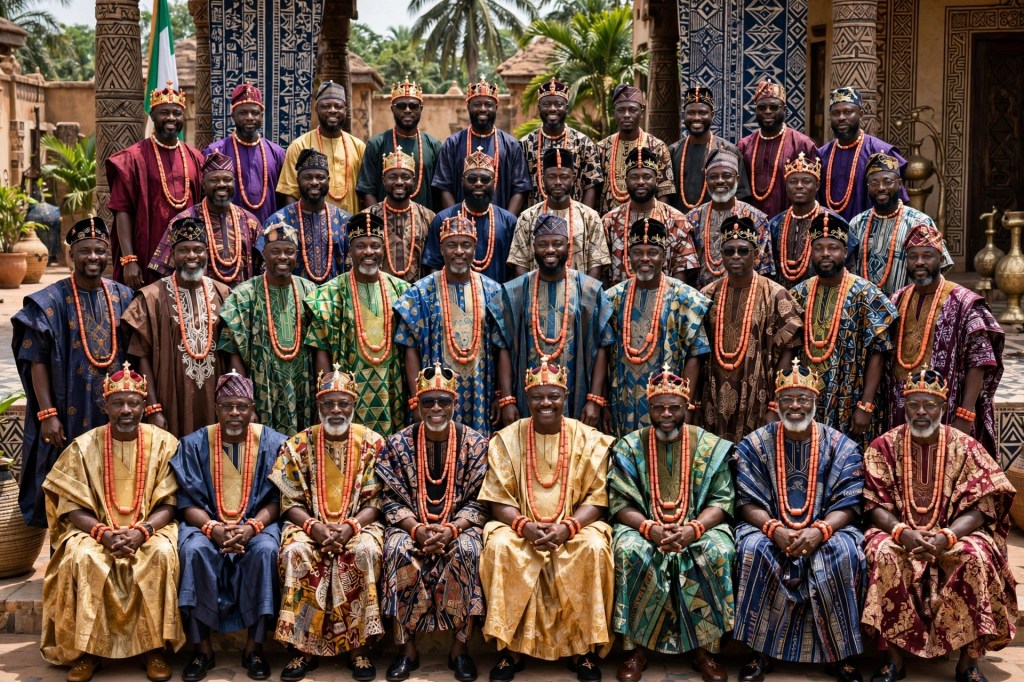
Then there are the custodians of what was supposed to be untouchable. Traditional rulership in Nigeria was once a check on the transient vanity of elected office — the Oba, the Emir, the Obi answered to history and ancestry, institutions considerably older and, one hoped, more dignified than the average four-year electoral cycle. Today, too many of these thrones have become ceremonial furniture for rent, wheeled out to bless whichever politician’s convoy is passing through with the fattest envelope. A crown that took centuries to accumulate legitimacy can now apparently be rented out for a state visit and a photo opportunity, the monarch reduced to a glorified master of ceremonies for men who, in an earlier century, would have had to remove their sandals before entering his presence.
This is not merely embarrassing. It is structurally corrosive, because it collapses the one remaining institution that was meant to outlast politics into just another vendor in politics’s marketplace. When the sacred starts taking instructions from the temporary, a society has quietly agreed that nothing is, in fact, sacred — only unpriced.
Act IV: What Ghana Got Right, By Accident or Otherwise
It would be too neat to claim Ghana has some superior national character; no country holds a patent on virtue, and Accra has its own catalogue of sins. But Ghana’s institutions, however imperfect, have generally continued to perform embarrassment when caught, a health minister resigns, a judge is investigated, a scandal produces consequence rather than merely produces content for the next news cycle. The muscle of shame, however weak, still occasionally twitches. In Nigeria, that muscle has, in too many quarters, atrophied entirely. We have become expert at outrage as spectacle and amateur at outrage as consequence, which is precisely the gap in which a poverty of spirit does its quiet, permanent work.
Coda
Nigeria will, in time, likely fix its material poverty, commodity cycles turn, reforms occasionally take, a generation eventually inherits enough competence to matter. Spiritual poverty is a slower repair, because it cannot be disbursed, budgeted, or donor-funded. It has to be relearned, person by person, shame reintroduced like a species reintroduced to a landscape that has forgotten how to host it. Until then, the tragedy is not that Nigeria is poor. It is that Nigeria has, in places, stopped being ashamed of it and a people that has lost the capacity for shame has lost, whether or not the World Bank has noticed, its most valuable asset of all.
 Centre for Nigeria Progress