

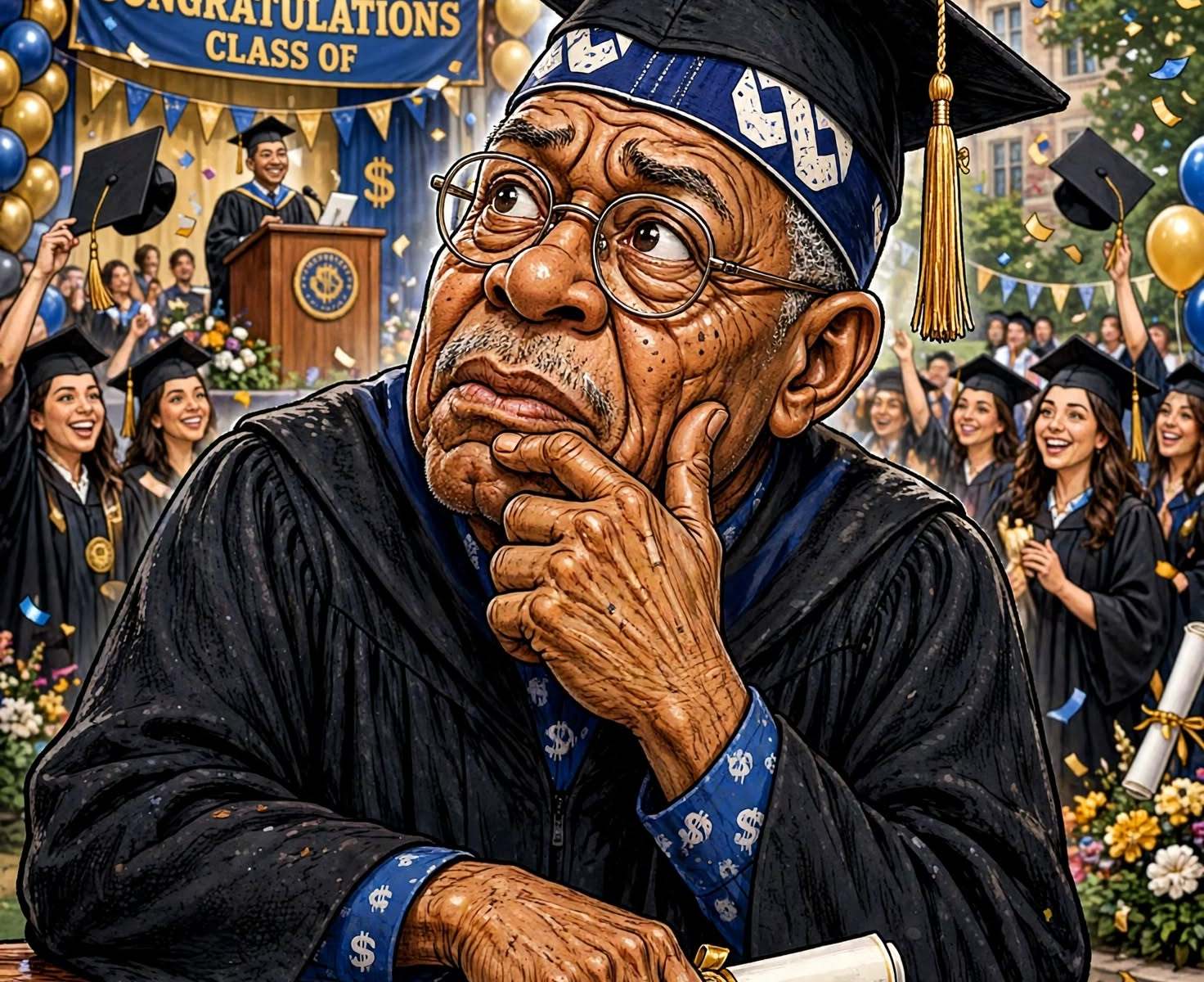
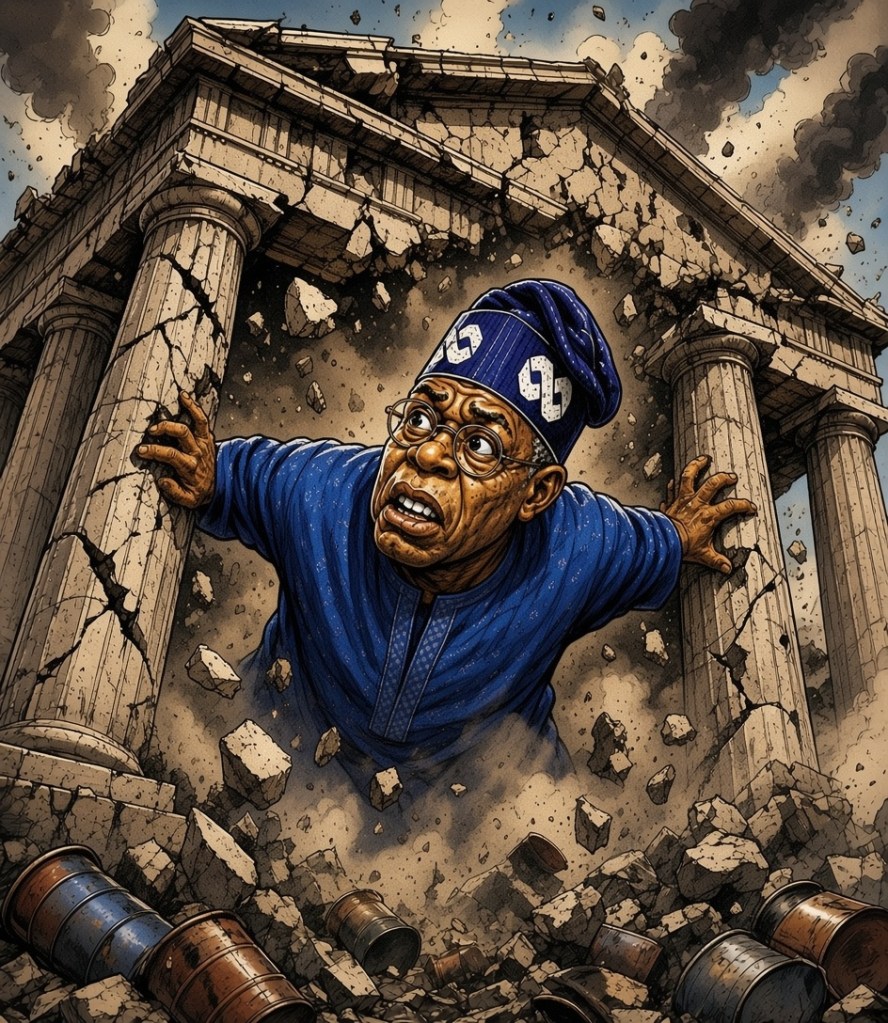
President Bola Ahmed Tinubu and his APC government have proclaimed an ambition to build a one-trillion-dollar Nigerian economy.
If it comes to pass, Nigeria’s GDP will be larger. The economy will have expanded. The numbers will look impressive. Economists will produce charts showing the trajectory from hundreds of billions to the magical trillion-dollar mark.
And that is a good thing, right?
No. That is not the answer to my question.
My question is: What is Tinubu’s Nigeria?
Because before we discuss the size of an economy, perhaps we should discuss the character of the country producing it.
Who is Bola Tinubu?
That question has followed Bola Ahmed Tinubu throughout his political career, and much of the controversy surrounding it has never been satisfactorily resolved in the court of public opinion.
The President’s defenders have frequently responded to questions about his past through lawyers, litigation and political argument. The United States dimension has produced its own collection of controversies, allegations and official records.
At some point, one is entitled to ask a rather simple question:
Why is discovering the truth about a Nigerian president’s past treated as though it were an act of national sabotage?
And when American authorities become involved in disputes concerning matters surrounding a Nigerian political figure, the Nigerian public is entitled to wonder what exactly is being protected, by whom and from what.
My concern is not merely the biography of Bola Tinubu.
It is what the opacity surrounding power tells us about the Nigeria he wants to construct.
Because an economy can be one trillion dollars and still be a badly governed economy.
It can be enormous and unjust.
It can produce billionaires while producing citizens who cannot afford dinner.
It can attract foreign capital while frightening domestic capital.
It can build airports, railways and skyscrapers while the ordinary Nigerian is hiding from kidnappers on the road home.
GDP is a measurement of economic activity.
It is not a certificate of good government.
The economy of state capture
This is where the argument becomes more uncomfortable.
An economy created under state capture is not necessarily an economy worth having.
State capture occurs when political power and private economic interests become so intertwined that the machinery of government increasingly serves networks around power rather than the public interest.
South Africa under Jacob Zuma provided a particularly instructive example of how political patronage, state institutions and private interests can become entangled.
America under Donald Trump offers a different version of the same warning: the proximity of political power, private wealth, business interests, personal loyalty and public institutions can create a democracy in which the boundaries between the state and the interests of those controlling it become increasingly blurred.
The lesson is not that Nigeria is identical to either country.
It is that economic growth without institutional integrity can become a very expensive trap.
A trillion-dollar economy in which the politically connected control access to contracts, licences, concessions, land, public finance and regulatory decisions would not represent an economic revolution.
It would represent the industrialisation of privilege.
Subsidy removal and the politics of the gambler
I have never argued that petroleum subsidies were economically perfect.
But there is a difference between reforming a bad policy and simply detonating it.
Fuel subsidy removal was presented as though the Nigerian people were expected to absorb the consequences first and ask questions later.
There was little sense of a carefully sequenced national economic programme capable of cushioning the shock.
No comprehensive preparation that the ordinary citizen could see.
No convincing social contract saying:
“We are going to make this sacrifice, and here is precisely what you will receive in return.”
Instead, the Nigerian citizen was effectively told to tighten the belt.
But there is a small problem with that instruction.
The belt was already on the last hole.
Removing the subsidy may have been defensible as economic policy. The manner, sequencing and social consequences are another matter entirely.
Economic reform cannot simply mean transferring the cost of government failure from government to citizen.
Otherwise reform becomes an elegant word for “you suffer now and perhaps prosperity will arrive later.”
And later, in Nigeria, has developed a remarkable talent for never arriving.
Tighten your belt while government loosens its own
Then comes the symbolism.
A new presidential aircraft.
A larger political entourage.
Expensive government projects.
Lavish official residences.
Political officeholders enjoying the privileges of power while citizens are repeatedly reminded that the economy requires sacrifice.
The problem is not merely the expenditure itself.
It is the message.
If government tells a struggling Nigerian that there is no money, the citizen quite reasonably looks at government and asks:
No money for whom?
If the ordinary Nigerian is expected to endure higher food prices, higher transport costs, higher electricity costs and declining purchasing power, then the government must demonstrate corresponding restraint.
Leadership during economic hardship requires more than speeches.
It requires example.
You cannot spend like Versailles and preach austerity from the pulpit.
Insecurity and the Nigerian bargain
And while all this economic engineering is taking place, Nigerians continue to confront insecurity.
Kidnapping.
Banditry.
Terrorism.
Cult violence.
Communal conflict.
Criminality.
For many Nigerians, the greatest economic indicator is not GDP.
It is whether they can travel from one town to another without becoming a statistic.
What good is a trillion-dollar economy to a farmer who cannot safely reach his farm?
What is GDP to a trader whose goods can be stolen on the highway?
What is economic growth to a family whose principal economic activity has become paying ransom?
A functioning state must first establish the basic bargain between citizen and government:
I obey the law, pay my taxes and respect the state; you protect my life, liberty and property.
When the state cannot reliably provide that protection, everything else becomes secondary.
The young woman who died in a minister’s house
Then there are the incidents that test whether Nigeria has one law or several.
A young woman dies in the home of a serving minister.
Questions arise.
Her burial reportedly takes place amid controversy.
And the state appears strangely quiet.
This is precisely where the rule of law should become visible.
Not because the accused is necessarily guilty.
Not because the minister is necessarily responsible.
But because the powerful deserve due process just as much as the powerless.
The answer to suspicion should be investigation, not silence.
The answer to tragedy should be transparency, not political convenience.
When a poor Nigerian dies under suspicious circumstances, the machinery of the state can suddenly become very energetic.
When the powerful are involved, Nigerians should never be left wondering whether the machinery has suddenly developed arthritis.
What exactly are we building?
This is why the trillion-dollar promise leaves me cold.
I do not oppose a prosperous Nigeria.
Far from it.
I want Nigeria to become richer.
I want industries producing goods.
I want Nigerian farmers feeding Nigerians and exporting food.
I want manufacturing to flourish.
I want technology companies creating global products.
I want Nigerian universities producing knowledge rather than certificates.
I want electricity that allows factories to operate.
I want transport infrastructure that connects production to markets.
I want a naira that Nigerians can trust.
I want an economy in which a young Nigerian can become wealthy without first becoming politically connected.
That is the Nigeria I want.
And this is where I find myself attracted to Peter Obi’s economic argument.
Not because Peter Obi possesses a magic economic wand. He doesn’t.
And not because every policy associated with him is beyond criticism.
But because the philosophical direction is more important than the headline number.
I would rather have an economy built around investment, production and productivity than one built principally around consumption and political expenditure.
I would rather have a smaller economy that is honest, productive and institutionally credible than a larger economy whose principal beneficiaries are those sitting closest to government.
I would rather see government create the conditions for Nigerians to produce wealth than government becoming the mechanism through which wealth is distributed to politically favoured Nigerians.
The state must belong to the people
Ultimately, this is not merely an argument about Tinubu.
It is an argument about Nigeria.
The Nigerian state has become too valuable to those who control it and too expensive for those who live under it.
Political power determines economic opportunity.
Government contracts determine fortunes.
Access determines success.
Connections substitute for competence.
And the citizen is repeatedly told to wait.
We need to reverse that equation.
The Nigerian state must be released from both state and non-state capture.
It must cease being the private property of political networks, godfathers, oligarchs, criminal enterprises and rent-seeking interests.
Government should become boring again.
Competent.
Predictable.
Transparent.
Bound by law.
That may not sound as exciting as announcing a trillion-dollar economy.
But it is considerably more important.
Because the question Nigeria should be asking is not:
“How quickly can we become a trillion-dollar economy?”
It should be:
“What kind of Nigeria will that trillion dollars create?”
If the answer is a Nigeria in which the politically connected become extraordinarily rich while ordinary citizens become extraordinarily tired, then the trillion dollars will simply make the inequality bigger.
If it is an economy of production, investment, enterprise, justice and opportunity, then by all means, let us chase the trillion.
But let us remember something.
A nation’s wealth is measured in dollars. A nation’s worth is measured in how it treats its people.
And Nigeria needs both.
 Centre for Nigeria Progress