
There is a peculiar American tradition that rarely makes it into the patriotic pageantry: the premature funeral of American democracy.
Every generation seems to produce its own undertakers, its own mourners and its own carefully worded obituary announcing that the republic is finally approaching the end.
The coffin is polished. The eulogy is prepared. Constitutional scholars are summoned. Cable television fills the air with mournful music.
And then, inconveniently, the corpse sits up and asks for coffee.
American democracy has been declared dead so many times that its obituary should probably have its own nursing-home room.
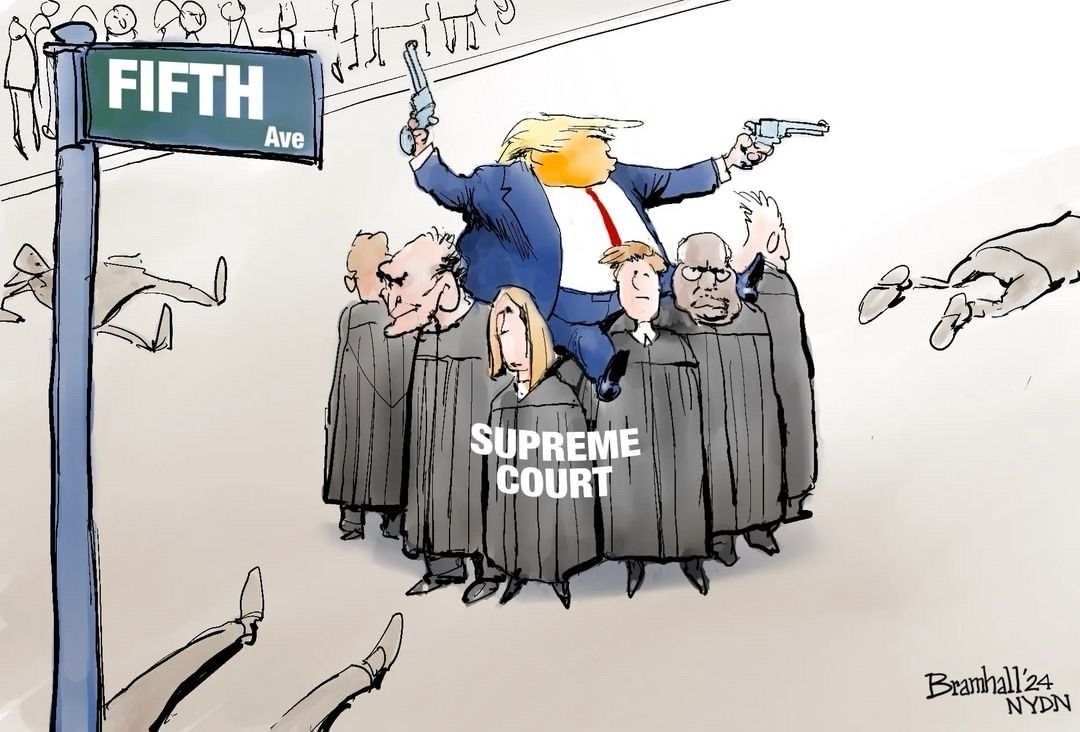
The latest diagnosis is familiar. Donald Trump, the argument goes, represents the existential threat that may finally push the American constitutional experiment beyond the point of recovery.
There is certainly no shortage of reasons for concern. Democratic institutions can be weakened. Constitutional norms can be abused. Political parties can become dangerously tribal. Presidents can test the boundaries of executive power. Courts can become politicised. Elections can become exercises in mutual suspicion.
All of that deserves serious attention.
But there is a difference between saying American democracy is under pressure and declaring American democracy is finished.
Americans have been confusing the two for roughly 250 years.
THE REPUBLIC HAS BEEN HERE BEFORE
The Civil War was supposed to be the final act.
A country that could not decide whether millions of human beings were property or citizens tore itself apart. More than 600,000 Americans died. The Union survived, slavery was abolished, and the Constitution was amended to transform the legal status of millions of people who had previously been denied the most basic rights.
The republic emerged wounded, morally compromised and politically unstable.
But it emerged.
Then came Reconstruction and its collapse.
Then the Gilded Age, when money and political influence danced together so enthusiastically that today’s complaints about oligarchy sometimes sound like a remake rather than a new production.
Then the Great Depression.
The economic system appeared to be collapsing. Banks failed. Unemployment exploded. Millions lost their livelihoods.
Yet the American constitutional order survived and Roosevelt’s New Deal fundamentally reshaped the relationship between government and the economy.
Then came the Second World War.
Then the Cold War.
Then Korea.
Then Vietnam.
Then the assassinations of John F. Kennedy, Martin Luther King Jr. and Robert Kennedy.
For a country already wrestling with racial injustice, social upheaval and an unpopular war, the 1960s sometimes looked less like a democratic republic than a country undergoing political surgery without anaesthetic.
And still it survived.
Then came Watergate.
That was supposed to be the great constitutional nervous breakdown.
The President of the United States was implicated in a scandal involving political espionage, obstruction and abuse of presidential power.
Richard Nixon resigned.
And here is the inconvenient part of the story.
The system worked.
Congress investigated. Courts asserted themselves. The press investigated. Political allies eventually turned against the President. The Supreme Court ordered the release of evidence.
The President left office.
The republic remained.
THEN CAME THE HANGING CHAD
The election of 2000 gave America something different: constitutional crisis mixed with political farce.
Florida became the centre of the democratic universe.
There were recounts, disputed ballots, hanging chads and arguments about voter intent that sometimes sounded like constitutional law had been outsourced to a particularly confused photocopier.
The Supreme Court intervened.
George W. Bush became President.
Half the country remained furious.
The republic carried on.
Then came September 11.
Then two wars.
Then the financial crisis of 2008.
Then the political polarisation that increasingly turned Washington into something resembling a permanent family argument in which nobody remembered who started it.
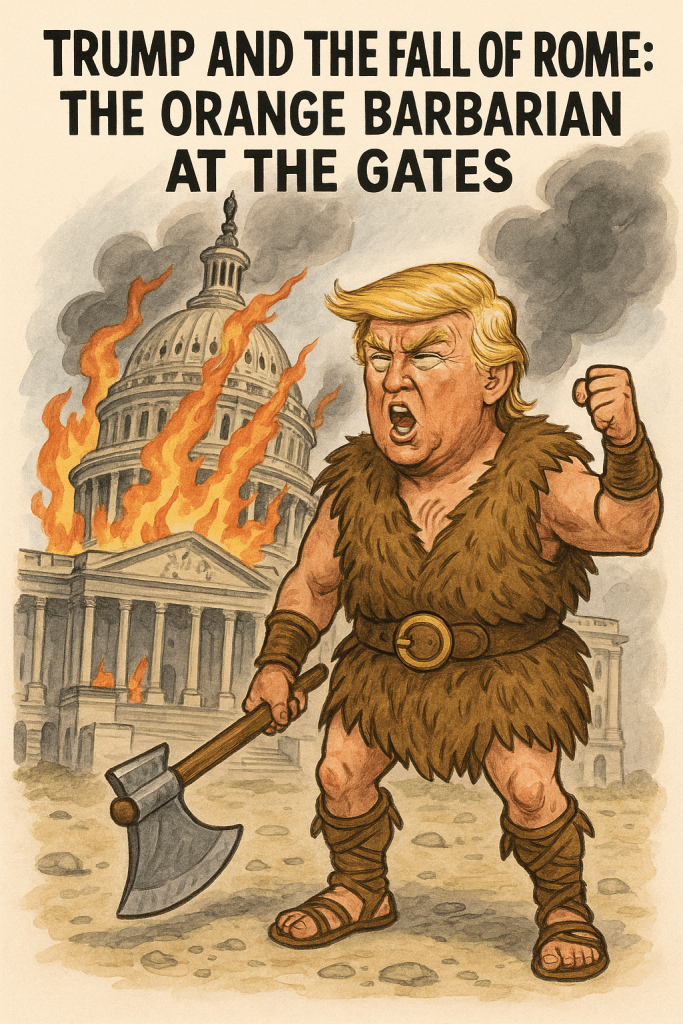
Then Donald Trump arrived.
And suddenly the obituary writers discovered a fresh vocabulary.
This time is different.
Perhaps.
But that phrase has appeared on the death certificate of American democracy so frequently that it has lost some of its dramatic power.
TRUMP IS SERIOUS. THAT DOES NOT MAKE HIM THE END OF AMERICA.
There is a temptation to swing between two equally lazy conclusions.
One is that Trump represents no danger at all.
The other is that Trump necessarily represents the death of the republic.
Neither is satisfactory.
A democracy is not healthy merely because it survives a dangerous politician. Nor is it dead merely because a dangerous politician occupies the presidency.
The real question is whether the institutions surrounding political power retain sufficient strength to constrain it.
That means courts.
Congress.
States.
The electoral system.
The civil service.
The press.
Universities.
Civil society.
Political parties.
And, ultimately, voters.
Institutions are not immortal. They depend upon people defending them. Constitutional government is not a self-driving automobile. Somebody has to keep their hands on the wheel.
But America has something that many political systems lack: a deeply entrenched constitutional culture supported by a remarkably durable institutional architecture.
That does not make American democracy invulnerable.
It makes it difficult to kill.
CHURCHILL’S AMERICAN DIAGNOSIS
Winston Churchill famously observed that Americans could always be counted upon to do the right thing, after they had exhausted all the other possibilities.
The quotation is probably too convenient, and Churchill’s relationship with historical accuracy was occasionally as flexible as his relationship with breakfast.
But as a description of the American political temperament, it remains irresistible.
America does not necessarily learn from history.
It often repeats history until the lesson becomes too expensive to ignore.
The country makes enormous mistakes.
It argues about them.
It polarises over them.
It sometimes elects people who make the mistakes worse.
Then, eventually, some combination of voters, courts, markets, Congress, states and sheer political exhaustion pushes the system towards correction.
The process is rarely elegant.
It is frequently embarrassing.
It is sometimes terrifying.
But it is remarkably persistent.
AMERICA IS NOT A FRAGILE REPUBLIC
There is another reason the latest democratic obituary deserves some scepticism.
America is not a small European republic whose institutions can be brought to their knees by a single political earthquake.
It is a continental power of more than 340 million people, possessing enormous economic resources, technological capacity, military power, agricultural production, universities, financial institutions and state governments.
It is effectively a political continent pretending to be a country.
California alone would be a major economy.
Texas has an economy larger than many nations.
New York remains one of the world’s great financial centres.
The federal government is only one layer of American political life. Beneath Washington sits an enormous ecosystem of state governments, courts, municipalities, universities, businesses, unions, churches, civic organisations and independent institutions.
That decentralisation matters.
A President may command enormous power.
But he does not command America.
That distinction is frequently forgotten by both Trump’s critics and some of his admirers.
THE AMERICAN ECONOMIC MACHINE
The same resilience exists in America’s economic system.
The United States has extraordinary inequalities, enormous social problems and political dysfunction that would exhaust several smaller countries.
Yet it also possesses extraordinary productive capacity.
It remains one of the world’s principal centres of technological innovation, finance, scientific research, energy production, agriculture and entrepreneurship.
America can simultaneously invent the next revolutionary technology, create an entirely new billionaire class around it and spend the evening arguing on television about whether the invention is destroying civilisation.
That is not necessarily evidence of national decline.
It is evidence of a country that remains intensely alive.
And very noisy.
DEMOCRACY IS SUPPOSED TO BE UGLY
One of the mistakes we make when assessing democracy is expecting it to look orderly.
It doesn’t.
Democracy is an argument.
It is supposed to be noisy.
People vote for foolish ideas. They vote against their own economic interests. They elect people who disappoint them. They change their minds. They become angry. They protest. They sue governments. Governments lose elections. Presidents become unpopular. Congress becomes dysfunctional.
Sometimes the entire system looks ridiculous.
That is not necessarily democratic collapse.
Sometimes it is democracy doing what democracy does.
The alternative is considerably less amusing.
A functioning democracy gives citizens the ability to remove their political leaders without having to remove them physically.
That is a rather remarkable invention.
THE REAL DANGER
None of this means complacency is justified.
Democracies do not normally disappear overnight.
They erode.
Institutions are weakened one precedent at a time. Political opponents are gradually reclassified from competitors into enemies. Constitutional restraints become inconvenient obstacles. Truth becomes tribal property. Elections become illegitimate whenever the preferred candidate loses.
That is where vigilance matters.
The greatest danger to American democracy may not be one President.
It may be the gradual acceptance of the idea that the constitutional rules matter only when they benefit our side.
That is the poison that can eventually destroy a republic.
The Constitution cannot survive indefinitely if every political faction treats it as a weapon against the other faction rather than as the common legal framework within which both must operate.
America’s democratic resilience should therefore inspire neither panic nor complacency.
It should inspire responsibility.
THE FUNERAL DIRECTORS SHOULD WAIT
The current political convulsions look apocalyptic because Americans are living through them.
That is how political crises work.
Watergate looked unprecedented to the generation that experienced it.
The Civil War looked existential to those living through it.
The Depression looked like capitalism had reached the end of the road.
The assassinations of the 1960s made the country appear almost ungovernable.
The financial crisis of 2008 produced fears of another Great Depression.
Every generation discovers its own version of “this cannot continue.”
And sometimes it cannot.
But that does not mean the country ends.
It means the country changes.
America’s history is not a straight line of progress. It is a jagged political road filled with reversals, injustices, scandals, wars, economic disasters, constitutional confrontations and extraordinary recoveries.
The republic has never been perfect.
It was never designed to be.
It was designed to be correctable.
That may be its greatest strength.
The American political system has survived presidents who abused power, Congresses that failed spectacularly, wars that divided the nation, economic catastrophes, racial conflict, political assassinations, constitutional crises and movements that seemed determined to tear the country apart.
So perhaps we should stop writing its obituary every time America enters another period of political madness.
The patient is not necessarily dying.
It may simply be arguing with the doctors.
And if American history teaches anything, it is that the argument can become spectacularly loud before somebody eventually remembers that the patient still has a pulse.
The obituary of American democracy has been written so many times that it now deserves its own rest home.
But don’t order the coffin yet.
The American republic has buried too many predictions of its own death to be impressed by another one.
The best may still be ahead.
 Centre for Nigeria Progress