

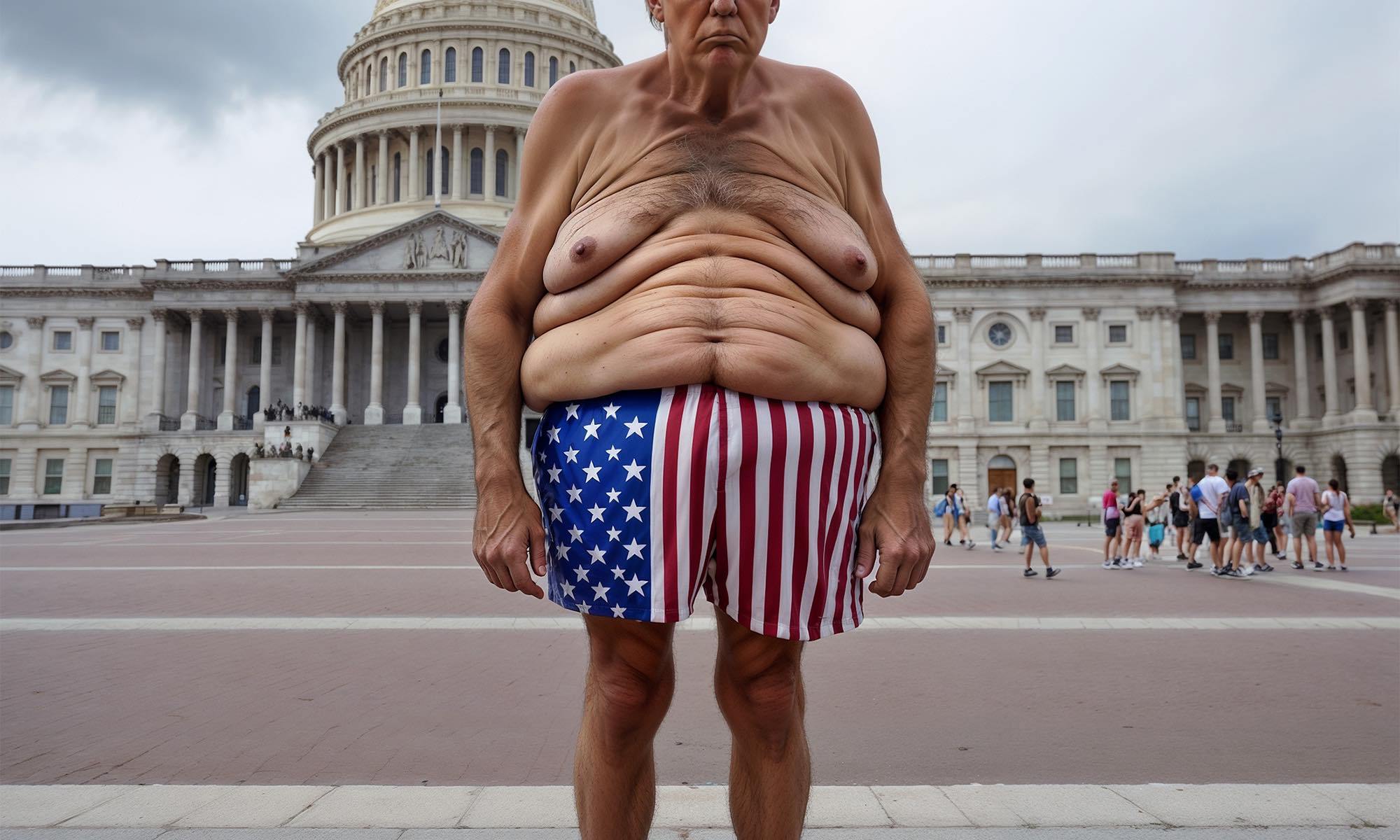

Ronny Jackson once served as physician to the most powerful office on earth. Then Donald Trump arrived and medicine became performance art.
There is a particular cruelty in a medical report. Unlike a political speech, a budget forecast, or an election manifesto all genres of creative literature to which democratic publics have made a resigned peace a medical report carries with it the residual authority of science. When a doctor speaks, we are conditioned, in some prelinguistic way, to believe them. Which is precisely why what has happened to American presidential medicine under Donald Trump is so arresting. The clinic has been converted into a theatre, the stethoscope swapped for a megaphone, and the diagnosis subordinated entirely to the demands of the narrative.
At the centre of this transformation stands one Ronny Jackson former Rear Admiral, former White House physician, former holder of a full medical licence in the State of Virginia, and current Republican Congressman for Texas’s 13th district. Jackson’s career is a study in what proximity to power will do to a professional reputation if one is not careful. He was not careful.
Act I
The Physician Before the Patron
Jackson’s years as physician to Barack Obama were unexceptional in the best possible sense. Obama emerged from those annual examinations as a healthy middle-aged man who exercised regularly, maintained a sensible diet, and whose cardiovascular indicators provoked no alarm. The reports were competent, measured, and crucially boring. This is, of course, precisely what a head-of-state medical report should be: a careful accounting of facts, not an audition for a standing ovation.
Then came 2018, and Jackson’s first full physical report on Donald Trump. The performance began immediately. Jackson declared the president’s health to be “excellent” a word that would recur in subsequent reports with the insistence of a campaign slogan while noting Trump’s BMI of 29.9, a figure one decimal point below the clinical definition of obesity, a fact the report appeared to regard as a triumph rather than a warning. He noted elevated cholesterol requiring increased medication. He recommended dietary changes and exercise. He then, apparently feeling the occasion required something grander, claimed that Trump had “great genes” and that if he ate better, he might live to be 200 years old.
“If he had a healthier diet, he might live to be 200 years old.” Dr. Ronny Jackson, 2018, on the health of a man whose cholesterol required immediate medication adjustment
Two hundred years. Not one hundred and twenty, not one hundred and ten figures which would at least have the virtue of inhabiting the realm of biological possibility but two centuries. One wondered, in 2018, whether Jackson had confused the Oval Office with the Garden of Eden. One wonders now whether he has ever stopped.
Act II
The Candyman and the Collapsed Licence
Jackson’s reward for this loyalty to the preferred narrative was a nomination to lead the Department of Veterans Affairs. The Senate quickly reminded him and the watching world of the dangers of confusing access to power with actual standing. Allegations emerged that he had dispensed prescription medication with the liberality of a man handing out confectionery at Halloween, earning him, amongst Washington’s permanent class, the enduring sobriquet “Candyman.” He was forced to withdraw his nomination. The Navy subsequently stripped him of his rank as Rear Admiral. His full medical licence in Virginia, where he had practised, lapsed in 2020.
He then ran for Congress in Texas and won. The American political system has a peculiar genius for this sort of rehabilitation or rather, for ensuring that the concept of rehabilitation never quite applies, because nothing is ever treated as having required it. Jackson arrived on Capitol Hill having lost his licence, his rank, and his nomination, and was received as an entirely respectable legislator.
More to the point, he retained and continues to exercise his informal role as Trump’s favourite medical authority. When an assassin’s bullet grazed Trump’s ear in Butler, Pennsylvania, in July 2024, it was Jackson who rushed to his side to issue a memo. When Trump needed health certification at a Mar-a-Lago gala in November 2024, it was Jackson who vouched for his superiority over Obama and George W. Bush as a “physical specimen.” When the White House needed a statement on the president’s health in August 2025, it issued one in Jackson’s name rather than that of the actual serving White House physician.
Act III
What the Eyes See and What the Report Says
We arrive, now, at the present. Trump is seventy-nine years old and has made five visits to Walter Reed National Military Medical Center in just over a year. The photographs that have accompanied his public appearances tell a story that the official reports are reluctant to narrate. His ankles are visibly, sometimes dramatically, swollen a condition the White House initially declined to explain, then acknowledged in July 2025 as chronic venous insufficiency, a circulatory disorder common in individuals over seventy in which the valves responsible for returning blood up the legs against gravity gradually fail. His hands carry the bruising that the official medical memo attributes, with admirable specificity, to “frequent handshaking in the setting of aspirin use.” His neck required dermatological treatment in March 2026, a fact that the subsequent medical report declined to address. In October 2025, he underwent an MRI. The White House initially declined to say why, then confirmed it had been to “definitively rule out cardiovascular issues.”
His ankles announced a circulatory disorder to the international press corps before the White House thought to mention it.
The official record throughout this period has maintained, with remarkable consistency, that the president is in “excellent” health and “fully fit to execute the duties of Commander-in-Chief.” The April 2025 report from his actual physician, Navy Captain Sean Barbabella, noted that “blood flow to his extremities is unimpaired.” Weeks later, the photographs of those extremities at a Club World Cup final in New Jersey told a somewhat different story. His ankles announced a circulatory disorder to the international press corps before the White House thought to mention it. He subsequently confirmed to the Wall Street Journal that he had been briefly given compression socks, but had stopped wearing them because he “didn’t like them.” This is and one says it without relish not the behaviour of a man whose blood flow to his extremities is unimpaired.
The most recent Walter Reed visit, in May 2026, produced a memo in which Trump’s “slight lower leg swelling” was noted — with the reassurance that it showed “improvement from last year” and the hand bruising was described, once more, as “common,” “benign,” and entirely explicable by handshaking. Everything, as the president himself immediately summarised upon emerging, “checked out perfectly.”
Act IV
Alice’s Wonderland, Staffed by Grown Men
What strikes the outside observer and here one speaks as a foreigner who has no horse in this particular race is not the deterioration itself. Men of seventy-nine deteriorate. This is not a scandal; it is biology. What is remarkable, and genuinely disorienting, is the machinery erected around the deterioration to insist that it is not happening, or that what is happening is, in fact, evidence of remarkable vitality.
The White House’s response to a journalist who enquired about Trump’s swollen ankles was to accuse the journalist of stupidity that would “prevent him from working for a legitimate news outlet.” When Congress was presented with a health briefing, the administration deployed a man who no longer holds a full medical licence to vouch for the president’s superiority over predecessors who were a generation younger when they held office. The official April report declared blood flow to the extremities unimpaired; the ankles demurred publicly, in front of cameras, at an international football final.
It is the quality of the performance that produces the whiplash. These are not nervous apparatchiks from a collapsed regime, speaking in halting cadences around a staticky microphone in some provincial capital. These are polished operators with Ivy League educations and American accents the full apparatus of the most sophisticated communications infrastructure in the world deployed in service of the proposition that what your eyes observed at the Club World Cup is not what you observed. The alternate truth is delivered with the crisp confidence of a man who has never once doubted whether the audience believes him, because in his world, the audience has been told believing is compulsory.
These are not nervous apparatchiks from a collapsed regime. These are polished operators deployed in service of the proposition that what your eyes observed is not what you observed.
One thinks, watching this, of the propaganda officials of mid-twentieth century despotic regimes the ones whose heavily accented and broken-toothed broadcasts assured the citizenry, in the face of overwhelming contrary evidence, that the frontlines were stable, the harvest was in, the dear leader was vigorous and hale. The difference is that those officials were, by and large, terrified. The American version performs the same function with the easy confidence of a man at brunch.
Coda
The 200-Year Prophecy, Revisited
Ronny Jackson said in 2018 that Donald Trump, with better diet and exercise, might live to two hundred. Trump is seventy-nine, has five Walter Reed visits on his calendar in a year, wears compression socks when he remembers to and does not always remember to and has a circulatory condition that causes his ankles to announce themselves before he enters a room. He is also, according to every official document his administration has released, in “excellent” health and “fully fit” for the demands of the presidency.
Perhaps Jackson was simply out by a factor of about two-and-a-half. Perhaps “excellent” has, in Trump’s Washington, acquired a meaning available only to those with the correct security clearance. Or perhaps and this is the hypothesis that the evidence most stubbornly supports the White House medical report has become, like so many other instruments of this administration, not a record of facts but an extension of a political will. A document whose purpose is not to tell you what is true, but to tell you what is required.
Alice, stepping through the looking glass, at least had the decency to acknowledge that things had become strange. In this Wonderland, the strangeness is the official position.


👍good🌹
LikeLike