


There is an old, bitter administrative joke in Nigeria that you are only formally counted twice: never when you arrive, and certainly not when you leave. In between, your existence is largely an unverified rumor negotiated between your creator, your luck, and whatever age declaration affidavit you paid a court clerk two thousand Naira to stamp.
When a country cannot establish with ironclad certainty the precise birth year of its sitting President, a man who sits at the very apex of state records, expecting the average citizen to be accounted for at death feels like wild optimism. We enter the world unannounced by the state, and we exit through an administrative trapdoor.
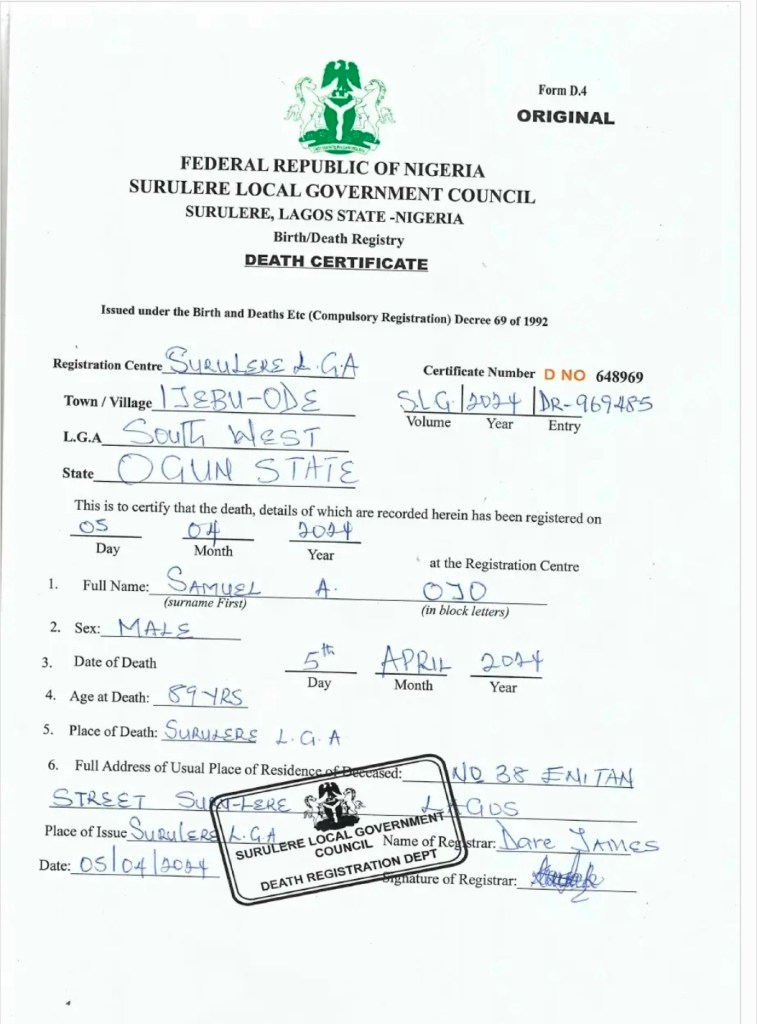
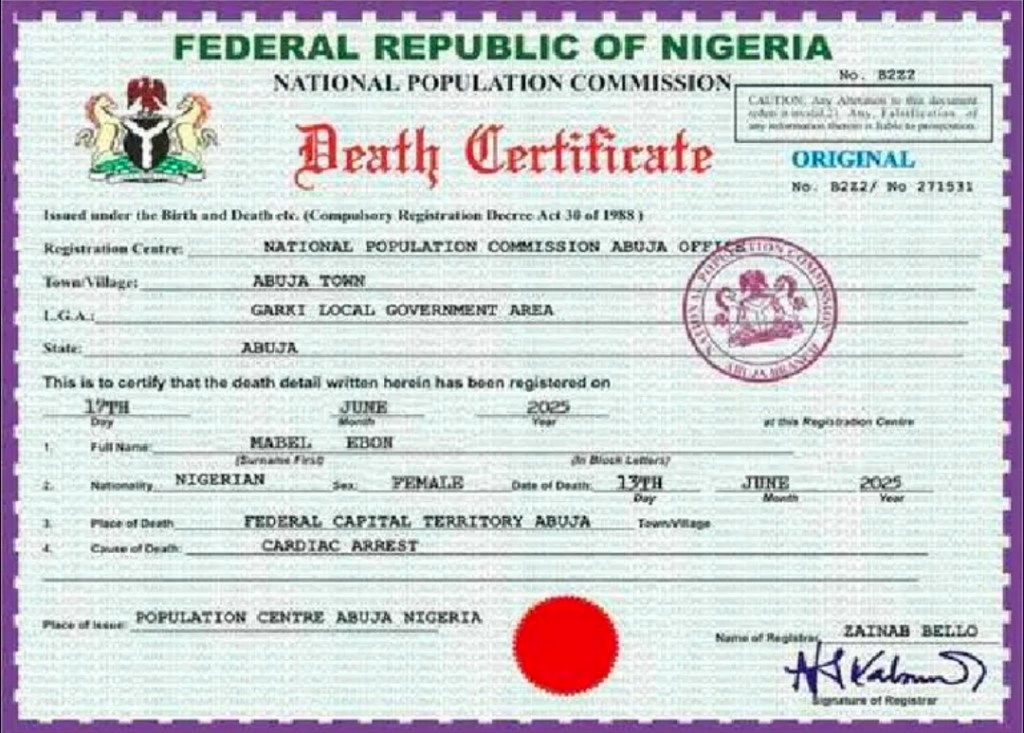
The personal evidence of this national erasure is painfully common. When my mother was killed in a car accident, the machinery of state did not twitch. There was no police reconstruction report, no coroner summoned, and no death certificate issued. She was buried quietly, her abrupt end treated as an entirely private domestic matter rather than a matter of public fact.
Years later, my mother-in-law passed away in a Nigerian hospital. Wanting to do things by the book, I went through the bureaucratic obstacle course, paid the official fees, and waited for the certified paperwork. The document finally arrived, duly signed and stamped by a qualified medical doctor. Under the column demanding the specific medical cause of death, the physician had boldly inscribed a single, magnificent word:
DEATH.
You have to admire the philosophical economy of it. Why did she die? Because she died. It is the clinical equivalent of asking a mechanic why the car stopped moving and being told, “Because it isn’t running.” Yet behind the dark comedy lies a genuine tragedy: the complete surrender of professional rigor, legal duty, and basic human dignity.
When my father died in the United States, his death certificate was a masterclass in forensic bookkeeping. It detailed the primary cause, secondary complications, underlying factors, and chronological intervals. It was a formal acknowledgment that an individual life had ended, and that the state owed that life a factual summary. In Nigeria, that basic dignity was denied to his wife, and it would have been denied to him had he died at home.
This casual indifference is not reserved for ordinary families; it is the default setting of the Republic. Consider the case of 26-year-old Mary Habila, who died under deeply suspicious and contested circumstances at the private residence of a federal minister. Despite conflicting narratives, visible trauma, and clear legal advice from the Director of Public Prosecutions that an independent post-mortem was essential, the case dissolved into the usual fog. After weeks of public hand-wringing and petitioning by civil society, she was quietly buried in Kaduna State without an open coroner’s inquest or a publicly verified forensic conclusion.
Under Nigeria’s received statutes and state-level Coroners Laws, any death that is sudden, violent, unnatural, or suspicious legally triggers an official inquiry. Coroners have the legal power to halt burials, compel witnesses, and order autopsies. Yet in reality, a coroner’s office in Nigeria is easily one of the most peaceful places to work in the entire civil service. Unless public uproar threatens political comfort, the system relies on collective amnesia and a quick burial.
A country that refuses to count its dead will never know how to protect its living. We do not fix killer roads because no forensic traffic report forces the government to admit why the crash happened. We do not reform negligence in our hospital wards because the official diagnosis was merely “DEATH.”
A proper death certificate is not just a document for processing probate; it is the final receipt of citizenship. To be born without a record is an infrastructural failure, but to be buried without a single official sentence explaining why you are no longer here is an absolute deficit of dignity. Until the state decides to count us in and count us out, millions of us will continue to live and vanish entirely off the record.

