



There is an old British political habit which deserves rather more scrutiny than it usually receives: when governments want the public to accept an uncomfortable policy, they wrap it in the Union Jack and call it national security.
It is not a new trick.
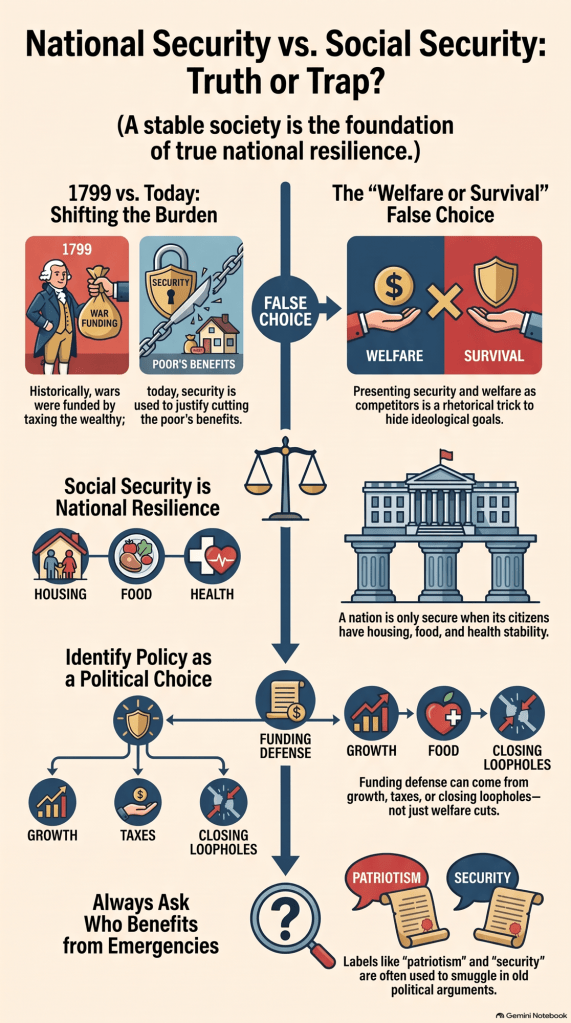
In 1799, Prime Minister William Pitt the Younger introduced what became Britain’s first modern income tax. Britain was at war with revolutionary France and facing the enormous financial demands of the conflict that would eventually become the Napoleonic Wars. The government needed money for the army and navy, and taxation became an essential part of the war effort.
The important point is not merely that Pitt introduced income tax during wartime. It is how the burden was distributed.
Pitt’s tax was graduated. Those earning more paid more, while people earning below £60 were excluded altogether. The principle was brutally simple: if the nation needed extraordinary resources for an extraordinary threat, those with the greater capacity to contribute should carry a greater share of the burden.
National security, in other words, was not conceived as an excuse to make the poor poorer.
It was a reason for the nation to mobilise its resources.
That distinction matters enormously today.
The New Security Argument
We are now hearing from the Conservative Right and the increasingly influential far right, ReformUK Ltd, that Britain has somehow placed “social security before national security.”
It sounds wonderfully Churchillian.
It has the vocabulary of patriotism, danger and national survival. It suggests that somewhere inside Whitehall there is a Minister sitting in a bunker, clutching a benefits spreadsheet while Russian submarines approach the English coast.
But strip away the rhetoric and something rather more political emerges.
The argument appears to be that Britain cannot simultaneously afford a functioning social safety net and the security demands of the modern state.
That proposition requires examination.
Because if national security means that the country must spend more on defence, intelligence, policing, border security and resilience, then the obvious question is:
Who should pay?
And this is where the politics becomes particularly interesting.
From Taxation to Austerity
Pitt’s response to an existential national threat was taxation.
The modern Right’s increasingly fashionable response appears to be something rather different: reduce the protection available to those at the bottom of society.
The direction of travel matters.
Instead of saying:
Britain faces a serious security challenge, therefore those with the greatest economic capacity should contribute more towards meeting it,
The argument increasingly becomes:
Britain faces a serious security challenge, therefore people receiving social security must receive less.
That is quite a transformation.
The enemy has apparently changed from Napoleon to the bloke receiving Universal Credit.
The battlefield has moved from the English Channel to the benefits office.
And the cannonballs have been replaced by spreadsheets.
There is, of course, a perfectly legitimate argument to be had about the appropriate size of the welfare state, the structure of benefits, incentives to work, taxation and public expenditure.
But those are political and economic arguments.
They should be made honestly.
They should not require the rhetorical camouflage of national security.
The Poor Do Not Suddenly Become a Security Threat
There is something intellectually peculiar about suggesting that protecting people from poverty is somehow incompatible with protecting Britain from external threats.
A society’s security is not simply measured by the number of frigates in Portsmouth or aircraft in RAF hangars.
A society is also secure when people have somewhere to live.
When children are properly fed.
When elderly people can heat their homes.
When illness does not automatically mean financial catastrophe.
When unemployment does not result in destitution.
When citizens believe that the state will not abandon them when circumstances turn against them.
That is also national security.
Indeed, a society in which large numbers of citizens experience economic insecurity, housing insecurity and declining living standards is hardly a model of national resilience.
There is therefore something backwards about the proposition that social security competes with national security.
Social security can itself be part of national security.
The question is not whether Britain should have security.
The question is what we mean by security and who gets to define it.
Follow the Money
This is where the political argument becomes much more revealing.
If Britain genuinely requires substantially greater expenditure on defence and national security, there are several ways of paying for it.
The government can borrow.
It can increase taxation.
It can reduce other forms of expenditure.
It can tax wealth and income more progressively.
It can close loopholes.
It can increase economic growth.
Or it can combine several of these approaches.
But there is nothing inevitable about the proposition that the person dependent upon social security must surrender part of the little protection they possess.
That is not an economic law.
It is a political choice.
And political choices should be identified as such.
The genius of the phrase “social security before national security” is that it attempts to make that choice disappear.
It presents the political dispute as though there were only two alternatives:
welfare or survival.
That is the trick.
Security as a Political Trojan Horse
This is where one should be particularly careful.
Security is one of the most powerful words in politics.
Who wants to be against security?
Who wants to stand in Parliament and say, “No, I prefer the country to be less safe”?
It is an extraordinarily effective rhetorical device because it changes the burden of proof.
Instead of the Government having to demonstrate why a particular policy is necessary, the critic is invited to prove why national security does not require it.
That is how perfectly ordinary political choices acquire an aura of inevitability.
A cut to benefits becomes a security measure.
A reduction in social protection becomes resilience.
A restriction on migration becomes border security.
An increase in military expenditure becomes patriotism.
And before long, anyone questioning the policy risks being portrayed as soft on the enemy.
This is not necessarily an argument about security.
It can be an argument about ideology dressed up as security policy.
The Great Red Herring
The Right may genuinely believe that Britain faces serious security threats. Russia is not imaginary. International instability is not imaginary. Cyber warfare, terrorism, organised crime and geopolitical competition are not imaginary.
But the existence of genuine security threats does not make every policy proposed in their name sensible.
Nor does it establish that the welfare state is the cause of Britain’s security problems.
That is the red herring.
The real ideological project may be something much older: reducing the size of the state, weakening collective provision and transferring greater responsibility for social welfare from the state to the individual.
That is a legitimate political philosophy.
One can disagree with it, but at least it can be debated.
What should not be accepted without examination is the attempt to smuggle that philosophy into public policy under the label of national security.
Pitt’s Lesson
There is an irony in invoking the language of national security while forgetting the history of how Britain actually financed national emergencies.
Pitt did not tell Britain in 1799 that the poor should bear the principal burden of defeating Napoleon.
He constructed a taxation system which sought to extract more from those who had greater means. Parliament’s own historical account notes that the income tax became accepted by many as the price of winning the war.
The lesson from Pitt is therefore not that national security requires an enormous state.
Nor is it that taxes should always rise.
The lesson is simpler:
When the nation faces an exceptional threat, the burden of meeting it is a matter of collective responsibility.
And collective responsibility does not mean that the person with the least should automatically surrender what little they have.
So What Is Actually Being Defended?
Perhaps the most useful question is therefore not:
“Is national security more important than social security?”
Of course national security is important.
The better question is:
“Why is the cost of national security being presented as a reason to weaken social security?”
That question exposes the politics.
If the country needs more money for defence, let us have the argument about taxation.
If the wealthy must contribute more, let us debate that.
If government spending elsewhere should be reduced, identify it.
If borrowing is appropriate, explain why.
If welfare reform is necessary, make the economic case.
But do not tell the public that their neighbour’s modest social security payment is somehow standing between Britain and national survival.
That is not an economic argument.
It is political theatre.
And perhaps the most revealing part of the theatre is that the people being asked to make the sacrifice are very often those least capable of absorbing it.
The irony is almost too perfect.
In Pitt’s Britain, national security helped produce modern income taxation.
In today’s Britain, some on the Right want national security to help dismantle social protection.
The security threat may be real.
But the proposed remedy is still a political choice.
And when politicians tell us that there is no alternative, we should remember the oldest rule in politics:
Always ask who benefits from the emergency.
Because sometimes the emergency is real.
Sometimes the solution is ideological.
And sometimes national security is simply the most impressive suit in which an old political argument has been dressed.
 Centre for Nigeria Progress