


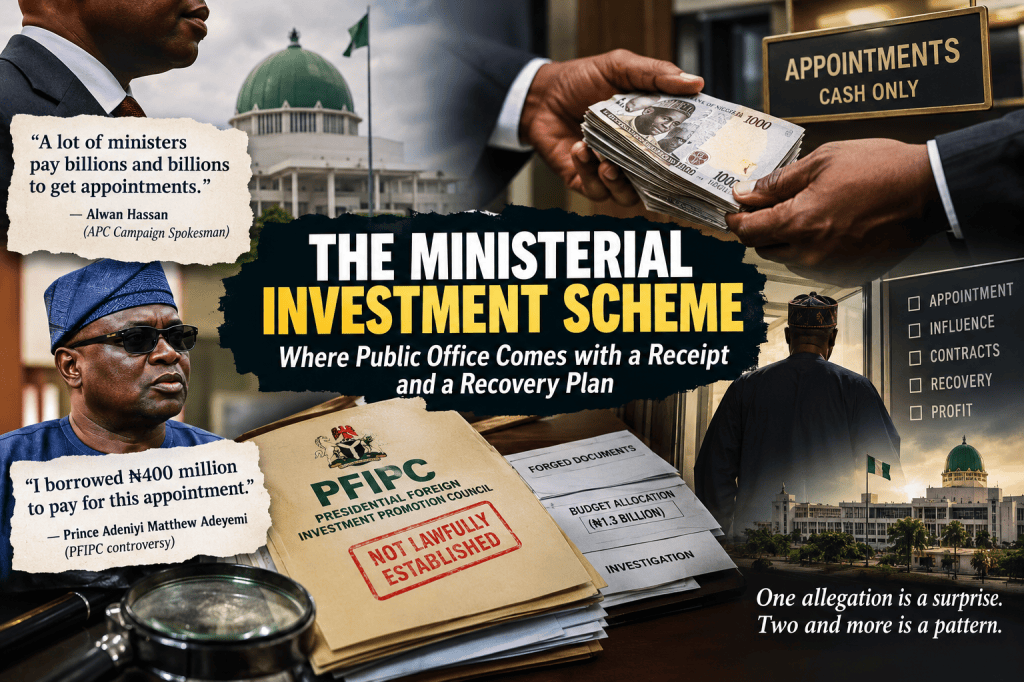
In the grand theatre of Nigerian politics, where truth occasionally stumbles onto the stage like an uninvited guest who has had one too many, Alwan Hassan has just delivered a masterclass in accidental honesty.
Appearing on Arise TV’s Prime Time, the APC Presidential Campaign Council spokesman casually informed the nation that “a lot of ministers pay billions and billions” to secure appointments. Once installed, their first order of business is not governance, not service, not even the odd press conference about “Renewed Hope”. It is, rather, the urgent recovery of capital.
One imagines the swearing-in ceremony followed immediately by a spreadsheet titled “Return on Investment: First 100 Days”. The portfolio is public, the capital allegedly private, and the recovery mechanism apparently left to the ingenuity of the investor.
Hassan’s disclosure would have been scandalous enough on its own. But Nigeria has an unfortunate habit of supplying a second act before the audience has recovered from the first.
Enter Prince Adeniyi Matthew Adeyemi and the extraordinary saga of the Presidential Foreign Investment Promotion Council (PFIPC).
The connection between the two controversies is not that they establish the same offence, nor that one automatically proves the other. It is that both raise a question Nigerians should no longer be expected to regard as an amusing feature of political life: what happens when obtaining public office becomes a financial transaction, and what happens when the transaction itself becomes more important than the legality of the office?
One allegation is a surprise. Two or more is a pattern.
Hassan alleges that ministers pay billions of naira to secure appointments and subsequently seek to recover their money. He did not name the ministers, identify the alleged recipients or provide documentary evidence during the television interview. His assertion remains an allegation requiring investigation, not a judicial finding.
Yet the PFIPC controversy supplies a concrete and deeply troubling point of comparison.
In July 2026, Adeyemi reportedly told Channels Television’s Politics Today that he had borrowed ₦400 million to pay for the processing of his purported appointment as director-general of the council.
“I borrowed this money to pay for this appointment,” he said, according to published reports.
That was not an allegation made by an opposition politician about an unidentified minister. It was a statement attributed to the very individual whose purported appointment became the centre of the PFIPC scandal.
The distinction is important. Adeyemi’s account concerned a specific sum and a specific appointment. The authorities, however, maintain that he was never appointed by the Federal Government and that the council itself had no lawful basis for existence. The Independent Corrupt Practices and Other Related Offences Commission (ICPC) recommended his prosecution over alleged forgery, impersonation and related offences. He has denied wrongdoing, and the criminal allegations must be distinguished from any final determination of guilt.
Nevertheless, the reported admission raises a question that Hassan’s broader allegation makes even more difficult to ignore: if money is allegedly required to obtain an appointment, who is selling the appointment, and what exactly is the purchaser buying?
Is it a genuine public office, access to a powerful patron, a forged letterhead, an opportunity to influence government institutions, or simply the promise that somebody important will recognise the buyer as important?
In the PFIPC affair, the alleged transaction did not merely concern a title. It became entangled with official-looking documents, access to government premises, dealings with public institutions and the appearance of governmental authority.
One allegation may be an isolated scandal. Two apparently different routes into the same marketplace demand an examination of the marketplace itself.
The PFIPC affair: When an appointment acquires a price tag
The Presidential Foreign Investment Promotion Council was presented as a body concerned with attracting foreign investment. Its name carried the weight of the Presidency, its claimed leadership suggested access to the highest levels of government, and its activities acquired an appearance of official legitimacy.
The subsequent investigation painted a very different picture.
The Presidency declared that the council had never been lawfully established and that Adeyemi had never been appointed to head it. The ICPC’s interim investigation similarly found that the purported appointment letter and other supporting documents were forged.
The controversy nevertheless extended into the machinery of government. The purported council obtained office accommodation at the Federal Secretariat, engaged with public institutions and was associated with a provision of approximately ₦1.3 billion in the 2026 federal budget.
The ICPC’s findings identified serious weaknesses in verification and administrative oversight. Officials in different institutions had processed documents and requests without adequate independent confirmation of the organisation’s legal status.
The commission did not find that Federal Government funds had been approved or disbursed to the purported council. That qualification matters. A budgetary provision is not the same thing as cash released, money spent or funds stolen.
But the absence of a confirmed government disbursement does not make the institutional failure less serious. The question is how an organisation that the authorities subsequently said had no lawful existence managed to penetrate so many layers of the administrative system.
A government office is not supposed to operate on the principle that whoever arrives with sufficiently impressive stationery, official-looking vehicles and an entourage becomes a public officer by popular acclaim.
Nor should an appointment acquire legal validity because enough people behave as though it exists.
The PFIPC affair demonstrates how the appearance of official authority can travel through government institutions when verification fails. It also illustrates the danger of allowing access, influence and personal representations to substitute for the lawful processes by which public institutions are created and their leaders appointed.
The scandal is therefore about more than an alleged impostor. It is about the vulnerability of the state when its institutions cannot reliably distinguish an authentic appointment from a convincing imitation.
The ₦400 million question
Adeyemi’s reported admission that he borrowed ₦400 million to pay for his purported appointment invites an obvious question: who received the money?
Reports of his subsequent statements indicate that he alleged the payment was made through an intermediary, the late Dolapo Tanimola, and implicated President Bola Tinubu’s Chief of Staff, Femi Gbajabiamila. Gbajabiamila denied wrongdoing. Adeyemi also said he could not personally confirm who ultimately received the funds.
These are serious allegations, but they are not proof that Gbajabiamila received the money or participated in an unlawful transaction.
Indeed, the ICPC’s interim investigation found no evidence that the purported appointment letter originated from the Presidency. A House of Representatives committee also reported that the appointment letter was fabricated and falsely attributed to the Presidency, and that the evidence before it did not establish Gbajabiamila’s involvement in establishing or operating the purported council.
Those findings must be acknowledged. A serious argument about public accountability cannot demand evidence when accusing one person and discard it when the evidence points in another direction.
But the unresolved financial questions remain.
Who supplied the ₦400 million? What did the lenders believe they were financing? Was the money transferred to an identifiable recipient, and can the full chain of transactions be reconstructed? What documentary or other evidence supports the competing accounts of what the money was intended to achieve?
If the money was genuinely paid to secure a public appointment, the circumstances demand a proper investigation. If it was paid to an intermediary under a false promise, that too demands investigation. If the account of the payment is disputed, the financial trail is precisely where investigators should begin.
The critical issue is not whether an allegation is politically convenient. It is whether the evidence establishes what happened.
And if an individual believes he must borrow hundreds of millions of naira to obtain a public appointment, Nigeria deserves to know why he believed such a payment was necessary, whom he expected to benefit and what assurances he received.
A public appointment should not require a private financing agreement.
From the appointment fee to the recovery plan
This is where Hassan’s disclosure becomes particularly disturbing.
According to his allegation, some ministers pay billions to secure their positions and then immediately consider how to recoup the expenditure.
The logic is chilling because it transforms the purpose of public office. A minister is no longer primarily the custodian of a portfolio, responsible for implementing policy and accounting for public expenditure. He becomes an investor whose capital must be recovered from the opportunities presented by government.
The public contract becomes a potential repayment instrument. The budget becomes a commercial prospectus. Regulatory discretion becomes a negotiable asset. Political influence becomes an income-generating opportunity.
The taxpayer, meanwhile, becomes the involuntary guarantor of an investment the taxpayer never authorised.
Of course, Hassan’s allegation does not establish that every minister is corrupt, that every appointment is purchased or that every contract awarded by a minister is tainted. Those conclusions would require evidence.
But if even a portion of his claim is true, the implications extend well beyond the conduct of individual ministers. They would concern the incentives built into the appointment system itself.
Why would a person pay billions for a position that offers a lawful salary and carries substantial legal responsibility? What return could reasonably justify such an expenditure? Is the alleged payment a contribution to political patronage, a payment to an intermediary, a demand by a powerful sponsor, or an investment in anticipated access to public resources?
And if the investor expects to recover the money, what source of revenue is being contemplated?
These are not merely rhetorical questions. They identify the financial relationships that an effective investigation must trace.
The distinction between political fundraising, patronage and criminal bribery must also be maintained. Not every contribution to a political party is unlawful, and not every expensive political campaign proves that a public appointment has been sold. But a payment intended to purchase an appointment or secure an improper official favour raises a fundamentally different question from a lawful political donation.
The law does not become irrelevant simply because the transaction is dressed in the language of political loyalty.
Who is the cashier?
Who, pray tell, is the cashier in this arrangement?
Is there a discreet window at the Villa marked “Appointments: Cash Only”? Are there intermediaries with briefcases and better security than most banks? Is the payment allegedly made to the appointing authority, a political sponsor, an informal network of influential persons, or someone who claims access to the Presidency?
Hassan left these details tantalisingly vague. The accusation was sweeping; the names and transactions were absent.
The PFIPC affair, by contrast, demonstrates why the identity of intermediaries and the movement of money matter. Adeyemi’s reported account pointed to a payment connected with his purported appointment, while the official investigation questioned the authenticity of that appointment and the documents used to support it.
The two controversies therefore call for different but complementary inquiries.
In the case of the alleged ministerial payments, investigators would need to establish whether payments occurred, who made them, who received them, what was promised and whether subsequent official decisions were connected to those transactions.
In the PFIPC case, investigators must establish the complete financial trail, determine the role of intermediaries, examine any payments to public officers and distinguish genuine victims of alleged deception from those who knowingly facilitated or benefited from unlawful activity.
The objective should be neither to convict everyone by association nor to declare the entire system innocent because a particular allegation has not been proved.
It should be to follow the evidence wherever it leads.
The state cannot be run by stationery and influence
There is a deeper constitutional problem here.
Public office is not created by personal ambition, a title conferred by an associate, an impressive office at the Federal Secretariat or a letter bearing a convincing signature. The authority to establish public institutions and make appointments must come from the Constitution, legislation and other lawful governmental instruments applicable to the office concerned.
The PFIPC findings exposed the consequences of losing sight of that elementary principle.
If the council was not lawfully established, the appearance of its name in a budgetary document could not, by itself, confer legal existence upon it. Nor could an appointment letter acquire validity merely because officials processed it or outsiders accepted it as authentic.
The same principle applies to the alleged purchase of ministerial appointments. If an appointment is obtained through bribery, improper inducement or another unlawful arrangement, the fact that the appointee subsequently takes an oath does not erase the underlying questions of legality and accountability.
The public service is not a private club in which access can be purchased and membership fees recovered from the public purse.
There is also an institutional question that the PFIPC controversy makes impossible to avoid. How did a purported government body secure administrative recognition and official accommodation before its legal existence and appointment documents were adequately verified?
The ICPC identified shortcomings in verification and oversight. The wider lesson is that public institutions must not rely blindly on documents supplied by the very individuals whose authority those documents are intended to establish.
Every institution should independently verify the legal instrument creating a body, the authority appointing its head and the authenticity of documents used to obtain public resources.
Where those checks fail, responsibility should not stop with the person accused of presenting false documents. Any official who knowingly facilitates an unlawful scheme must be held accountable; any official whose negligence breaches applicable duties should face appropriate administrative consequences. Those determinations must, of course, rest on evidence and due process.
A functioning state requires more than honest individuals. It requires procedures that make dishonesty difficult to conceal.
The President’s responsibility
Hassan attempted to defend President Tinubu’s personal oversight of expenditure by arguing that ministers could not necessarily be trusted with public funds.
That defence creates its own constitutional and administrative puzzle.
If ministers are routinely suspected of being so compromised that the President must personally supervise expenditure, why appoint them in the first place? If the appointment process itself is allegedly vulnerable to financial inducements, how does the President ensure that those selected are suitable custodians of public resources?
A presidency cannot plausibly present ministerial appointments as instruments of executive policy while treating the alleged corruption of those appointees as an unavoidable national tradition.
Nor is presidential micromanagement a substitute for accountable institutions. Government expenditure should be governed by the Constitution, appropriation laws, procurement rules, financial regulations and effective auditing. The answer to corruption is not simply to concentrate discretionary power in one individual, however well-intentioned that individual may be.
The PFIPC controversy reinforces the point. President Tinubu ordered an ICPC investigation after the council’s status became a major public issue. The commission’s interim findings recommended prosecution of Adeyemi and identified administrative weaknesses requiring attention.
That response is relevant, but it does not remove the need to establish how the failures occurred, who was responsible and whether corrective measures are sufficient to prevent a recurrence.
The test of leadership is not merely whether the Presidency disowns an unauthorised institution after its existence becomes embarrassing. It is whether the machinery of government can prevent such an institution from acquiring the appearance of legitimacy in the first place.
The same test applies to the alleged purchase of ministerial appointments. If the practice exists, it cannot be dismissed as a problem inherited from previous administrations and then left to survive under a new political label.
An inherited scandal is still the responsibility of the government in which it continues.
When the budget becomes part of the mystery
The PFIPC affair also raises a question about the relationship between appointments and public finance.
The council was associated with an allocation of approximately ₦1.3 billion in the 2026 federal budget. Yet the ICPC stated that its interim investigation found no evidence that Federal Government funds had been approved or disbursed to the purported council.
That distinction is essential. It would be wrong to describe the entire allocation as money stolen by Adeyemi when the investigation did not establish that the funds were released or spent.
But how did a purported organisation without a lawful foundation appear in the national budget at all?
The investigation identified failures in the verification of documents and the administrative processes through which the organisation acquired recognition. Those failures raise questions about the quality of the safeguards surrounding the budget process.
A national budget is not a guest list to which anyone with sufficiently persuasive connections can add a name. Every public expenditure must have a lawful foundation, an identifiable purpose and the necessary approvals.
If an organisation can enter the budgetary process without adequate verification, the danger is not limited to the amount eventually disbursed. It is the possibility that the public financial system can be manipulated by individuals who understand how to exploit gaps between government institutions.
This is why the PFIPC affair should not be treated solely as a colourful story about an alleged impostor. It is a test of whether the administrative systems that protect public money are functioning as they should.
And if Hassan’s allegation about ministers purchasing appointments is to be taken seriously, the same financial scrutiny must be applied to the political processes that precede appointment. Investigators must establish whether the alleged payments are real and, where they are, whether public contracts, procurement decisions or budgetary choices subsequently serve as vehicles for repayment.
The link must be proved, not presumed. But it must be investigated.
One scandal, two scandals, or a systemic problem?
Nigeria has witnessed too many controversies in which the first response is political defensiveness, the second is selective outrage and the third is a promise that the matter will be investigated.
The PFIPC affair followed a familiar trajectory: a purported institution acquired official trappings, questions were raised about its status, the Presidency disowned it, and investigative bodies began examining the documents and institutional processes involved.
Hassan’s disclosure now introduces a different but related concern: whether political appointments themselves can become commercial transactions.
The allegations are not interchangeable. Adeyemi’s reported admission concerns money he said he borrowed to pay for the processing of his purported appointment. Hassan’s statement concerns unnamed ministers who allegedly paid billions to secure their positions and intended to recoup their expenditure.
One account does not prove the other. Neither should be used as a shortcut to a verdict against unnamed officials.
But their juxtaposition demands a serious examination of the systems through which public office is obtained, verified and exercised.
If the alleged ministerial payments are real, who receives them? If appointment payments are being demanded by intermediaries, who are those intermediaries? If the recipients promise influence over presidential appointments, what authority do they claim to possess? If appointees subsequently seek to recover their expenditure through official decisions, can those decisions be traced to improper financial relationships?
And if the PFIPC controversy demonstrates that official recognition can be obtained through forged documents and failed verification, what other safeguards require urgent reform?
These are questions for investigators, auditors, the National Assembly and the relevant anti-corruption institutions. They should not be answered by political spin, nor should the outcome be predetermined by the identity of the person under investigation.
The country needs evidence, financial records, authenticated documents, transparent findings and, where the evidence warrants it, prosecution.
The investment is private. The risk is public.
The tragedy of a pay-to-play political culture is that it punishes citizens who have no part in creating it.
A competent professional who cannot afford an alleged entry fee may never receive an opportunity to serve. A public servant with no political sponsor may be passed over. An honest investor may find that access to government depends less on the merits of a proposal than on relationships beyond the reach of ordinary competition.
Meanwhile, citizens continue to pay taxes, endure inadequate services and finance the machinery of government.
If a minister regards an appointment as an investment, the temptation to use the powers of office to generate returns becomes obvious. If an individual believes a public appointment can be purchased for hundreds of millions of naira, the question of who receives the money becomes unavoidable. And if a purported agency can acquire the appearance of legitimacy despite lacking a lawful foundation, the question of institutional oversight becomes urgent.
The public pays the price in all three scenarios, even where the precise financial loss has yet to be established.
There is an especially bitter irony in a council supposedly established to promote foreign investment becoming the centre of a controversy over an alleged payment to secure its leadership. An institution presented as a gateway for investment became a test of whether the state could distinguish lawful authority from its imitation.
The irony practically writes its own headline.
But beneath the satire lies a serious concern. Foreign investors, domestic businesses and ordinary citizens need confidence that public institutions operate according to known rules, that appointments are genuine, that public money is protected and that access to government is not secretly auctioned to the highest bidder.
No amount of investment promotion can compensate for a loss of confidence in the integrity of the state.
The investigation must follow the money
If Hassan’s claim is accurate, it demands more than another round of television debates and strongly worded editorials. It demands an investigation with actual teeth.
The relevant authorities should examine the allegation of paid ministerial appointments, identify the alleged payments and recipients, and establish whether any subsequent official decisions were linked to them.
The PFIPC investigation should likewise pursue the financial trail associated with Adeyemi’s reported ₦400 million payment, establish the role of any intermediaries and determine whether any public officers knowingly participated in unlawful conduct.
The administrative failures identified in the PFIPC affair also require remedies. Appointment documents must be independently authenticated. Newly established public bodies must demonstrate their lawful foundation before receiving official recognition, office accommodation, staffing arrangements or budgetary consideration. Financial and administrative approvals must be traceable to the officers and institutions responsible for them.
The National Assembly should scrutinise the findings and demand accountability for institutional failures without prejudging criminal guilt. Anti-corruption agencies should investigate the evidence impartially. Where allegations are not substantiated, those accused should not be condemned merely because their names appeared in a scandal. Where wrongdoing is established, political office must offer no shield against the law.
Above all, the authorities must resist the temptation to investigate only the most convenient individual while leaving the systems that enabled the alleged conduct untouched.
The PFIPC affair is a warning that a purported institution can exploit weaknesses across several agencies. Hassan’s disclosure is a warning, if substantiated, that the problem may begin even earlier, at the point where political appointments are negotiated.
One concerns the machinery through which an office acquired the appearance of legitimacy. The other concerns the possibility that legitimate offices may themselves be treated as purchasable assets.
Both deserve scrutiny.
Conclusion: A republic is not a recovery scheme
Public office, we are solemnly told in every Independence Day speech and every anti-corruption seminar, is a public trust.
In practice, Hassan’s allegation suggests that some may regard it as a high-stakes investment vehicle. The PFIPC controversy, meanwhile, has exposed how an individual could allegedly claim a presidential appointment, operate through a purported government body and exploit weaknesses in official verification.
The two stories are not proof of a single conspiracy. They are, however, a compelling reason to examine the integrity of the appointment process and the institutions responsible for protecting it.
One almost admires the audacity of a system in which the alleged purchase of an appointment can be discussed alongside the public duty that appointment is supposed to serve. Almost.
But a republic cannot be administered as a collection of private investments. A minister is not entitled to recover a political expenditure from the public purse. A title does not create a lawful office. An official-looking document does not establish presidential authority. And a budgetary entry does not, by itself, turn an unauthorised organisation into a legitimate institution.
If ministers are paying billions to obtain their portfolios, the country deserves to know who is collecting the money. If an individual borrows ₦400 million to secure a purported appointment, the country deserves to know where the money went and what it was intended to purchase. If government institutions failed to verify the legality of the PFIPC before dealing with it, the country deserves to know how those failures occurred and what will prevent their repetition.
One allegation is a surprise. Two or more may reveal a pattern. But a pattern becomes a finding only when the evidence establishes it.
That is precisely why the allegations must be investigated rather than explained away.
Until then, Nigerians are left with the uncomfortable image of public office as a private equity play. The entrance fee is allegedly steep. The expected returns may be extracted from the rest of us. And the only people not in on the joke are those still paying taxes under the impression that government exists to serve them.
The taxpayer is not an investor in someone else’s political ambition. The public purse is not a repayment facility. And the Nigerian state must never become a franchise in which the right to govern is sold to those willing to pay, while the duty to serve is treated as an inconvenient detail in the contract.
One almost admires the honesty. Almost.

