


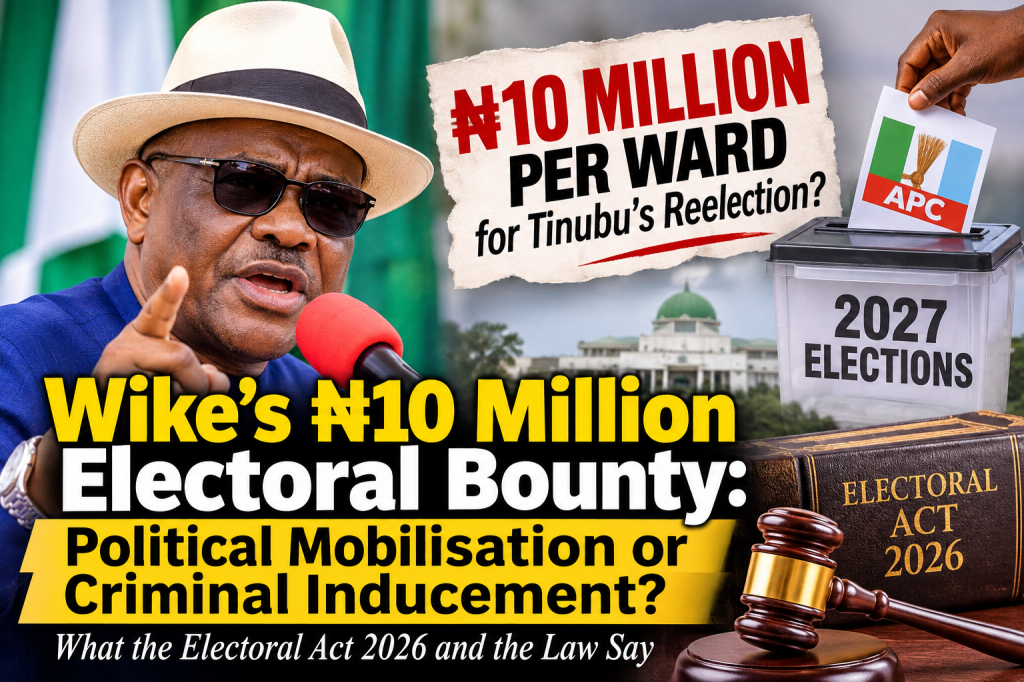
There is an increasingly disturbing tendency in Nigerian politics to treat the electoral process as a commercial transaction. Votes are commodities, political loyalty is negotiable, and electoral victory is something that can be purchased through an elaborate network of financial incentives.
The latest illustration comes from the Minister of the Federal Capital Territory, Nyesom Wike, who has reportedly promised ₦10 million to each councillor who delivers his or her ward to President Bola Tinubu and the All Progressives Congress (APC) in the 2027 general elections.
The announcement was made at a Rainbow Coalition stakeholders’ meeting in Kwali Area Council on 9 November 2026.
Wike reportedly instructed the councillors to engage community leaders, youth groups and associations to secure electoral victory for Tinubu and APC candidates. The promise, if extended to all 62 councillors in the FCT, could amount to ₦620 million.
Wike has subsequently defended the arrangement, arguing that it is a reward for political mobilisation rather than vote-buying. His explanation is that he did not instruct anybody to distribute money to voters in exchange for their votes. Instead, he challenged political actors to work for electoral victory and promised to reward those who succeeded.
He likened the arrangement to bonuses paid to athletes for winning sporting competitions.
It is an interesting defence. Unfortunately, the law does not necessarily share the distinction he wishes to draw.
The relevant question is not simply whether money is handed directly to voters. It is whether money is corruptly offered to another person as an inducement to procure electoral victory.
And that takes us directly to the Electoral Act 2026.
1. Section 125(1)(a): The question of electoral bribery
The most relevant provision is section 125(1)(a) of the Electoral Act 2026, which deals with bribery and conspiracy.
It criminalises a person who directly or indirectly, personally or through another person, corruptly makes a gift, loan, offer or promise to another person in order to induce that person to procure or endeavour to procure:
– The return of a person as a member of a legislative house;
– The return of a person to an elective office; or
– The vote of any voter at an election.
The significance of this provision should not be overlooked.
The law does not restrict electoral bribery to the person standing in front of a polling booth receiving cash. It also addresses the person who provides financial inducements to an intermediary to procure electoral victory.
Consider the arrangement announced by Wike.
A financial reward of ₦10 million is promised to a councillor. The condition is that the councillor must deliver his or her ward to Tinubu and APC candidates.
The councillor is therefore being offered a financial benefit conditional upon securing an electoral outcome.
This is precisely why section 125(1)(a) deserves serious consideration.
The statutory language does not require the money to be handed directly to voters. It expressly contemplates an inducement offered to someone who is expected to procure or endeavour to procure the return of a candidate to elective office.
There is, however, an important legal qualification.
The prosecution would have to establish that the offer was made corruptly and with the requisite intention to procure electoral victory. Political mobilisation, canvassing, campaign organisation and payment for legitimate campaign services are not automatically criminal.
The issue is whether the proposed payment is a legitimate campaign expense or a corrupt inducement for the procurement of an electoral result.
That distinction must be determined from the evidence, not simply from the minister’s description of the transaction.
2. Section 125(1)(b): The responsibility of the recipient
The same section also addresses the person who, upon or in consequence of a corrupt gift, loan, offer or promise, procures or endeavours to procure the return of a candidate to elective office or the vote of a voter.
Consequently, the legal exposure is not necessarily confined to the person making the promise.
If a councillor accepts the financial inducement and undertakes to deliver the ward in consequence of that inducement, the councillor’s conduct may also fall within section 125(1)(b).
Section 125(5) further criminalises conspiracy, aiding and abetting offences under the relevant Part of the Act.
The provision therefore potentially reaches both the person financing the arrangement and those who knowingly participate in its corrupt execution.
There is a further qualification worth mentioning. Section 125(3) preserves payments for lawful expenses genuinely incurred in connection with an election.
That exception is important. A genuine reimbursement of documented campaign expenditure is not necessarily bribery. But a flat ₦10 million bonus conditional upon delivering an electoral result is a different proposition.
Calling a payment a reward does not automatically transform it into a lawful campaign expense.
3. Section 131: Undue influence
Another provision worth examining is section 131 of the Electoral Act 2026, dealing with undue influence.
It criminalises the corrupt payment of money, directly or indirectly, to influence another person to vote or refrain from voting, or payments made on account of a person having voted or refrained from voting.
There is, however, a timing requirement.
The provision applies after the date of an election has been announced. Accordingly, whether it applies to Wike’s November 2026 announcement will depend on the relevant election timetable and the statutory requirement being satisfied.
It would therefore be premature to declare section 131 conclusively engaged by the announcement alone.
Section 125 remains the more immediate provision because its language expressly criminalises corrupt promises intended to procure electoral victory.
4. The ICPC Act: Abuse of public office and gratification
The Electoral Act is not the only legislation that may become relevant.
The Corrupt Practices and Other Related Offences Act 2000 also deserves consideration.
Section 19 criminalises the use of public office or position by a public officer to gratify or confer a corrupt or unfair advantage upon himself, a relation, an associate or another public officer.
The punishment prescribed is imprisonment for five years without an option of fine.
Wike is not making this announcement as an ordinary private citizen. He is a serving Minister of the Federal Republic and the political activity is taking place alongside his ministerial responsibilities.
The question is whether he is using the authority, resources or influence of his public office to confer an improper advantage on political associates.
If public resources are involved, the matter becomes considerably more serious.
The investigation would need to establish the source of the money, the capacity in which it is being offered, the relationship between the ministerial office and the proposed payments, and whether public office has been used to confer a corrupt or unfair advantage.
Section 18 of the ICPC Act may also become relevant where gratification is offered to a public officer to induce or reward the performance of an official act. Its application would depend on whether the necessary connection with official functions can be established.
It is important not to assume that every payment to a politician is automatically an offence under the ICPC Act. The statutory elements must be proved.
Nevertheless, the ICPC has sufficient reason to examine the circumstances if there is evidence that public office or public resources are being deployed for an improper political benefit.
5. The constitutional Code of Conduct for Public Officers
There is also a constitutional dimension.
Paragraph 1 of Part I of the Fifth Schedule to the 1999 Constitution provides that a public officer must not put himself in a position where his personal interest conflicts with his duties and responsibilities.
Paragraph 6 prohibits a public officer from asking for or accepting property or benefits for himself or another person on account of anything done or omitted in the discharge of his official duties.
Paragraph 13 further provides that a public officer cannot escape responsibility for a prohibited act merely because it was performed through a nominee, trustee or agent.
These provisions raise legitimate questions about the boundaries between ministerial responsibility and partisan political activity.
The Code of Conduct provisions should not be stretched to suggest that a minister cannot participate in politics or support a political party. Ministers are not stripped of their political rights.
The constitutional concern arises where public office is used in a manner that conflicts with the responsibilities attached to that office or facilitates an improper advantage.
The source and intended use of the money therefore become particularly important.
6. Where is the money coming from? Sections 91, 92 and 93
Perhaps the most important unanswered question is the source of the proposed ₦620 million.
Is it Wike’s personal money?
Is it money contributed by political supporters?
Is it money belonging to the APC or another political organisation?
Or is it money sourced from public funds?
These are not interchangeable categories.
Section 91 of the Electoral Act 2026 empowers INEC to limit contributions by individuals to political parties or candidates and demand information about the amounts contributed and the source of funds.
Section 92 establishes expenditure limits for candidates. The presidential election expenditure ceiling is ₦10 billion.
Section 93 deals with political party election expenses, including accounting and audited returns.
If the proposed payments are financed or incurred by or on behalf of a political party as election expenditure, the applicable spending limits and reporting requirements must be considered.
It would be wrong, however, to conclude that the minister’s promise automatically constitutes an expenditure by the presidential candidate. The legal relationship between the donor, party, candidate and expenditure must first be established.
The Electoral Act also requires transparency in political party contributions.
A political organisation cannot simply turn electoral financing into an unaccountable cash-distribution arrangement and expect statutory reporting requirements to disappear.
The Nigerian public deserves to know who is financing the proposed payments and under what authority.
7. The fundamental constitutional question: Is the minister governing or campaigning?
There is a broader constitutional issue that should not be lost in the debate over the criminal provisions.
The FCT Minister occupies a public office entrusted with responsibilities concerning the administration and development of the Federal Capital Territory.
The office is not a private political enterprise.
Under section 14(2)(c) of the Constitution, the participation of the people in their government is a fundamental objective of the Nigerian State.
Section 14(2)(a) further provides that sovereignty belongs to the people of Nigeria, from whom government derives its powers and authority.
Elections are the constitutional mechanism through which citizens exercise that sovereignty.
Political parties are entitled to campaign. Political leaders are entitled to mobilise support. Candidates are entitled to persuade voters to support their programmes.
But the constitutional legitimacy of elections rests on the freedom of citizens to make their choices without corrupt inducement, intimidation or manipulation.
There is a difference between persuading citizens to vote for a candidate and paying political intermediaries to deliver a predetermined electoral result.
The latter raises a particularly uncomfortable question about whether political loyalty is being treated as a commercial service.
8. What should INEC and the anti-corruption agencies do?
The announcement is sufficiently specific to justify public scrutiny.
INEC should examine whether the proposed financial arrangement engages section 125 of the Electoral Act 2026.
The Independent Corrupt Practices and Other Related Offences Commission should examine whether public office has been used to confer an improper advantage and whether public resources are involved.
The Economic and Financial Crimes Commission may also have a role if evidence emerges of diversion, laundering or other financial crimes.
At a minimum, the following questions deserve answers:
1. Who is providing the ₦10 million per councillor?
2. Is the money personal, political-party or public money?
3. What precisely does delivering a ward mean?
4. Is the payment conditional on the actual electoral result?
5. Will the payments be declared as political contributions or campaign expenditure?
6. What independent mechanism will verify the expenditure and its source?
These are questions of public accountability, not merely partisan criticism.
Conclusion: Electoral victory cannot be purchased through intermediaries
Wike’s defence rests on a distinction between paying voters and rewarding the people who organise them.
That distinction may be politically convenient, but section 125(1)(a) of the Electoral Act 2026 is not confined to direct payments to voters. It expressly addresses corrupt offers and promises made to intermediaries to procure electoral victory.
The prosecution of any individual would, of course, require proof of the statutory elements, including the corrupt character and purpose of the inducement. An announcement, however controversial, is not itself a criminal conviction.
But neither should the language of political mobilisation become a convenient escape route from electoral accountability.
If the arrangement is a legitimate campaign expense, its source, purpose and accounting should withstand scrutiny.
If it is a corrupt financial inducement to procure an electoral outcome, the Electoral Act provides a framework for investigation and prosecution.
There is something fundamentally wrong with a political culture in which public officials discuss the delivery of entire wards as though citizens were parcels awaiting dispatch.
A ward is not the personal property of its councillor. Its voters are not employees of a political party. Their votes are not assets held in trust by local political operatives.
The Nigerian Constitution gives sovereignty to the people, not to the political machinery that claims to speak on their behalf.
A councillor may organise a campaign. A minister may endorse a candidate. But neither has the legal authority to convert the people’s sovereign votes into a financial contract.

