


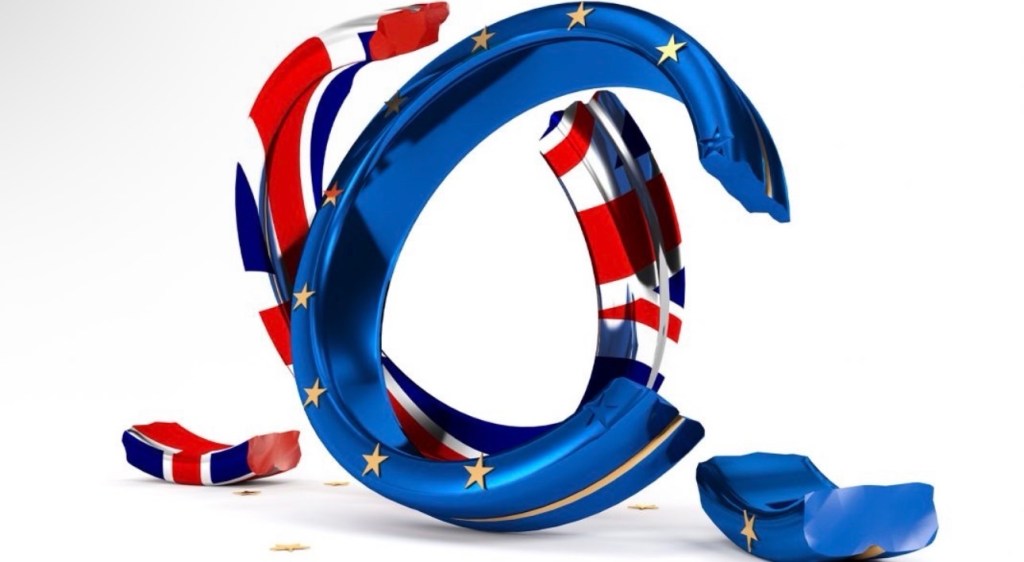
Exactly ten years ago, 52% of Britain voted to step off the continental cruise ship and construct a sovereign raft. Three years later, in 2019, this article originally warned that the country was about to paint a giant clown mask on its face by electing Boris Johnson, chasing a “rainbow highway” where trade-offs didn’t exist.
A decade into this spectacular experiment, the verdict is in. The predictions didn’t just come true; they arrived with a vengeance, accompanied by a rotating door at 10 Downing Street.
Just weeks ago, Keir Starmer announced his resignation, making him the seventh Prime Minister to be chewed up and spat out by the British political machine in ten years. It turns out that whether you approach Brexit with right-wing bravado or Labour’s “sensible manager” energy, objective reality remains entirely undefeated.
The 10-Year Receipt: A decade after the vote, economists confirm the UK economy is 6% to 8% smaller than it would have been inside the EU. That is not a statistical rounding error; it is a permanent, self-inflicted economic haircut.
The Myth of the Frictionless Fantasy
The original article pointed out the foundational lie of the Leave campaign: that Britain could possess full regulatory autonomy while maintaining frictionless trade with its largest market.
We now have the data on how that fantasy met the border patrol:
- The SME Exodus: Roughly 39,000 small and medium-sized British businesses have completely stopped exporting to the EU. They didn’t stop because they ran out of things to sell; they stopped because they drowned in the VAT paperwork, customs declarations, and logistics costs.
- The Productivity Trap: Business investment stagnated for years under a cloud of policy uncertainty. While the rest of the world was investing in tech and innovation, British management was busy filling out phytosanitary forms for sausages.
The Great Immigration Irony
If there was one emotional pillar of the Brexit vote, it was “taking back control” of Britain’s borders to reduce immigration. The populist press promised an immediate end to foreign workers taking up space.
What actually happened is pure comedic irony. To combat crippling labor shortages in healthcare and hospitality, the government had to implement a points-based visa system. Far from falling, net migration actually surged to an all-time record of 891,000 in 2022. The only difference? Instead of young Eastern Europeans coming to work in cafes and fields, the UK imported workers from non-EU nations to prop up the NHS.
We traded free movement with our neighbors for a massive bureaucratic visa apparatus, only to end up with more immigration.
A decade after the vote, economists have confirmed that the UK economy is 6% to 8% smaller than it would have been if the country had stayed inside the European Union. This is not just a minor statistical rounding error; it represents a permanent, self-inflicted economic haircut.
The “Reset” That Wasn’t
When Labour took power in 2024, the plan was to fix the relationship with a sophisticated, grown-up “reset.” The rhetoric changed from screaming about betrayal to proposing a sleek “single market for goods.”
But Brussels has the memory of an elephant and the rigidity of a diamond. The EU’s response to Starmer’s recent overtures was a polite, bureaucratic door slammed in the face: No cherry-picking. You cannot have the benefits of the single market without accepting the four freedoms including the free movement of people.
Starmer ran directly into the exact same brick wall that broke Theresa May: you cannot negotiate away the laws of physics, and you cannot negotiate away the fundamental rules of the European Union. Hemmed in by his own political red lines and a restless electorate, Starmer became yet another casualty of the never-ending soul search.
The Permanent Lesson
A decade later, Britain has finally stopped debating whether the tooth fairy exists. The culture war has cooled into a dull, grinding acceptance of a suboptimal reality. The “magic technological solutions” for the Irish border turned into the Windsor Framework; the grand US-UK trade deal was thoroughly minimized; and the country has accepted a lower growth trajectory as the price of its sovereign isolation.
The original article concluded with a hope that Britain would remember that choices involve trade-offs. It took ten years, an economic throttling, and enough Prime Ministers to field a 5-a-side football team with substitutes, but the lesson has finally been beaten into the national consciousness.
Sovereignty is a fine thing to chase. But when you build an entire national strategy on a refusal to look at a spreadsheet, the spreadsheet always wins in the end.

