In 1998, Hollywood released Small Soldiers, a film that was far more insightful than its creators probably intended.
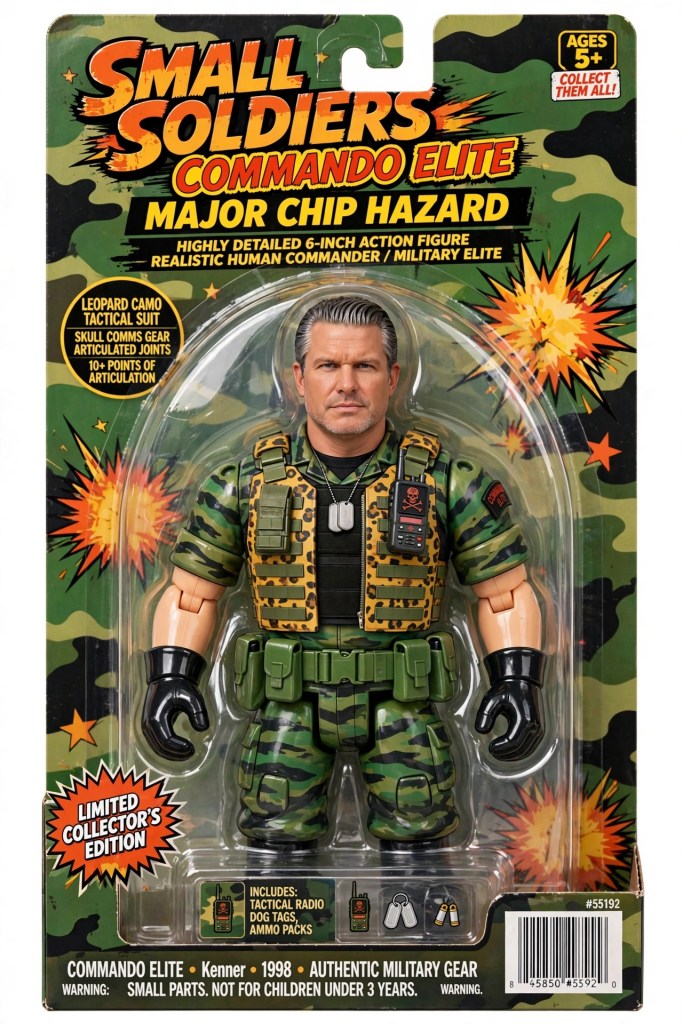
The star of the show was Major Chip Hazard, commander of the Commando Elite. He had the voice of Tommy Lee Jones, the swagger of a decorated war hero and the confidence of a man who believed every problem could be solved with sufficient firepower.
Major Chip Hazard looked like a soldier.
He sounded like a soldier.
He talked like a soldier.
The catch was that he was a toy.
Nearly three decades later, America appears to have recreated the character in real life.
Donald Trump’s return to the White House marked the triumph of image over expertise. Cabinet positions increasingly resembled casting decisions. Loyalty became more important than experience. Television skills became more valuable than administrative competence.
The Pentagon eventually found itself under the stewardship of Pete Hegseth, a former Army Major and television host whose primary qualification appeared to be his ability to look directly into a camera and sound perpetually outraged.
To be fair to Hegseth, he certainly looked the part.
He wore the military bearing comfortably.
He spoke in martial language.
He projected toughness.
He seemed tailor-made for an administration that prefers strength as performance art.
Like Major Chip Hazard, he arrived fully equipped with confidence.
What he lacked was the one thing that becomes indispensable when nations actually go to war.
Judgment.
The Department of Defense or the War Department?
At one point Hegseth began publicly embracing the language of the old “War Department”, a title that disappeared from American law in 1947 when Congress created the Department of Defense.
To many supporters this sounded refreshing.
Defense sounded cautious.
War sounded strong.
The symbolism was obvious. America was back. The warriors were in charge.
The problem is that military effectiveness is not measured by branding exercises.
Calling a hospital a battlefield does not make doctors soldiers.
Calling the Pentagon the War Department does not make its leadership strategic geniuses.
It merely changes the stationery.
Unfortunately, Washington has increasingly confused military aesthetics with military competence.
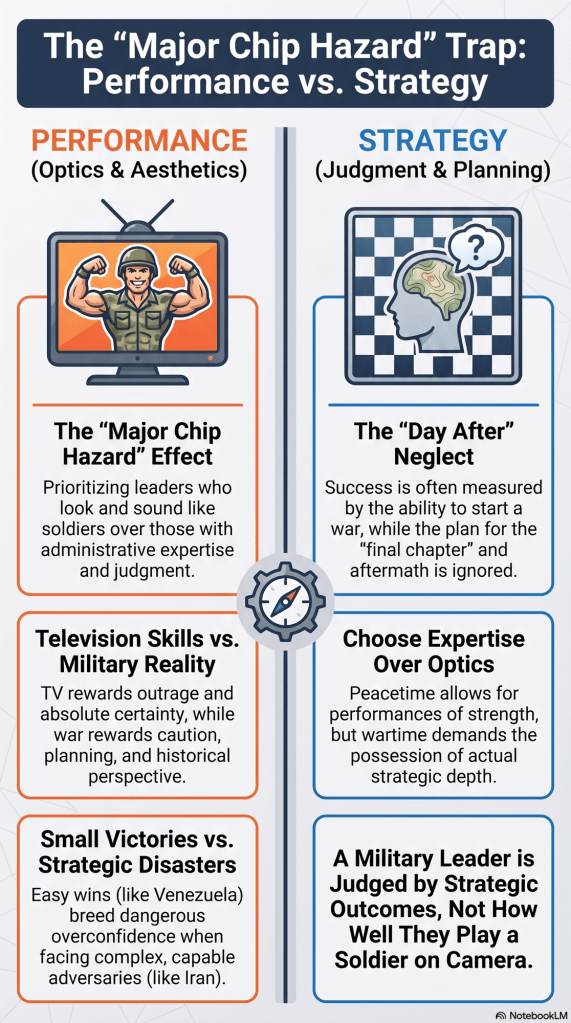
The Difference Between Television and Warfare
America has spent years elevating television personalities into positions of immense responsibility.
The skills required to host a television programme are not the skills required to manage a military superpower.
Television rewards confidence.
War punishes overconfidence.
Television rewards certainty.
Military history rewards caution.
Television rewards dramatic statements.
Reality rewards careful planning.
Yet modern politics increasingly treats performance as a substitute for expertise.
The result is that governments recruit performers and then appear surprised when reality demands administrators.
The danger becomes especially acute when a nation transitions from peacetime rhetoric to wartime decisions.
During peacetime, almost anybody can sound like Patton.
During wartime, reality conducts the auditions.
Venezuela: Trump’s Grenada Moment
Every American administration seems to acquire its own Grenada.
A conflict small enough to produce headlines, dramatic enough to project strength and limited enough to avoid immediate political consequences.
For Ronald Reagan, it was Grenada.
For Donald Trump, it may well be Venezuela.
The operation delivered precisely the sort of result that modern politicians adore. There were images of American power, declarations of success and triumphant commentary from supporters. The administration could point to action rather than deliberation, force rather than diplomacy.
The danger lies not in the victory itself but in the conclusions drawn from it.
Small victories have a habit of whispering dangerous lies into the ears of powerful men.
They suggest that future wars will be equally manageable.
They encourage leaders to believe that military force is a universal solvent capable of dissolving every geopolitical problem.
History repeatedly demonstrates otherwise.
Grenada was not Iraq.
Iraq was not Afghanistan.
Afghanistan was not Libya.
And Venezuela is certainly not Iran.
Yet the temptation remains the same.
A successful limited operation creates a sense of invincibility. Political leaders begin to view military power as a reliable shortcut to complex political outcomes. Advisors who raise questions are dismissed as pessimists. Skeptics are portrayed as weak.
Soon confidence evolves into overconfidence.
The Trump administration appears to have learned precisely the wrong lesson from Venezuela. Rather than viewing it as a unique operation with unique circumstances, it seems to have been treated as proof that larger and more dangerous confrontations can be managed with similar ease.
That is where Pete Hegseth enters the story.
Like Major Chip Hazard, he speaks as though every challenge has a military solution and every military solution is straightforward. The rhetoric is always decisive. The certainty is always absolute.
Reality, unfortunately, does not operate on television scripts.
The Missing Chapter
Military planners often devote enormous attention to the opening chapter of a conflict.
Far less attention is given to the final chapter.
The invasion of Iraq remains perhaps the most expensive illustration of this principle.
Washington knew how to remove Saddam Hussein.
It had no coherent plan for governing Iraq afterward.
The result was years of insurgency, sectarian violence, regional instability and trillions of dollars in expenditure.
History’s graveyard is crowded with leaders who mastered the art of beginning wars and neglected the art of ending them.
This is where the current enthusiasm for confrontation with Iran becomes troubling.
The advocates of military action discuss targets, weapons systems and tactical objectives.
The questions they avoid are considerably more important.
What follows the strikes?
What follows escalation?
What follows retaliation?
What follows regional destabilisation?
What follows regime weakening?
What follows military success?
The phrase “day after” remains the most neglected phrase in modern warfare.
Iran Is Not Venezuela
One of the recurring problems in Washington is the tendency to treat every conflict as if it were simply a larger version of a previous one.
Iran is not Venezuela.
Iran is not Grenada.
Iran is not Panama.
Iran is not Libya.
Iran is not Iraq.
Iran possesses significant military capabilities, regional influence, strategic geography and decades of institutional experience surviving pressure from larger powers.
Military action may achieve tactical victories.
Tactical victories are not strategic outcomes.
The United States learned this lesson in Vietnam.
It learned it again in Afghanistan.
It learned it once more in Iraq.
Each lesson appears to have been promptly misplaced.
The architects of Iraq believed they were creating a new Middle East.
The architects of Afghanistan believed they were building a stable democracy.
The advocates of intervention in Libya imagined a cleaner, more prosperous future.
Reality delivered a different verdict.
The recurring assumption is always the same.
The war will be easy.
The aftermath will somehow take care of itself.
History’s response is equally consistent.
No, it will not.
When the Batteries Run Low
The genius of Small Soldiers was that Major Chip Hazard’s fearsome image ultimately collapsed under scrutiny.
His aggression was not evidence of wisdom.
His certainty was not evidence of competence.
His confidence was not evidence of understanding.
The electrical current that fried his military chip exposed what he truly was.
A plastic toy programmed to fight.
Reality performs a similar function in politics.
Wartime has a way of exposing weaknesses that peacetime conceals.
Public relations campaigns stop working.
Television appearances become irrelevant.
Political slogans lose their magic.
The spotlight shifts from performance to results.
And results are stubborn things.
A defence secretary is not judged by how forcefully he speaks.
He is judged by outcomes.
By planning.
By preparedness.
By foresight.
By understanding consequences before they arrive.
The challenge facing Pete Hegseth and the Trump administration is that history has seen this movie before.
Leaders become captivated by the promise of quick victories.
They assume military force can achieve political objectives at acceptable cost.
They underestimate complexity.
They overestimate control.
Then reality arrives carrying a very large invoice.
History’s Unpleasant Habit
History possesses an irritating habit of refusing to stay buried.
Every generation believes it has discovered new answers to old problems.
Every generation eventually discovers why those problems existed in the first place.
That is why competence matters more than appearances.
It is why expertise matters more than television ratings.
It is why governments should resist confusing military branding with military strategy.
And it is why Major Chip Hazard remains one of the most unintentionally relevant political metaphors of the twenty-first century.
The toy soldier looked impressive.
The toy soldier sounded impressive.
The toy soldier was absolutely convinced of his own brilliance.
Then reality hit him with a surge of electricity and exposed the plastic beneath the camouflage.
Wars have a similar effect on governments.
Peacetime allows leaders to perform strength.
Wartime requires them to possess it.
The question confronting Washington today is whether it has learned anything from Vietnam, Iraq, Afghanistan and Libya before embarking on yet another confrontation whose consequences extend far beyond the first round of missiles.
The evidence so far is not encouraging.
Major Chip Hazard would probably approve.
Which is precisely the problem.