

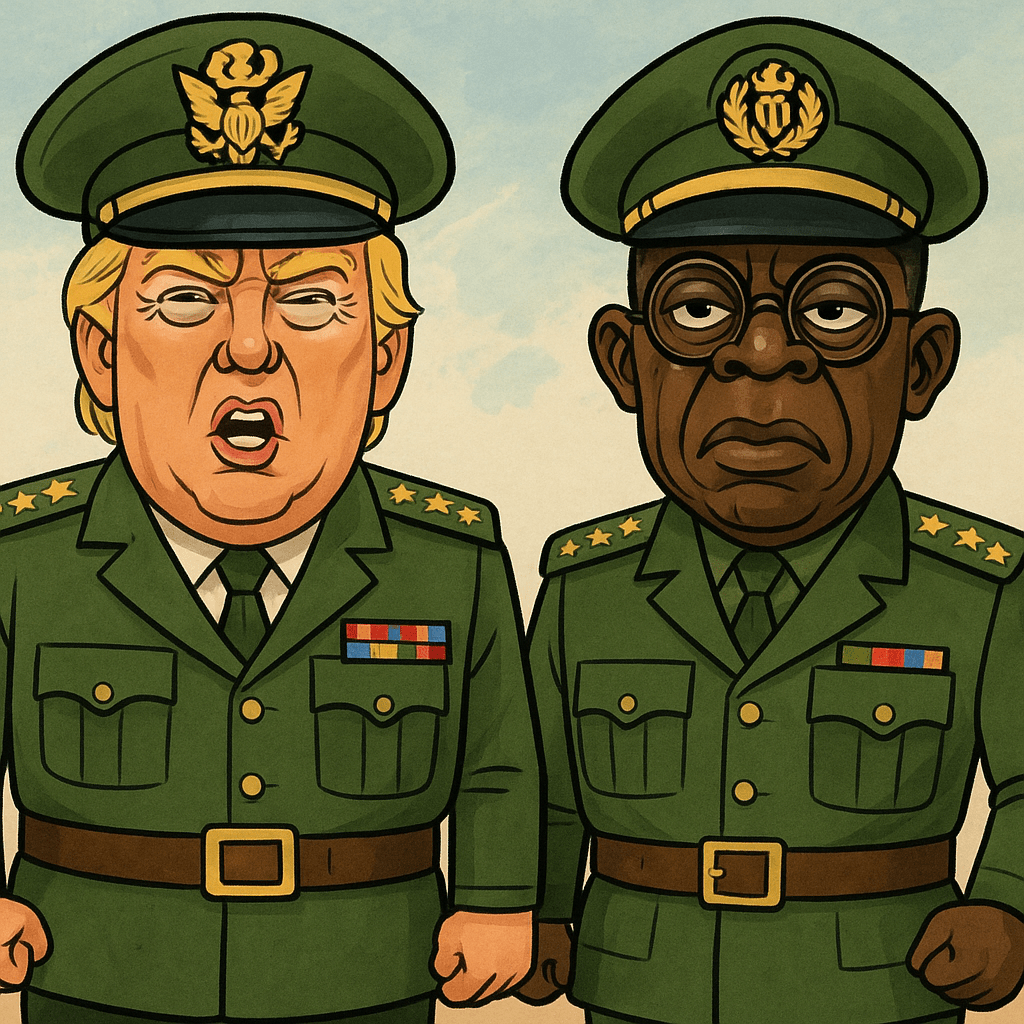
When a leader becomes more interested in the symbol of his authority than the substance of his government, politics begins to resemble a cult. The insignia becomes the message, the slogan becomes the policy, and the citizen is expected to admire the packaging while living with the consequences.
There is something particularly dangerous about political leaders who govern through an insignia. They understand the power of symbols, the attraction of simple slogans and the psychological appeal of belonging to something larger than oneself. They give their followers a badge, a colour, a slogan or an easily recognisable identity. They then invite the public to look towards that symbol as though it contains the answers to the country’s problems.
But what happens when the symbol becomes more important than the government it is supposed to represent?
What happens when the political brand is carefully maintained, the leader’s image relentlessly promoted, and the machinery of publicity works overtime, while the substance of governance remains conspicuously absent?
We end up with audio government, politics by illusion and power pursued for its own sake.
The insignia is visible. The substance is harder to find.
The politics of the symbol
Consider three very different political figures: Bola Ahmed Tinubu, Donald Trump and Adolf Hitler.
Yet there is a useful political question that can be asked across these otherwise very different examples: how does a leader use a recognisable political identity to organise loyalty, shape public perception and make personal authority appear inseparable from the nation?
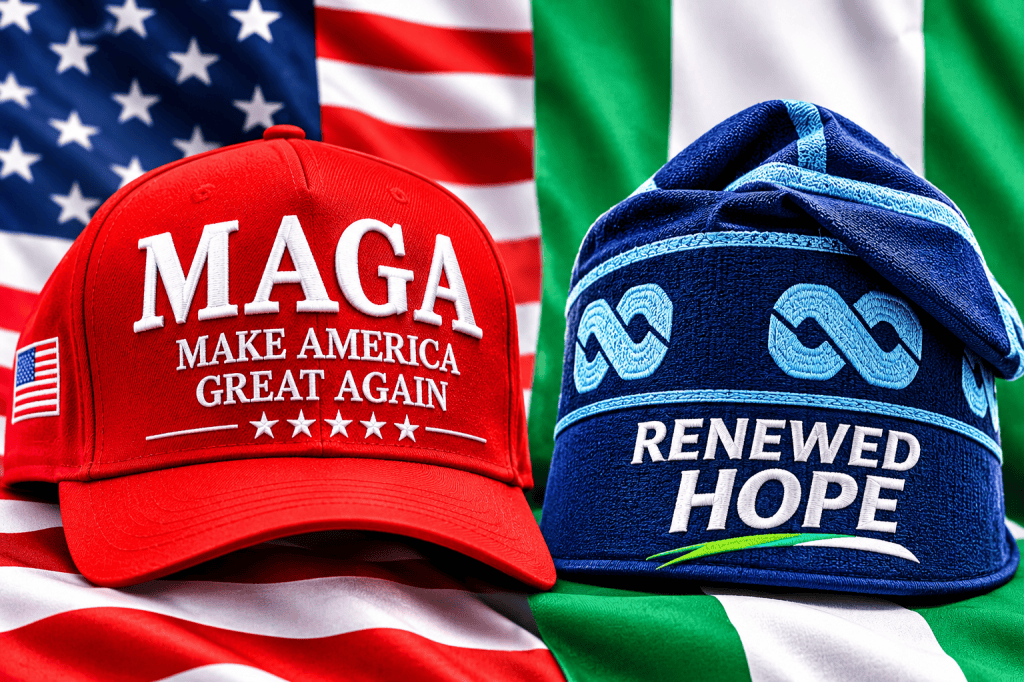
Trump has MAGA. Tinubu has Renewed Hope. Hitler had the swastika and the elaborate visual and ceremonial machinery of National Socialism.
They demonstrate the political power of branding and insignia.
The slogan is short enough to remember. The symbol is simple enough to reproduce. The message is sufficiently uncomplicated to travel from political rallies to television screens, social media and the conversations of ordinary supporters.
The danger begins when citizens are encouraged to confuse recognition with achievement, loyalty with accountability, and the leader’s public image with the performance of the state.
A political slogan can communicate an aspiration. It cannot substitute for delivering it.
The leader as the product
The modern political leader increasingly resembles a commercial product. There is a logo, a slogan, a carefully constructed personality and an army of promoters. Political communication becomes less about explaining what government has done and more about persuading people to believe what government represents.
Trump’s MAGA movement illustrates the effectiveness of this approach. The red cap became a recognisable political object, an expression of identity and a declaration of allegiance. The Smithsonian’s National Museum of American History records the development of the MAGA slogan into a trademarked campaign identity and the popularity of the red campaign cap. Smithsonian Institution
Tinubu’s Renewed Hope has similarly become the central identity of his administration. The Nigerian Presidency presents it as an eight-point development agenda, covering economic growth, security, agriculture, energy, infrastructure and other priorities. The Presidency +1
There is nothing inherently wrong with a government having a slogan or a recognisable identity. Governments need to communicate their programmes. Political movements need symbols. The problem arises when communication becomes a substitute for performance.
A government cannot feed people with a logo. It cannot secure communities with a slogan. It cannot create employment by repeatedly announcing its commitment to economic growth.
Nor can a presidential administration demand that citizens measure its success by the number of times its slogan appears on government billboards, television advertisements and social media accounts.
The proper measure is what happens to the citizen.
Does the child have access to education? Can the family afford food? Can the business obtain reliable electricity? Can a citizen travel without fear of kidnapping? Can the public trust the institutions that are supposed to protect it?
These are the questions that should define political success.
The political brand should be the receipt for delivery, not a substitute for the goods.
Hitler and the industrialisation of political imagery
The Hitler comparison requires historical precision.
The Nazi swastika was not merely a campaign logo. It became an instrument of ideological mobilisation, racial exclusion, terror and state power. The United States Holocaust Memorial Museum documents how Nazi propaganda used symbols, flags, slogans, posters, radio and other mass communication to manufacture political allegiance and spread its racial ideology.
Hitler understood that a political movement could be made instantly recognisable. Its symbols were everywhere. Its leader was presented as the embodiment of the nation. Its propaganda cultivated the idea that loyalty to the leader was loyalty to Germany itself.
The personality cult was deliberately constructed. The Holocaust Memorial Museum describes how Nazi propagandists portrayed Hitler as the living embodiment of the German nation and cultivated public adulation as a mass phenomenon.
This is where the historical lesson becomes relevant to contemporary politics.
The danger is not that every politician with a slogan is Hitler. That would be a careless and historically indefensible comparison. The danger is the political mechanism through which a leader’s identity is made larger than the institutions of the state.
When the leader becomes the movement, the movement becomes the government, and the government becomes an extension of the leader’s personal authority, democratic accountability begins to lose its independence.
The citizen is no longer encouraged to ask whether the government is performing. The citizen is encouraged to demonstrate whether he or she is loyal.
That is a profound reversal of the democratic relationship.
In a democracy, the leader is accountable to the people. In a personality cult, the people are increasingly expected to demonstrate their loyalty to the leader.
Government by PR and the emptiness behind the watermark
The watermark is an interesting metaphor for this kind of politics.
A watermark is visible, recognisable and deliberately embedded in a document. It identifies the source. But it is not the substance of the document.
Political insignia can function in precisely the same way. The branding is everywhere, but the question remains whether anything of value is contained beneath it.
The administration can commission advertisements, organise rallies, distribute branded merchandise, manufacture hashtags and maintain an army of political defenders. It can make every public event an opportunity to promote the leader’s identity.
But publicity cannot permanently conceal the difference between what a government says and what it does.
Indeed, the more a government depends on public relations to manufacture an impression of achievement, the more important it becomes to examine its actual record.
This is not an argument that all government communication is propaganda or that every public information campaign is dishonest. It is an argument that communication must remain subordinate to accountability.
A road is not completed because the President’s photograph appears on a billboard beside it. A reform is not successful because a minister has announced it. An economic recovery is not established because the government has produced a presentation celebrating it.
The country is not a marketing campaign.
And the citizen is not a consumer obliged to accept whatever the political brand promises.
From political movement to political cult
There is another consequence of politics built around the leader’s insignia: the gradual transformation of political supporters into guardians of the leader’s reputation.
The party ceases to be primarily an organisation for debating policy, scrutinising government and producing alternative ideas. It becomes a loyalty network.
The political appointment is increasingly understood as a reward for allegiance. Access to power depends on proximity to the leader. Public criticism is interpreted as hostility to the movement. Those who question government decisions are accused of undermining the national project.
In such an environment, the distinction between public interest and the leader’s personal interest becomes dangerously blurred.
This is where the pursuit of power for its own sake becomes particularly corrosive.
Power is supposed to be an instrument for achieving public objectives. It is not an entitlement, a personal possession or a family inheritance. Yet when political authority becomes inseparable from the personality of its holder, the incentives change.
Loyalty can become more valuable than competence. Obedience can become more useful than independent judgment. Political survival can take precedence over national development.
And corruption finds a comfortable environment in which to operate.
It is important to understand that corruption is not automatically produced by political branding. Nor does every personality-driven movement necessarily become a dictatorship. But where institutions are weakened, scrutiny is discouraged and loyalty to an individual replaces accountability to the public, the opportunities for abuse of power multiply.
The ultimate tragedy is that the machinery of government can remain physically intact while its democratic purpose is hollowed out.
Parliament may still sit. Courts may still function. Elections may still take place. Ministries may still issue statements. But if the institutions cannot independently challenge the political leadership, their existence alone does not guarantee effective constitutional government.
The state becomes increasingly personalised.
The emptiness of power
Perhaps the greatest irony of these political arrangements is that they promise national greatness while concentrating so much attention on the greatness of the leader.
The country is asked to admire the man, the movement and the insignia. The political conversation becomes a continuous referendum on the leader’s personality.
Meanwhile, the ordinary business of government risks becoming secondary.
Trump’s MAGA, Tinubu’s Renewed Hope and Hitler’s swastika belong to different political and historical worlds. Examining the different ways political symbols can organise allegiance raises a common question about the relationship between political identity, propaganda and accountability.
Who benefits when the symbol becomes more important than the institution?
Who benefits when the leader becomes more important than the country?
And who benefits when citizens are so preoccupied with defending a political personality that they forget to demand an account of public expenditure, public appointments, public policy and public performance?
The answer is usually found close to the centre of power.
A political movement should be bigger than its leader. A political party should be capable of questioning its own government. A constitution should be stronger than the personality of the person occupying the presidency.
These are not luxuries of democracy. They are its safeguards.
The citizen must look beyond the insignia
There is a reason democratic societies need independent institutions, a free press, an opposition and citizens who are prepared to question authority.
They exist because power has a natural tendency to protect itself.
The responsibility of citizens is therefore not to become unpaid public relations officers for their political leaders. It is to remain interested in what government actually does.
A slogan should be interrogated. An insignia should be recognised for what it is. A leader should be measured against the promises made and the constitutional obligations undertaken.
The question is not whether Renewed Hope sounds attractive, whether MAGA inspires its followers or whether a political movement has successfully created a recognisable identity.
The question is what these identities produce in the lives of the people.
A nation is not made great by the size of its leader’s image. Hope is not renewed by repeating the word. And political strength is not measured by the number of people wearing the same insignia.
The greatest danger in politics is not necessarily the leader who has a symbol. It is the leader who persuades the people that the symbol is the country, that loyalty to the symbol is loyalty to the nation, and that questioning the leader is an act of betrayal.
When that happens, politics stops being a contest over how best to govern the people. It becomes a competition over who is permitted to stand closest to the person exercising power.
And that is when the insignia becomes a watermark of something far more troubling: a political culture in which the appearance of power survives even when the substance of government has disappeared.
Beware the leader who wants you to admire his insignia more than you examine his government. Behind the loudest political branding, there may be very little beyond the appetite to remain in power.

