

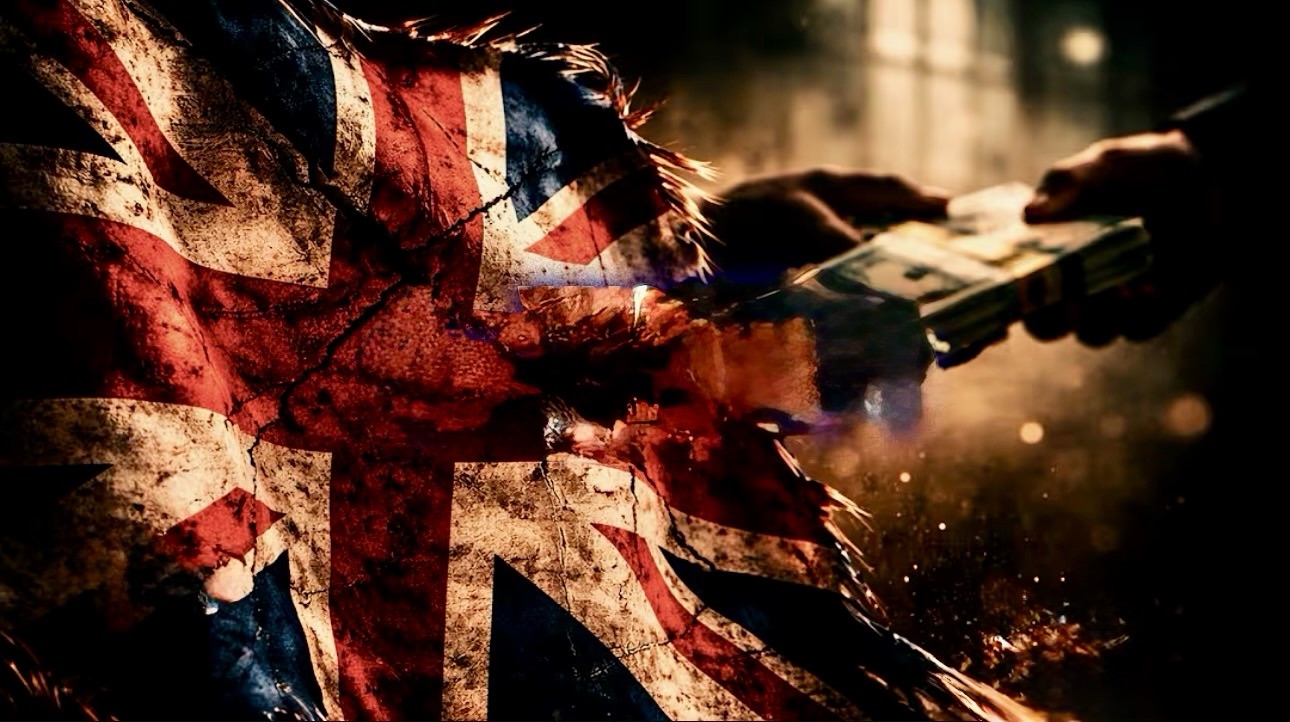
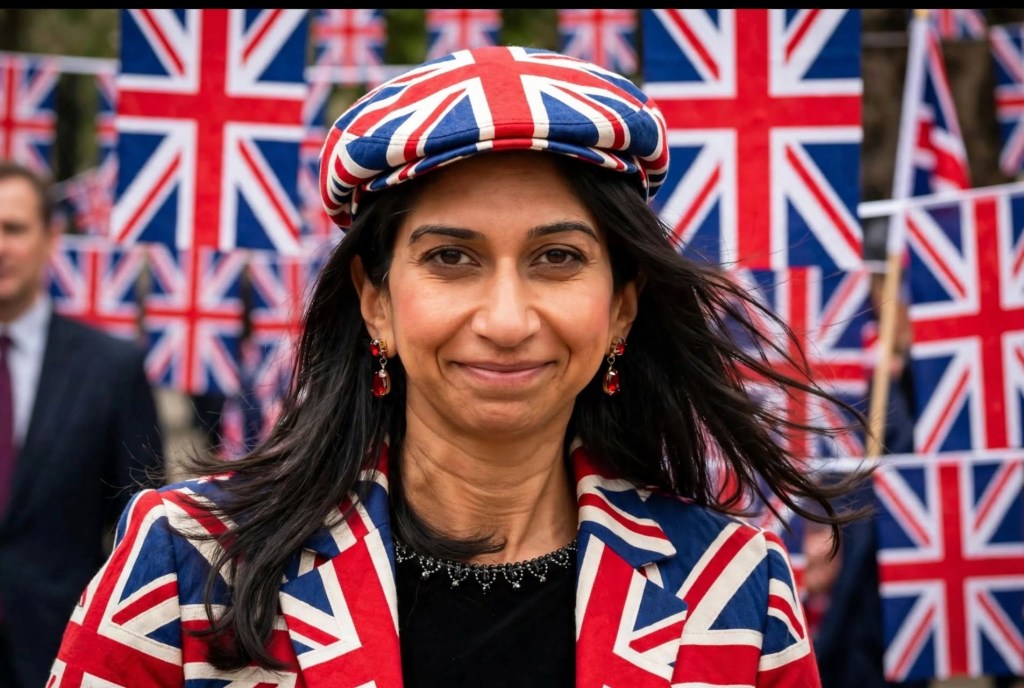
There is something almost touching about the desperation of British political nostalgia.
When a political movement cannot quite explain where Britain should go, it apparently finds comfort in explaining where Britain used to be.
And so, ladies and gentlemen, the Union Jack has been summoned.
Suella Braverman, now comfortably installed in Reform UK after her Conservative political career came to resemble a revolving door with a Union Jack attached to it, has unveiled the latest miracle cure for Britain’s educational crisis.
Every school should fly the Union flag.
Every school should display a portrait of the King.
Children should sing the national anthem and great hymns.
And, most importantly, Britain needs a new “patriotic” and “balanced” curriculum which, according to Braverman, will correct the terrible injustice of children learning too much about the less flattering bits of British history and too little about the good bits. She has also declared that the British Empire “did so much good for the world”.
There we have it.
The great educational revolution of Reform Britain:
More flags. More hymns. More Empire.
Somewhere between the playground and the history classroom, Britain’s productivity crisis has apparently been solved.
The Flag Has Become Reform’s Favourite Policy Instrument
One has to admire the simplicity of it.
Britain has housing problems?
Fly the flag.
The NHS is struggling?
Fly the flag.
Schools need better buildings, teachers and resources?
Fly the flag.
Children are leaving school without the educational foundations they need?
Fly the flag.
Economic growth is weak?
You guessed it.
Fly the bloody flag.
The Reform political machine has discovered the ultimate low-cost policy.
It requires no complicated economic modelling, no difficult infrastructure programme and no tedious negotiations with people who know what they are talking about.
You simply put a Union Jack on the wall and declare the nation restored.
It is political Viagra for a movement suffering from policy impotence.
And the symbolism is everything.
Because once you have persuaded people that the country has been stolen from them, you can avoid the awkward question of who is actually responsible for fixing it.
Britain Has Not Forgotten That It Is Britain
The central absurdity is that Britain supposedly requires this enormous patriotic intervention because British children are in danger of forgetting that they are British.
Really?
This is the country that gave the world Shakespeare, Newton, the Industrial Revolution, parliamentary government, the BBC, the Beatles, the NHS, cricket, imperialism and an almost supernatural ability to queue.
Britain’s problem has never been insufficient exposure to Britishness.
If anything, Britain has spent centuries exporting Britishness to everybody else.
The Union flag is already everywhere.
It flies over government buildings. It appears on passports, military insignia, public institutions, sporting occasions, souvenirs, political rallies and an extraordinary number of mugs.
Indeed, the British Government already encourages the Union flag to be flown year-round on government buildings.
So what precisely is the child in Bradford, Birmingham or Bristol supposed to discover when Braverman’s flagpole finally arrives?
That Britain is Britain?
Thank God.
We nearly missed it.
Kenya Might Have Something to Say About This
There is an especially delicious historical irony in Braverman’s enthusiasm for imperial nostalgia.
Her own family has Kenyan roots.
Kenya became independent from British colonial rule in 1963.
For a newly independent country, national symbolism mattered. The flag represented sovereignty. National institutions and national education helped construct a common identity after colonial rule.
That was nation-building.
Britain is not Kenya in 1963.
Britain is the former imperial power.
It does not need to discover itself through a flag. It needs to understand itself through history.
And that means accepting that the British Empire was neither the satanic horror of simplistic anti-imperial mythology nor the glorious humanitarian project of the Reform imagination.
It was an empire.
It contained achievement, innovation and institutional development.
It also contained conquest, coercion, extraction, racial hierarchy, violence and the denial of political freedom.
Those things are not mutually exclusive.
That is precisely what makes history interesting.
The Empire Was Not a Family Achievement Award
There is something rather peculiar about politicians celebrating imperial achievement as though they personally built the Empire before popping home for tea.
The Empire was not created by “the British people” sitting collectively around a table and agreeing upon a humanitarian development programme.
It was constructed through political power, military force, commercial interests and colonial administration.
Some benefited enormously.
Others did not.
And millions of the people living under British rule did not experience imperialism as a benevolent educational opportunity.
That does not mean Britain must hate itself.
It means Britain must grow up.
A mature nation should be able to say:
We did some remarkable things.
We did some terrible things.
We did some remarkable things while doing terrible things.
And we can study all of them without collapsing into an identity crisis.
That is called history.
It is not an attack on Britain.
Indeed, it is rather insulting to British children to suggest that learning uncomfortable historical facts will somehow destroy their patriotism.
If patriotism is so fragile that it cannot survive a history lesson, perhaps the problem is not the history lesson.
Reform’s Great Enemy: Complexity
This is where Reform’s politics becomes particularly revealing.
Complexity is the enemy.
Everything has to be reduced to a simple moral drama.
Good Britain.
Bad establishment.
Good patriots.
Bad liberals.
Good old days.
Terrible modernity.
British people versus somebody else.
The flag becomes useful because a flag has no footnotes.
You cannot ask a Union Jack whether the East India Company behaved ethically.
You cannot cross-examine a flag about the Amritsar massacre.
You cannot ask a flag about the treatment of Mau Mau detainees.
You cannot interrogate a flag about colonial extraction.
You simply wave it.
And waving is wonderfully efficient because it does not require an answer.
Farage Understands the Theatre Perfectly
Nigel Farage understands this theatre better than almost anybody in British politics.
He knows that modern populism is partly a performance.
The flag campaigners arrive.
The flags go up.
The crowd cheers.
The establishment becomes the villain.
The immigrants become the threat.
The past becomes glorious.
The future becomes frightening.
And Farage becomes the man standing between Britain and “terminal decline”.
At Reform’s recent conference, Farage went further, publicly praising the Raise the Colours campaign and offering legal support to its leader, Ryan Bridge, who attended the conference while on police bail in connection with allegations of racially and religiously aggravated harassment. Bridge denies wrongdoing.
The symbolism could hardly be clearer.
The flag is no longer simply a national symbol.
It has become political territory.
Who waves it.
Who doesn’t.
Who is sufficiently patriotic.
Who is allegedly ashamed of Britain.
Who belongs.
Who supposedly does not.
That is where patriotism becomes dangerous.
Not because loving one’s country is dangerous.
But because politicians can turn the definition of “real patriot” into a political weapon.
And Then Comes the Wonderful Word: “Balanced”
Reform calls its proposed curriculum “balanced”.
What a beautiful word.
Balanced.
One can almost hear the scales of historical justice gently wobbling.
The current curriculum, Reform argues, gives too much attention to negative British history and insufficient attention to Britain’s achievements. Its proposal would place much greater emphasis on British history, with the party saying at least 60 per cent of assessed history content should be British.
But there is a problem.
British history is already taught.
The Magna Carta is taught.
The English Civil War is taught.
The Glorious Revolution is taught.
The Industrial Revolution is taught.
The British Empire is taught.
Victorian Britain is taught.
The question is therefore not whether British history should be taught.
The question is how it should be taught.
And that is where the politics begins.
Because “patriotic history” can easily become history with the uncomfortable bits put into a cupboard and the key thrown into the Thames.
Reform Has Discovered the Magic of the Culture War
This is the great genius of populist politics.
You take real problems.
You attach them to cultural grievances.
Then you give people an enemy.
Britain’s educational problems are real.
Children’s educational outcomes matter.
White working-class boys facing poor educational outcomes deserve serious attention.
Technical education and apprenticeships deserve serious attention.
Universities and vocational education deserve serious debate.
But none of these problems is solved by putting a portrait of King Charles in the school corridor.
And none is solved by turning the history classroom into a patriotic chapel.
Indeed, the Government’s own curriculum reform process already says the refreshed curriculum will strengthen pupils’ understanding of British heritage, British history and fundamental British values, while also being “modern and forward-looking”.
So the argument is not really about whether Britain should teach British history.
It is about who gets to define Britain.
That is the fight.
The Braverman Problem
And perhaps this is the real irony of Suella Braverman.
She was once a Conservative Cabinet minister.
Now she stands on a Reform platform telling us that the Conservatives failed because they were insufficiently Conservative.
This is rather like a chef who burns the restaurant down and then joins the fire brigade to complain about the quality of the extinguishers.
Reform’s answer is apparently to turn up the nationalism.
But Britain does not need politicians competing over who can shout “Britain!” the loudest.
It needs politicians capable of explaining what Britain is going to become.
What is the industrial strategy?
What is the housing strategy?
What happens to the NHS?
How does Britain become more productive?
How does it rebuild infrastructure?
How does it deal with an ageing population?
How does it repair its relationship with Europe?
How does it remain globally competitive?
How does it educate children for an economy that has not yet arrived?
These are difficult questions.
They require policy.
And policy is considerably less photogenic than a Union Jack.
A Nation Is More Than Its Flag
There is nothing wrong with flying the Union flag.
Fly it.
Fly ten if you like.
But don’t confuse the flag with the country.
Britain is not a piece of cloth.
Britain is its people.
Its institutions.
Its history.
Its arguments.
Its inventions.
Its failures.
Its literature.
Its music.
Its universities.
Its NHS.
Its councils.
Its courts.
Its communities.
Its immigrants.
Its minorities.
Its workers.
Its entrepreneurs.
Its eccentric pensioners shouting at the television.
Its children who will inherit whatever country today’s politicians leave behind.
And therein lies the inconvenient truth for Reform.
A confident Britain does not need to constantly announce how confident it is.
A confident Britain can examine its empire without becoming hysterical.
A confident Britain can welcome immigrants without believing the country has ceased to exist.
A confident Britain can celebrate Shakespeare without pretending the Victorians were morally perfect.
A confident Britain can fly the Union flag while acknowledging the Union itself is contested.
A confident Britain can love its country without requiring everybody else to prove that love in precisely the same way.
That is patriotism.
What Reform is offering is something rather different.
It is nostalgia dressed as policy.
Culture war dressed as education.
And the Union Jack used as a political bludgeon.
Britain once ruled an empire on which the sun famously never set.
Perhaps it is time its politicians stopped staring nostalgically at the sunset and started worrying about tomorrow morning.
Because the country does not need another flagpole.
It needs a future.
And if Reform UK has one, it might be helpful if somebody eventually found it and put it in the manifesto.
Until then, wave the flag.
Sing the anthem.
Polish the royal portrait.
And perhaps, somewhere between God Save the King and Rule Britannia, somebody might quietly ask the most unfashionable question in modern British politics:
What exactly is the plan for Britain?
 Centre for Nigeria Progress