

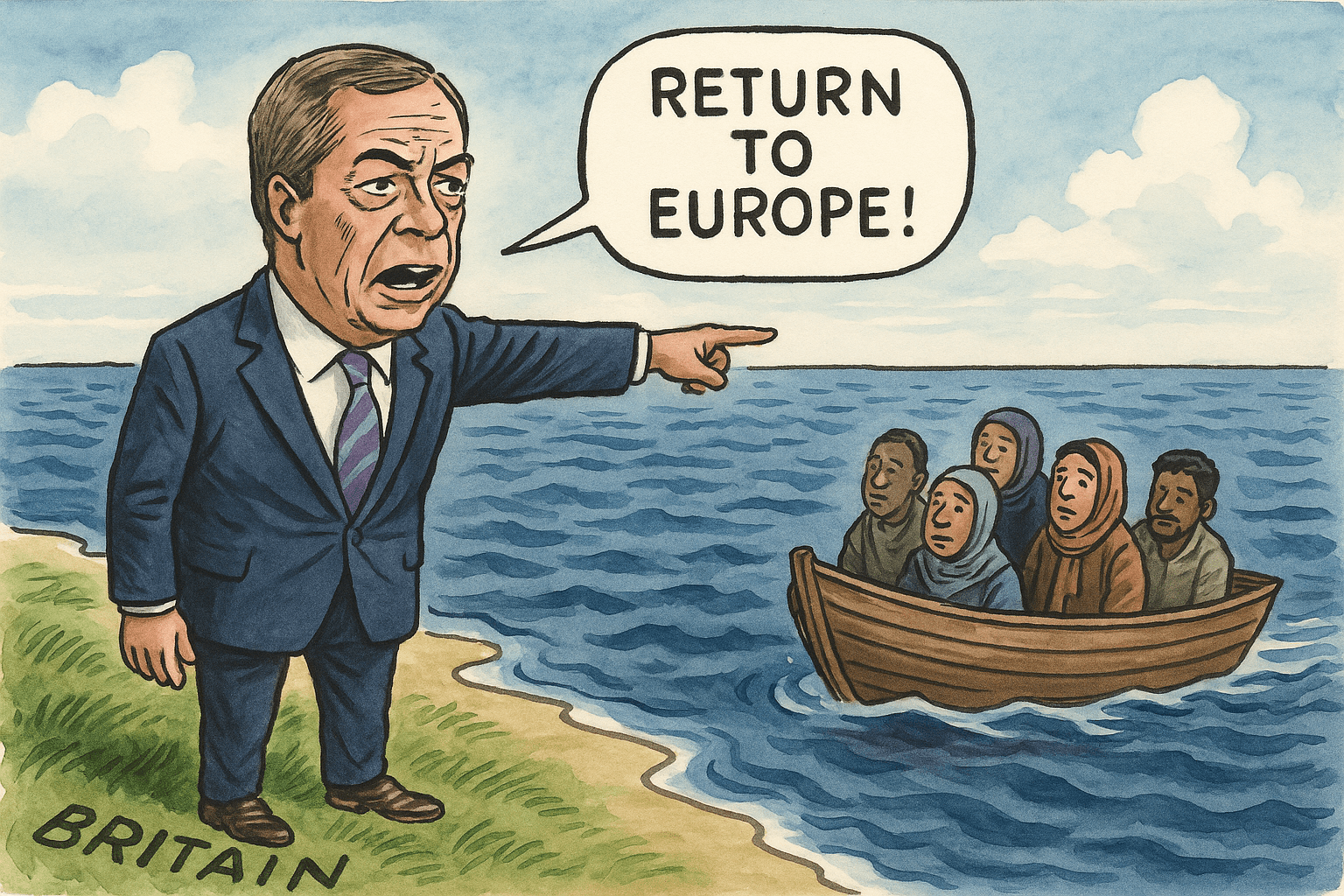

Black people account for roughly four percent of the population of England and Wales. More of them are in the EastEnders cast than are arriving on the asylum route in any given year. Yet Britain has contrived to make this the defining political question of the age. We should talk about that.
Let us begin with a geography lesson, because Britain’s current political conversation urgently requires one. Littlehampton is a coastal town in West Sussex, population roughly 30,000, located on the English Channel. It is a pleasant enough place, seafront arcades, a working harbour, the kind of town where the most cosmopolitan thing on offer is a Polish deli that opened in 2009. If you walk the length of its high street on a Saturday afternoon, you will not encounter what the tabloids have taken to calling “the great replacement.” What you will encounter is chip shops, a Greggs, and an elderly retriever tied to a lamppost outside Lloyds Bank. Scarborough, on the Yorkshire coast, is similarly constituted. It has a castle, a heritage, and an annual cricket festival. It does not have a visible minority population problem, because it does not, to any material degree, have a visible minority population.
These are not exceptional towns. They are, statistically speaking, representative of the United Kingdom outside its great conurbations. And yet, from the convulsions in Westminster to the recruitment drives of Reform UK, one might reasonably conclude that the country is under demographic siege — that somewhere between Calais and Clacton, Britain is being quietly replaced, one rubber dinghy at a time.
The 2021 Census, however, is unimpressed by this narrative. It contains numbers. Numbers are inconvenient things.
4%Black population of England & Wales (Census 2021)
81.7%UK population identifying as White (Census 2021)
~25%London’s share of UK economic output
49.3%Of all Black Britons living in London
Act I
The Census Has No Interest in Your Feelings
According to the Office for National Statistics, 81.7 percent of usual residents of England and Wales identified as White in the 2021 Census. The Black population — African, Caribbean, and other Black backgrounds — stood at precisely four percent. This is not, by any sensible reckoning, an invasion. This is a Tuesday afternoon on the Northern line.
Of that four percent, the majority are concentrated in London. Nearly half — 49.3 percent — of all Black Britons live in a single city. Venture outside the M25 and the numbers thin with extraordinary speed. In the North East of England, just one percent of residents identified as Black. In Wales, it was 0.9 percent. You are, statistically speaking, more likely to encounter Bigfoot in a Costa Coffee in Glasgow than you are an asylum seeker, a fact which will not appear in The Daily Mail at any point this decade.
The figure your more excitable commentators sometimes deploy that “nearly one in five” residents are non-white is technically accurate for England and Wales but requires unpacking. That eighteen percent includes nine percent who identify as Asian, covering British Indians, Pakistanis, Bangladeshis, Chinese, and numerous other communities, many of whose families have been in this country for three and four generations. It includes 2.9 percent of mixed heritage. The Black population specifically is four percent. To cite the broader figure and then cut to footage of small boats in the Channel is a form of statistical misdirection that should be prosecuted under the Trades Descriptions Act.
“If Nigel Farage’s Britain were a football squad, the bench would be less diverse than the England national team’s starting eleven. Possibly also less talented.”Law · Politics · International Affairs
Act II
EastEnders, Arsenal, and the Curious Optics of Representation
There is a useful exercise for calibrating one’s sense of British demographics: count the Black faces on EastEnders in a single episode, then consider that the entire Black population of the United Kingdom constitutes roughly 2.5 million people in a country of nearly 68 million. The BBC’s long-running soap opera set in Walford, a fictionalised East London has long reflected the genuine diversity of the capital. The capital, however, is not the country. What EastEnders depicts is Hackney, broadly. What Hackney is, is exceptional.
Mare Street in Hackney is one of those streets that tourists and politicians occasionally mistake for evidence that London has successfully become a model multicultural society. It is vibrant, it is diverse, and it is, above all, thoroughly Londonian. It is not, in any meaningful demographic sense, England. The North East of England, which alone has more than 2.5 million residents, has a non-white population of seven percent and that figure includes Asian, Mixed, and Other communities. The Black population of the North East would fit, with room to spare, inside the away end at St James’ Park.
If you want to understand where Black Britons actually live, the answer is: London, and then London again. The West Midlands accounts for another 11 percent. After that, the numbers become the kind of rounding errors that statisticians keep in separate spreadsheets. When Nigel Farage speaks to a crowd in Clacton-on-Sea about the great demographic transformation of Britain, he is speaking to people who live in the East of England, where the non-white population is approximately ten percent, and where the specific anxiety about Black immigration is, to put it charitably, arithmetically disproportionate.
Arsenal Football Club’s starting eleven, on any given matchday, contains more Black players than the entire senior leadership of the Metropolitan Police. The England national team has more Black players in its squad than there are Black senior officers across most regional constabularies. Whether this reflects an admirable meritocracy in professional football or a rather less admirable absence of one in public institutions is a question which the current political discourse, oddly, declines to address.
Act III
Durban Has More White People Than Britain Has Black Ones — and Nobody Is Having a Crisis About It
There is a comparative point so obviously relevant to the British immigration debate that its near-total absence from public discourse constitutes a minor mystery. Durban, South Africa uMasekwane, a city on the Indian Ocean coast has a substantial white population: descendants of British and Boer settlers who arrived during the colonial period and remained after 1994. Their presence in a majority-Black African country has not generated, in recent years, a political movement demanding their removal or a weekly press corps deployed to document their arrivals. They are, by the standards of public anguish, unremarkable.
By contrast, the entire Black population of the United Kingdom 2.5 million people, concentrated primarily in a single city has generated a permanent state of low-level political emergency, a renegotiated constitutional relationship with Europe, and a political party whose primary selling point is the implied promise to make the country slightly less like Mare Street and slightly more like Littlehampton.
This disproportion deserves to be stated plainly: there are more white South Africans in Durban alone than there are Black people in the entirety of the United Kingdom. No one has called this a crisis. No one has chartered boats to monitor it. No one has built a campaign poster about it. The asymmetry is not accidental. It reflects a very specific anxiety about who “belongs” by default, and who must perpetually justify their presence that the British political class has not found the courage to name directly.
“You are, statistically speaking, more likely to encounter Bigfoot in a Costa Coffee in Glasgow than you are an asylum seeker.”Law · Politics · International Affairs
Act IV
London Is a City-State Subsidising a Country That Resents It
Here is the structural contradiction at the heart of the British immigration debate, which no one currently seeking electoral office in a northern English constituency wishes to articulate. London is not representative of the United Kingdom. It is overrepresentative: of diversity, of wealth, of productivity, of foreign-born residents, and of the tax revenues that fund the public services which the rest of the country relies upon. The city accounts for approximately a quarter of the entire UK’s economic output, a figure rendered even more striking when one recalls that London contains roughly 13 percent of the population.
The House of Commons Library, not known for incendiary commentary, has confirmed that London raised £216.4 billion in tax revenues in 2022-23, more than any other region or nation of the United Kingdom, while receiving £172.8 billion in public spending. London’s estimated fiscal surplus the difference between what it puts in and what it takes out was £43.6 billion. Wales, Scotland, and Northern Ireland, taken together, run substantial fiscal deficits. They are, in the technical language of public finance, net recipients. In the vernacular: they are on welfare, and London is paying for it.
The productivity gap is similarly unambiguous. London workers were 28.5 percent more productive than the UK average in 2023. GDP per person in London stands at £69,077 against a UK average of £39,403. London has more foreign direct investment than any other city in Europe. It is, in short, the engine of the economy that the rest of England (and Wales, and Scotland, and Northern Ireland) criticises for being insufficiently British.
This engine is multicultural. Its financial services, its technology sector, its professional and scientific industries, its restaurants, its creative economy all are staffed, in substantial part, by people who were not born here, or whose parents were not born here, or who belong to communities that arrived within living memory. The very diversity which the political culture is currently engaged in treating as an existential problem is, in economic terms, a significant structural asset. You cannot simultaneously require London’s tax surplus to fund hospitals in Sunderland and demand that London become more demographically homogeneous. The mathematics of that position are irreconcilable. The politics of it are extremely popular.
Act V
The Moral of the Arithmetic
None of this is to argue that immigration policy requires no scrutiny. Legitimate debates exist about capacity, integration, housing pressure, and the pace of demographic change in specific localities. These are real policy questions that deserve serious analytical attention rather than the pantomime of small boats and deportation flights.
But the pantomime has a purpose. It serves to concentrate political anxiety on a population Black, brown, visibly non-British that is, in reality, so small as to be nearly invisible in most of the country, while deflecting attention from the structural inequalities that actually govern most people’s lives: an NHS that cannot staff its wards, a housing market that cannot house its young, a regional economy that has never recovered from deindustrialisation, and a capital city whose enormous productivity is distributed through Whitehall rather than market mechanisms.
The British political class has discovered that it is far easier to gesticulate at a rubber dinghy in the Channel than to explain why a nurse in Leeds cannot afford a house while a pension fund in the City of London owns half the social housing stock. It is far simpler to promise voters in Scarborough that fewer Black people will arrive from Rwanda than to confront the fact that Scarborough’s economic challenges have nothing whatsoever to do with the demographic composition of Hackney.
The census figures will not change this. Neither will satire, logic, nor the evident absurdity of building a national political movement around a crisis that, outside a postcode in East London, is largely theoretical. Britain has always been capable of an extraordinary degree of alarm about a threat it cannot quite find when it looks out of the window. On the available evidence, it intends to continue.
In Littlehampton, the chip shops remain open. The retriever is still outside Lloyds. The great replacement, apparently, is running late.

