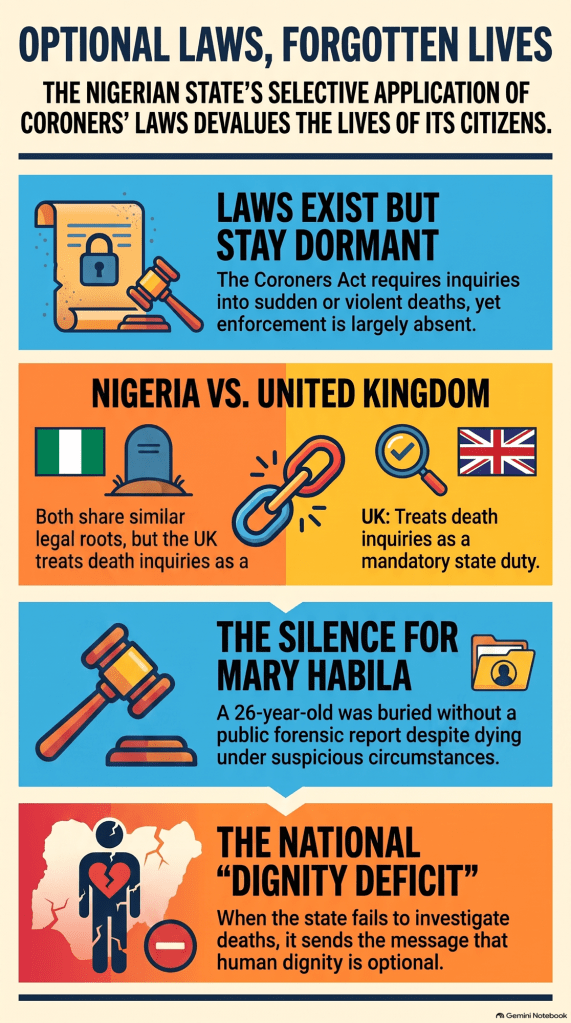
Nigeria inherited a substantial body of laws from its colonial period under British rule. Statutes governing everything from criminal procedure to the investigation of sudden or unnatural deaths were not abolished at independence; they were received into Nigerian jurisprudence and adapted over time. The old Coroners Act and its state-level successors remain part of the legal architecture. In theory, these laws require formal inquiry when a person dies under suspicious, sudden, violent, or unexplained circumstances. In practice, their application is selective, uneven, and often absent.
The difference between the United Kingdom and Nigeria is not primarily in the letter of the law. It is in the general application and consistent enforcement of that law. This divergence reveals a deeper reality about how the Nigerian state relates to its citizens.
A High-Profile Case That Reveals the Pattern
Consider the recent death of 26-year-old Mary Habila at the residence of the Minister of Works, David Umahi, in Uburu, Ebonyi State, on 27 June 2026. The circumstances were immediately contested: conflicting accounts of her role at the residence, reports of the body being found naked with blood around the nose and mouth, and public demands for a transparent forensic examination. Police investigated. The Ebonyi Director of Public Prosecutions advised that a post-mortem was necessary to determine the cause of the sudden death. Civil society groups, including SOKAPU, pushed for an independent inquiry. Yet after nearly two months of dispute, Habila was quietly buried in Nok, Kaduna State, on 21 August 2026. No publicly disclosed forensic report has established the precise cause of death. Key questions remain unresolved.
This is not an aberration. It is the usual practice. Authorities made limited efforts to follow the prescribed legal processes even for the optics of accountability. The body was eventually released and interred without the full formal closure that the law contemplates for deaths occurring under such circumstances.
What the Law Actually Requires
Under Nigeria’s various Coroners Laws (state-based, with roots in the colonial Coroners Act), a death that is sudden, unexpected, unnatural, violent, or suspicious ordinarily triggers a duty to report, a post-mortem examination in many cases, and a coroner’s inquest. The inquest is a fact-finding process designed to establish who the deceased was and how, when, and where they died. Coroners have powers to delay burial and, in appropriate cases, to order exhumation if the body was interred without proper inquiry. These provisions exist on the statute books across the country, though their modernity and robustness vary by state. Lagos has a relatively detailed 2007 framework; others rely on older versions.
In the United Kingdom, the Coroners and Justice Act 2009 imposes a clear duty on coroners to investigate deaths that are violent or unnatural, where the cause is unknown, or that occur in custody or state detention. Inquests are held as a matter of routine. The process is public, structured, and taken seriously. The state’s obligation to inquire into certain deaths is treated as a core function of governance and a component of the right to life.
The contrast is stark. In Nigeria, coroners’ offices are among the least busy units in the civil service. Formal inquests are rare. Autopsies in suspicious cases are frequently delayed, opposed, or quietly abandoned. Enforcement is discretionary and heavily influenced by the status of the persons involved.
The Broader Pattern of Indifference
The same indifference extends far beyond one ministerial residence. Victims of terrorism, road accidents, and everyday criminality are routinely denied the formal recognition and investigative dignity that the law promises. Mass deaths from attacks in the North-East or North-West often pass with perfunctory statements and no sustained public inquiry into systemic failures. Fatal road crashes claim lives daily with minimal forensic follow-up. Ordinary citizens who die under questionable circumstances rarely see a coroner’s court activated on their behalf.
This is not merely administrative inefficiency. It is a statement about the relative value the state places on different lives. When a Nigerian dies under circumstances that would automatically trigger official processes elsewhere, the default response is often silence, delay, or quiet burial. The formal machinery of the law is engaged selectively, if at all.
Dignity at Death
In the United Kingdom and much of Europe, the state’s duty to investigate certain deaths is treated as an expression of respect for the deceased and for the living who remain. The process affirms that every life matters enough to require an official accounting when the circumstances are unclear. Even animal welfare standards in the UK reflect a broader culture of regulated care and accountability that many Nigerians find painfully absent in the treatment of their own citizens.
When Nigerian authorities fail to activate even the basic procedures required by their own inherited laws in a high-profile case involving a federal minister’s residence, the message is unmistakable. The dignity of the average Nigerian at death is treated as optional. Formal action by the authorities is not automatic. It is contingent.
The laws remain on the books. The institutional capacity, political will, and cultural expectation of consistent application do not. Until that changes, the gap between the letter of the law and the lived reality of citizenship will continue to define the relationship between the Nigerian state and those it claims to serve. The quiet burial of Mary Habila is only the latest illustration of a long-standing practice. It is not the exception. It is the rule.